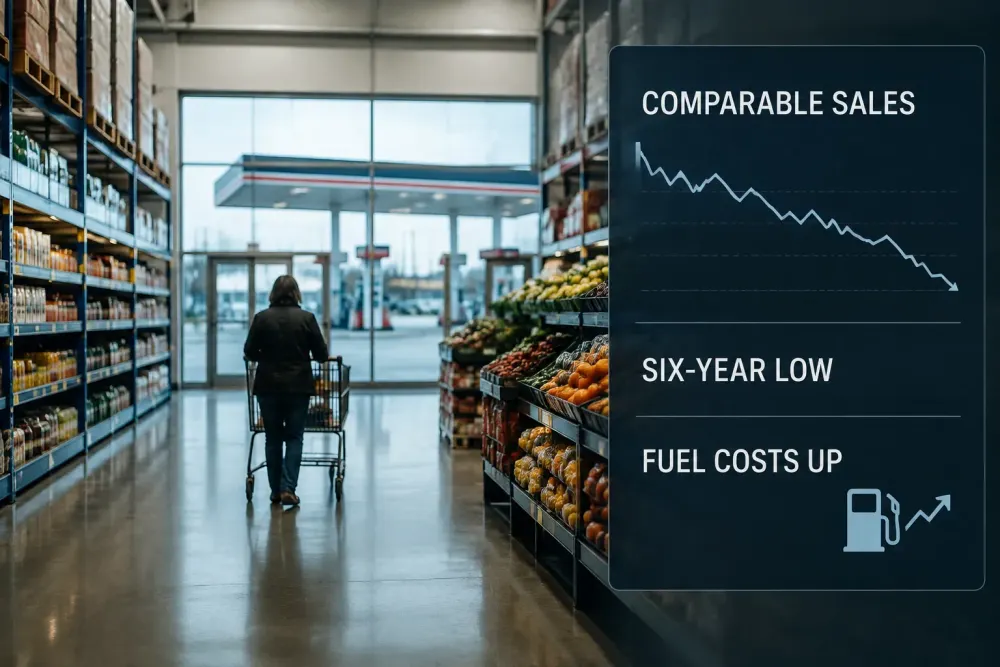
Walmart's U.S. comparable sales increased 2.6% in its latest quarter, the company's slowest growth in six years, as consumers facing higher fuel costs became more selective about discretionary purchases. Walmart shares fell roughly 9% after the results even though total revenue increased 5.9%, the company raised its full-year outlook and a $2.9 billion one-time tariff refund helped finance thousands of price reductions. Reuters reported that the result erased more than $80 billion of market value in Thursday trading.
The quarter creates a more complicated picture than either "consumers are strong" or "consumers are collapsing." Walmart is still growing. It is still gaining business online. It expects full-year revenue to rise. Yet the pace of spending at the largest U.S. retailer has slowed enough to concern investors accustomed to Walmart outperforming during periods of economic uncertainty.
That matters because Walmart sells an unusually broad range of necessities and discretionary goods to households across income levels. Its results do not represent the entire U.S. consumer economy, but they offer a large and frequently updated sample of how households are allocating money.
Gasoline competes directly with the merchandise in a shopping cart
Higher gasoline prices affect retailers differently from many other forms of inflation because fuel is difficult for commuting households to avoid.
If a family spends an additional $40 or $60 a month filling vehicles, that money must come from somewhere else unless household income rises by the same amount. Groceries, medicine and housing payments may be difficult to reduce, leaving discretionary purchases such as clothing, electronics, home goods or entertainment more exposed.
Walmart estimates higher fuel costs will add roughly $2 billion to its own expenses, while customers are simultaneously experiencing the same energy-price pressure, according to Reuters.
That creates a two-sided squeeze.
The company faces higher transportation and operational costs at the same time some customers have less discretionary income available to spend in its stores.
Retailers can respond by raising prices, accepting lower margins, reducing costs or attempting to sell more high-margin services. Walmart is pursuing several of those strategies simultaneously.
A $2.9 billion tariff refund improves one quarter without permanently changing the cost structure
The tariff refund is particularly important when interpreting the earnings report.
Walmart received about $2.9 billion in refunds associated with tariffs previously collected under emergency trade authority, giving the company an unusual one-time financial benefit. Management used part of that benefit to support thousands of price reductions, according to Reuters.
Economically, a refund differs from recurring operating income.
If a retailer improves margins because its supply chain becomes permanently more efficient, the benefit can persist. If it receives several billion dollars from a one-time legal or policy event, the cash is real but cannot automatically be repeated next year.
That is why investors separate underlying operating performance from exceptional items.
The price reductions may still have lasting competitive effects. A lower price can attract a shopper who then purchases additional merchandise or renews a membership. But the source of the funding matters when assessing whether Walmart can maintain the same level of pricing support after the refund has been absorbed.
Slower store growth does not mean Walmart is losing customers to competitors
One of the most important counterpoints comes from digital commerce.
Walmart reported strong online sales growth, with U.S. e-commerce continuing to expand rapidly, according to Reuters. The company has spent years transforming physical stores into fulfillment hubs, allowing groceries and general merchandise to be delivered from inventory already positioned close to customers.
That model changes the economics of Walmart's store network.
A supermarket or supercenter is no longer only a place where shoppers walk through aisles. It can also operate as a localized warehouse serving delivery orders, pickup customers and marketplace transactions.
That gives Walmart an advantage that digital-only competitors must recreate through dedicated distribution centers.
It also means comparable store sales alone capture only part of the company's relationship with consumers.
A shopper who once drove to Walmart but now receives the same groceries at home has changed channels without necessarily changing retailers.
Walmart's size makes a modest slowdown economically large
A 2.6% increase would be strong growth for many mature companies.
At Walmart, investor expectations are different because the company has benefited from several structural advantages. During periods of inflation or economic anxiety, higher-income households may trade down to Walmart for groceries and household necessities while lower-income customers continue shopping there because of price.
That can allow Walmart to gain market share even when overall consumer spending weakens.
The latest results suggest that advantage remains present but is not unlimited.
When fuel, housing and other essential costs absorb a larger percentage of household income, even value-oriented retailers face constraints. Consumers can switch brands, reduce quantities or postpone purchases, but eventually there are fewer discretionary dollars available across the entire retail sector.
The company's 9% share-price decline therefore says more about expectations than about whether Walmart is profitable. Investors were pricing a business that had repeatedly produced unusually strong comparable growth. A slowdown to 2.6% changes the assumptions used to value future earnings.
One quarter does not establish that the U.S. consumer is entering recession
Retail data are especially vulnerable to overinterpretation because spending can shift among categories without disappearing.
A family spending more on gasoline may spend less at a general-merchandise retailer while maintaining total household expenditures. Consumers may move purchases online. Government policy affecting pharmacy reimbursement can change reported sales without indicating that patients are buying fewer medicines.
Walmart itself raised its annual sales and earnings outlook despite the quarterly disappointment, according to Reuters.
That is difficult to reconcile with a simple narrative of collapsing consumer demand.
The more defensible conclusion is narrower.
Walmart's customers are still spending, but their budgets appear increasingly constrained by essential costs. The retailer is using its scale, e-commerce network and a large one-time tariff refund to protect prices and market share, while investors are questioning whether those tools can preserve the growth rates they had come to expect.
The defining number is therefore not only 2.6%.
It is the contrast between 2.6% comparable sales growth, a multibillion-dollar temporary pricing cushion and a company still confident enough to raise its full-year forecast.
Together, they describe a consumer economy that is slowing and making trade-offs, not one that has stopped spending.