
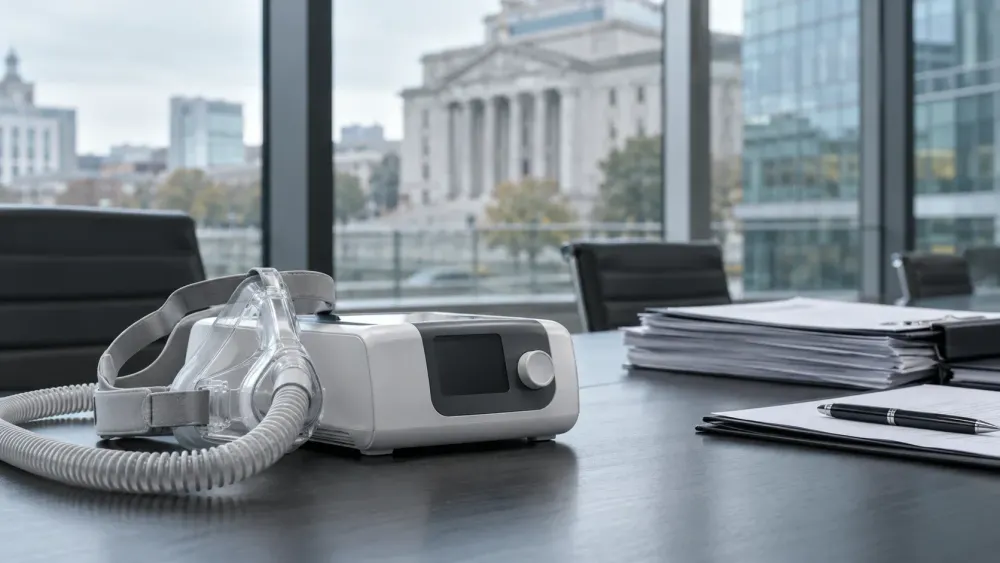
A Dutch court has rejected a bid by investors to force an inquiry into Philips’s handling of its 2021 sleep-apnea device recall, giving the health-technology group a significant victory in one of the governance cases still hanging over the company.
The Enterprise Chamber of the Amsterdam Court of Appeal said Saturday that the record did not provide well-founded reasons to doubt Philips’s policies or conduct—the threshold for ordering an investigation under the Dutch proceeding. The court’s summary says it found no indication that the company’s management or supervisory boards received reliable evidence of the foam-related health risk too late, failed to intervene when they should have, or misled investors. Independent reporting described the ruling as a dismissal of demands for an investigation into alleged disclosure and management failures.
A win on a narrow legal question
The decision matters because a court-ordered inquiry could have reopened years of internal decision-making and created another path toward findings useful in shareholder litigation. But the chamber emphasized the limits of its task. It was not deciding whether Philips’s Respironics subsidiary made mistakes, nor was it ruling on liability for investor losses. It considered only whether there were sufficient grounds to doubt the parent company’s management or affairs and order a formal investigation.
That distinction is central to the business impact. Philips can point to the ruling as judicial support for its contention that its top-level systems and disclosures did not justify an inquiry. The court said the company’s internal systems were built on international standards, regularly audited and strengthened over time. It also concluded that sufficiently reliable research pointing to health risks emerged only in the first months of 2021. Those findings reduce the immediate governance threat in the Netherlands, but they do not erase the recall’s financial, regulatory or reputational consequences.
Investors argued the warnings came too late
The Dutch investor association VEB and other shareholders had argued that Philips’s controls failed to surface problems promptly and that management should have acted earlier. VEB’s public case alleges delayed disclosure, weak oversight and substantial market losses. It sought an inquiry after talks with Philips did not produce a resolution for investors.
The chamber rejected those contentions on the evidence before it. It found no basis to conclude that the management board learned of the relevant information well before the company went public, that the supervisory board failed in its oversight role, or that Philips’s market communications were late, false or misleading. The ruling therefore closes this inquiry request without adopting the investors’ theory of corporate failure.
It does not, however, convert disputed allegations into a broad finding that every aspect of the recall was handled correctly. The court explicitly separated Philips-level governance from operational mistakes at Respironics and from compensation claims. That boundary is important for investors assessing what risk has actually fallen away.
The recall’s U.S. obligations remain
The underlying recall involved about 15 million ventilators, CPAP machines and BiPAP machines worldwide. The U.S. Food and Drug Administration says the polyester-based polyurethane foam used to reduce sound and vibration could break down, allowing particles or chemicals into a device’s air pathway. The agency’s record also shows that a federal court entered a consent decree in April 2024 requiring a recall-remediation plan and restricting production and sales at certain facilities until specified conditions are met.
The U.S. Justice Department’s account says the decree requires outside experts, corrective work and written FDA clearance before restricted operations can fully resume. The department noted that the claims resolved by the decree were allegations and that there was no determination of liability. Nothing in Saturday’s Dutch ruling changes those federal obligations.
Litigation and settlement costs still shape the outlook
Philips says a U.S. personal-injury settlement became final after more than 95% of eligible claimants registered. The company’s disclosure lists a $1.075 billion commitment, including $1.05 billion for a settlement fund and $25 million for notice and administration. It also reports a separate $25 million medical-monitoring fund and a €540 million contribution from insurers toward product-liability cash flows. Reuters separately reported the roughly $1.1 billion personal-injury settlement when explaining the history behind the Dutch case.
Philips’s own disclosures also identify other live matters, including civil damages suits in the Netherlands, international consumer actions and a U.S. securities case. The company says it is cooperating with a Justice Department investigation and a group of U.S. state attorneys general. Those proceedings have different legal standards and remedies from the Dutch inquiry process, so the chamber’s rejection does not automatically determine their outcomes.
What the ruling changes for Philips
The immediate benefit is reduced uncertainty around a potentially intrusive Dutch governance investigation. Management avoids another formal review of internal files and decision-making, while the company gains support for its argument that its board-level response and market disclosures were not grounds for an inquiry.
The larger recovery story remains less settled. Philips must continue satisfying the U.S. consent decree, managing pending claims and rebuilding its sleep-therapy business under regulatory scrutiny. Investors should therefore read Saturday’s decision as a meaningful but contained legal win: one avenue for a court-led investigation has closed, while the operational restrictions, settlement costs and separate litigation tied to the recall remain material to the company’s path forward.