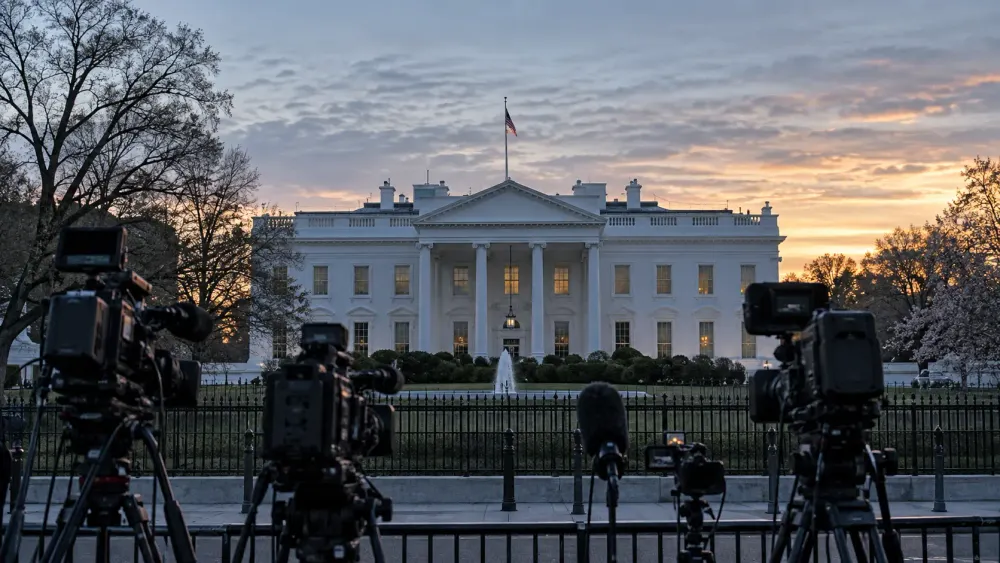
A federal judge on Tuesday preserved White House access for 78 journalists from CNN, MS NOW and Politico, finding that the three organizations are likely to succeed on claims that President Donald Trump’s September ban violated the First Amendment and the Fifth Amendment’s guarantee of due process. The preliminary injunction issued by U.S. District Judge Timothy J. Kelly keeps their “hard pass” credentials active while the lawsuit proceeds; it is not a final ruling on the constitutionality of the ban, and the administration can appeal.
The immediate consequence is operational: reporters for the three outlets may continue entering the White House press area rather than waiting outside while the case is litigated. The broader consequence is legal. According to accounts of the 26-page ruling from the Associated Press and Reuters, Kelly concluded that the record points toward retaliation for disfavored coverage and that the outlets received no meaningful process before their credentials were revoked.
What the injunction does
A preliminary injunction is designed to prevent likely irreparable harm before a court can resolve the merits. Kelly ordered White House officials and others acting with them not to enforce the Sept. 18 decision revoking the outlets’ hard passes. The ruling therefore replaces a shorter temporary restraining order and maintains the access restored in late September for as long as the case remains pending, unless a higher court changes the result.
The distinction matters. Kelly did not hold after a trial that every limitation on press access is unconstitutional, nor did he give reporters an unconditional right to every presidential event. Axios reported that the order does not guarantee places in small venues, the Oval Office or aboard Air Force One. It protects the credentials that give approved journalists regular entry to the White House press area, where they can observe events, question officials and report alongside competitors.
Kelly also emphasized that the government retains power to address genuine security threats or unlawful disclosure of classified information. But he found the administration’s national-security explanation appeared after the ban and lacked support in the record, while Trump’s own statements tied the decision to coverage he considered unfair or inaccurate. That sequence was central to the court’s preliminary conclusion that the government probably discriminated on the basis of viewpoint.
A sudden ban without a hearing
Trump announced the ban in a social-media post on Sept. 18, and the outlets said their reporters’ credentials were deactivated without advance notice. Kelly’s Sept. 24 court order temporarily required officials to restore the passes. That initial decision said the dispute was controlled by longstanding appellate precedent and imposed only a nominal $1 bond because the government had not identified economic losses from temporary restoration.
The administration argues that White House access is a privilege and that presidents have always exercised discretion over which journalists receive close physical access. In a Sept. 21 statement, the White House said the First Amendment protects publication but does not entitle any outlet to a hard pass, briefing-room seat or pool assignment. Government lawyers also cited concerns about accuracy and national security. Those arguments remain available as the case advances and, if appealed, will be reviewed under the more complete record.
The plaintiffs answer that access already extended to a broad group of comparable journalists cannot be withdrawn to punish particular viewpoints. They also contend that losing credentials changes how quickly and fully their reporters can gather news, creating harm that cannot be repaired later with money. The case record shows that press-freedom organizations supported the outlets and that the court heard argument on the preliminary-injunction request Oct. 8.
The precedent beneath the dispute
The legal foundation is the 1977 appeals-court decision Sherrill v. Knight. The U.S. Court of Appeals for the District of Columbia Circuit held that, once the White House creates a system of press access, officials may not deny a bona fide journalist a pass arbitrarily or without procedural safeguards. The court required notice of the factual basis for a denial, an opportunity to respond and a written statement of reasons.
That precedent does not erase security discretion. It requires that the government exercise it through defined standards and fair procedures, allowing judicial review of whether the stated reason is legitimate. Kelly concluded at this stage that the abrupt September revocations failed that test and that Trump’s public criticism of the outlets supported a separate inference of First Amendment retaliation.
Why the practical limits still matter
Hard passes are not equivalent to unrestricted proximity to the president. Even credentialed journalists compete for limited seats and pool assignments, and the White House can impose neutral security and space rules. The unresolved question is whether officials may use those administrative choices to disadvantage outlets because of their reporting. The current injunction addresses the broad credential revocations; disputes about travel pools or access to particular events may require separate analysis.
The case also arrives amid wider conflict over presidential coverage. The Justice Department has confirmed an antitrust investigation into television networks that briefly halted pooled video coverage after the September bans. That investigation is separate, and no finding of wrongdoing has been announced, but it illustrates how the access fight has spread beyond the three plaintiffs to the cooperative systems news organizations use to cover the presidency.
What comes next
The administration may seek review from the D.C. Circuit, while the district court continues toward a fuller decision. A preliminary injunction requires a judge to assess likelihood of success, irreparable harm, the balance of equities and the public interest; it does not settle disputed facts for all purposes. The final outcome could affirm, narrow or reverse the reasoning Kelly applied Tuesday.
For now, the concrete change is that CNN, MS NOW and Politico keep their White House hard passes. The evidence before Kelly was sufficient to preserve access, but the boundary between presidential control of secure spaces and constitutional protection against viewpoint discrimination remains to be tested through appeal or final judgment.