
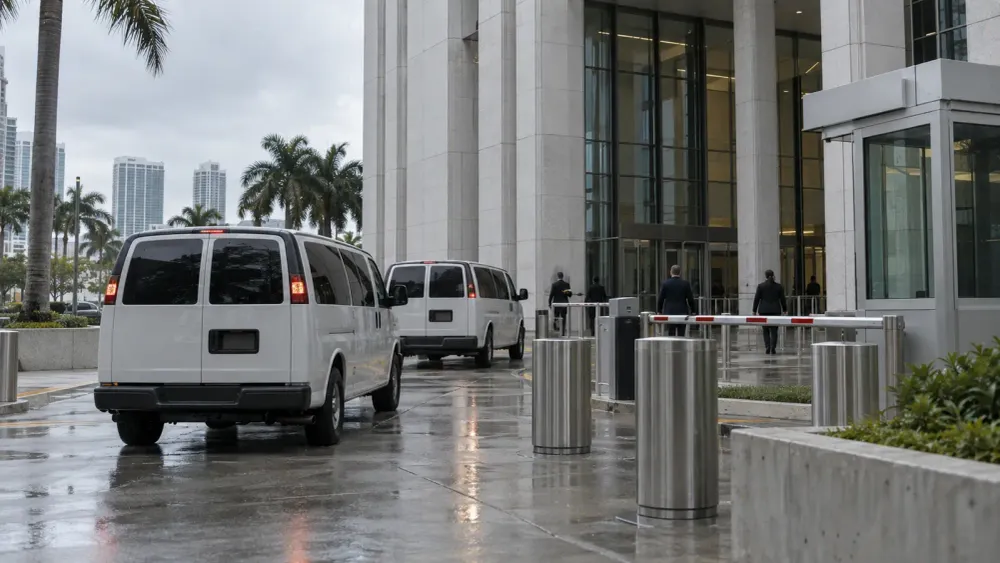
Eighteen defendants accused in the 2021 assassination of Haitian President Jovenel Moïse were transported to South Florida over the weekend, moving one of Haiti’s most consequential criminal cases into a U.S. court system that has already secured convictions against other participants. The transfer, confirmed Sunday by Haitian and American authorities, gives federal prosecutors custody of 17 former Colombian soldiers and Joseph Badio, a former Haitian Justice Ministry official.
The operation represents the largest single expansion of the American prosecution since Moïse was shot and killed at his private residence in Port-au-Prince on July 7, 2021. The Justice Department said an FBI and Homeland Security Investigations team brought the defendants to Florida to face federal charges. All are presumed innocent unless proved guilty.
A case with a South Florida center
Federal jurisdiction rests on prosecutors’ allegation that South Florida served as a staging ground for a cross-border conspiracy. The government contends that organizers used meetings, financing, equipment purchases and companies based in the Miami area while developing plans first to remove Moïse from office and later to kill him.
The current indictment charges defendants with offenses that include conspiring to provide material support for a plot to kill or kidnap a person outside the United States. Some counts carry a potential maximum sentence of life imprisonment. An indictment is an accusation, not proof, and prosecutors must establish each defendant’s guilt beyond a reasonable doubt.
Authorities have now indicted 30 people in the broader U.S. case, according to AP. The new arrivals substantially increase the number of defendants physically before the federal court and will require prosecutors to connect alleged conduct in Haiti with planning and support activity they say occurred in the United States.
Who was transferred
The group includes 17 former members of Colombia’s military who have been held in Haiti since shortly after the assassination, along with Badio, who previously worked in an anti-corruption unit within Haiti’s Justice Ministry. Prosecutors describe Badio as an important organizer, but that claim remains contested and unproved in court.
Haitian Justice Minister Patrick Pelissier confirmed that a U.S. military aircraft carried the 18 defendants out of Haiti, Reuters reported. Haiti’s government said the transfer was intended to permit a trial after domestic proceedings failed to advance.
Relatives and attorneys for some of the Colombian defendants said they received little warning. Families have also alleged mistreatment, poor prison conditions and coerced statements during the defendants’ detention in Haiti. Those claims have not been fully adjudicated, but they are likely to shape defense challenges to evidence gathered by Haitian investigators.
Earlier convictions established the U.S. theory
In May, a Miami jury convicted Arcangel Pretel Ortiz, Antonio Intriago, Walter Veintemilla and James Solages on conspiracy and material-support charges. The verdict followed a trial in which the government argued that the defendants sought political influence and lucrative Haitian contracts by installing a chosen successor to Moïse.
Prosecutors presented evidence that plans evolved from attempted kidnappings into an assassination operation and that the group recruited allies in the United States, Colombia and Haiti, including former Colombian soldiers. The four convicted men denied guilt. Their lawyers argued that evidence developed in Haiti was unreliable and that some participants believed they were joining a lawful arrest operation.
At least eight other defendants have pleaded guilty in the federal case, six of whom testified at the May trial, according to the Justice Department. Their testimony gave the government an inside account of the alleged planning but also exposed the prosecution to familiar questions about whether cooperating witnesses hoped to obtain more favorable treatment.
Haiti’s proceeding never reached trial
The contrast between the two systems is stark. Five years after the killing, Haiti had not begun a trial. Judges and court personnel have faced threats, files have changed hands repeatedly, and escalating gang violence has disrupted public institutions. Armed groups took control of major parts of Port-au-Prince and stormed the country’s two largest prisons in 2024, allowing thousands of inmates to escape.
The delay contributed to Haiti’s decision to surrender the defendants, but it also creates a difficult evidentiary record. Physical evidence, witness interviews and confessions collected amid political instability may receive intense scrutiny in Miami. Defense attorneys can challenge how statements were obtained, whether evidence was preserved and whether witnesses’ accounts are consistent.
The Miami trial showed the breadth of the government’s theory. Prosecutors said the plot involved a South Florida security company, a financing company and plans to install Haitian-American pastor Christian Sanon before directing government contracts to the conspirators. Sanon is still awaiting trial, and his guilt or innocence has not been determined. The defense position at the first trial was that the defendants initially contemplated arrest rather than assassination.
The transfer leaves larger questions open
Bringing the 18 defendants to Florida resolves an immediate jurisdictional obstacle, not the larger mystery surrounding Moïse’s death. The federal case has described layers of financiers, recruiters, security contractors, political aspirants and armed participants, but it has not produced a universally accepted account of who held ultimate authority over the operation.
Some important figures remain outside U.S. custody. Dimitri Hérard, the former head of security at Haiti’s National Palace, escaped during the 2024 prison break and remains a fugitive. Analysts have cautioned that the Miami-centered prosecution can establish criminal responsibility for activities tied to the United States without fully explaining every political and financial relationship in Haiti. Reuters noted after the May verdict that the U.S.-based group represented only part of the wider network under examination.
The new defendants will now have access to federal defense counsel, discovery rules and judicial review that were largely absent from Haiti’s stalled process. Their arrival makes a trial possible and may produce new evidence. It does not guarantee a comprehensive answer to the question that has shadowed the case for five years: who conceived the assassination, and who expected to benefit from it.