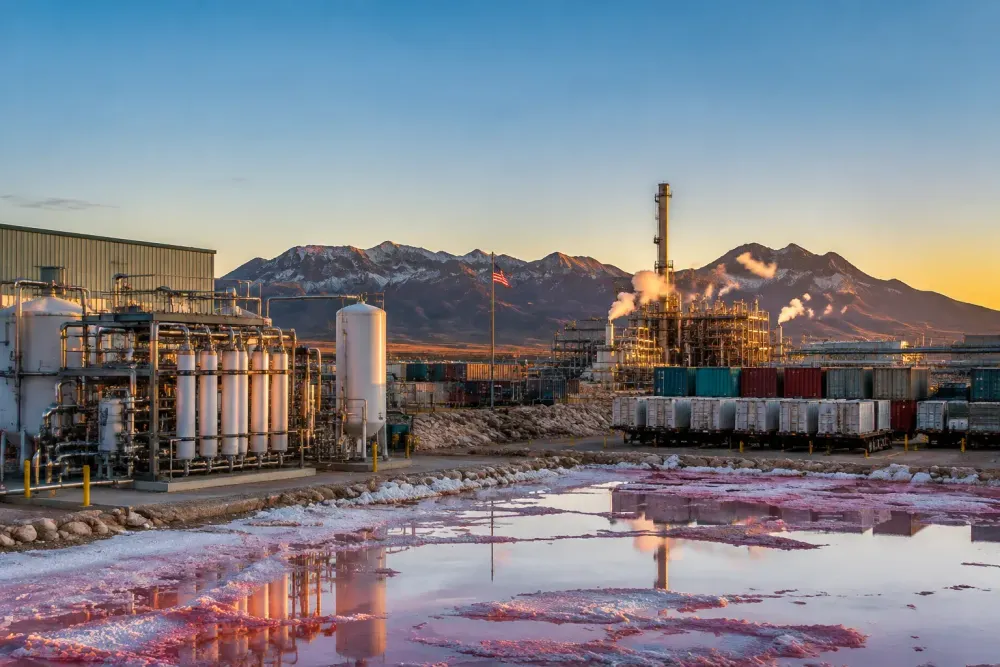
The Department of Energy has selected seven U.S. critical-mineral and battery projects for $500 million in federal grants, including $100 million for a planned lithium-extraction facility at Utah's Great Salt Lake and $100 million for what is expected to become the country's only primary cobalt refinery. The DOE announced the awards Thursday as the federal government attempts to reduce U.S. dependence on foreign processing for materials used in batteries, electronics, power systems and defense equipment.
The funding is often described as a mining initiative, but that understates the problem policymakers are attempting to solve. A country can possess mineral deposits and still depend on another country if it lacks the facilities needed to separate, refine, recycle and convert those materials into usable industrial products.
The grants therefore concentrate heavily on the middle of the supply chain, where raw material becomes battery-grade lithium, refined cobalt, recycled metal or advanced battery components.
The strategic bottleneck is often processing rather than geology
Lithium, cobalt, graphite, nickel and other critical materials do not move directly from a mine into an electric vehicle, grid battery or military system.
Ore and brines must be processed. Chemical compounds must meet purity requirements. Cathode and anode materials must be manufactured. Used batteries can be disassembled and recycled into feedstock.
The United States has domestic mineral resources but remains dependent on foreign processing in several of those stages.
China's position is particularly important because Chinese companies have built substantial capacity across refining and battery manufacturing, allowing them to achieve economies of scale that newer U.S. projects must compete against.
The Energy Department's long-running battery-materials grant programs explicitly target domestic processing and manufacturing capacity rather than mining alone, according to its grant program.
That approach recognizes that supply security is determined by the weakest link in the chain.
The Great Salt Lake project demonstrates why new extraction technology matters
Lilac Solutions is expected to receive $100 million for a direct-lithium-extraction facility using brine from Utah's Great Salt Lake. The project is intended to produce approximately 5,000 metric tons of lithium annually by 2028, according to Reuters.
Direct lithium extraction differs from conventional hard-rock mining and from the large evaporation ponds historically associated with some South American lithium production.
The technology seeks to separate lithium from brine more directly, potentially reducing land requirements and shortening processing time. Whether particular projects achieve those advantages economically at commercial scale depends on local chemistry, energy inputs, water management and recovery rates.
Federal investment therefore does not guarantee commercial success.
It attempts to move technologies from demonstration toward the scale at which their actual economics can be tested.
The cobalt refinery illustrates why markets alone may not produce strategic capacity
Jervois is expected to receive another $100 million toward a domestic cobalt refinery in Idaho, according to Reuters. The project's significance comes partly from what does not presently exist: the United States lacks a comparable operating primary cobalt refinery at scale.
Cobalt demonstrates the tension between national security and commodity economics.
A domestic project can be strategically desirable while being financially unattractive when global prices are low. Producers operating in countries with lower costs or large existing infrastructure can sell material below the price required for a new American facility to recover its investment.
If policymakers allow market prices alone to determine capacity, the cheapest foreign supplier may dominate.
If government subsidizes domestic capacity, taxpayers assume some of the cost of maintaining redundancy.
Neither option is costless.
The policy question is how much additional expense the country is willing to accept in exchange for reducing the risk that geopolitical disruption or export controls cut off a critical input.
Recycling is part of the same security strategy
Another $100 million award is intended for Nth Cycle, which processes “black mass,” the mixture of lithium, nickel, cobalt and other materials produced when used lithium-ion batteries are shredded for recycling, according to Reuters.
Recycling cannot eliminate the need for mining as battery demand grows because there are not yet enough end-of-life batteries in circulation to supply all new production.
But the balance changes over time.
Each battery entering service today becomes a potential mineral resource later. If valuable materials can be recovered economically and repeatedly, the country reduces the amount of newly mined material required for every future unit of battery capacity.
Recycling can also shorten supply chains because the raw material already exists inside the domestic economy.
That is particularly valuable for minerals concentrated geographically in countries where political instability, trade restrictions or conflict can interrupt primary supply.
$500 million buys projects, not mineral independence
Federal awards frequently create headlines that make industrial transformation appear immediate.
Actual development is slower.
Facilities must complete engineering, permitting, construction and commissioning. Extraction technologies must work reliably at scale. Projects need customers willing to sign purchase contracts. Commodity prices can change before a plant reaches production.
The seven selected projects can fail to achieve some of their announced targets without the policy itself being meaningless; conversely, receiving federal money does not establish that any particular project was commercially justified.
The relevant measure will be how much durable U.S. capacity ultimately operates after the grants are spent.
The current policy is therefore better understood as risk management than self-sufficiency.
The United States is unlikely to mine and process every critical material domestically at the lowest global cost. Allies and international trade will remain important.
The objective is to avoid a situation in which one foreign processing system becomes the only realistic source of materials required for automobiles, electronics, electricity infrastructure and military equipment.
The government is spending $500 million to make seven alternatives more plausible.
Whether they become competitive industries will be determined after the grants have been awarded, not by the awards themselves.