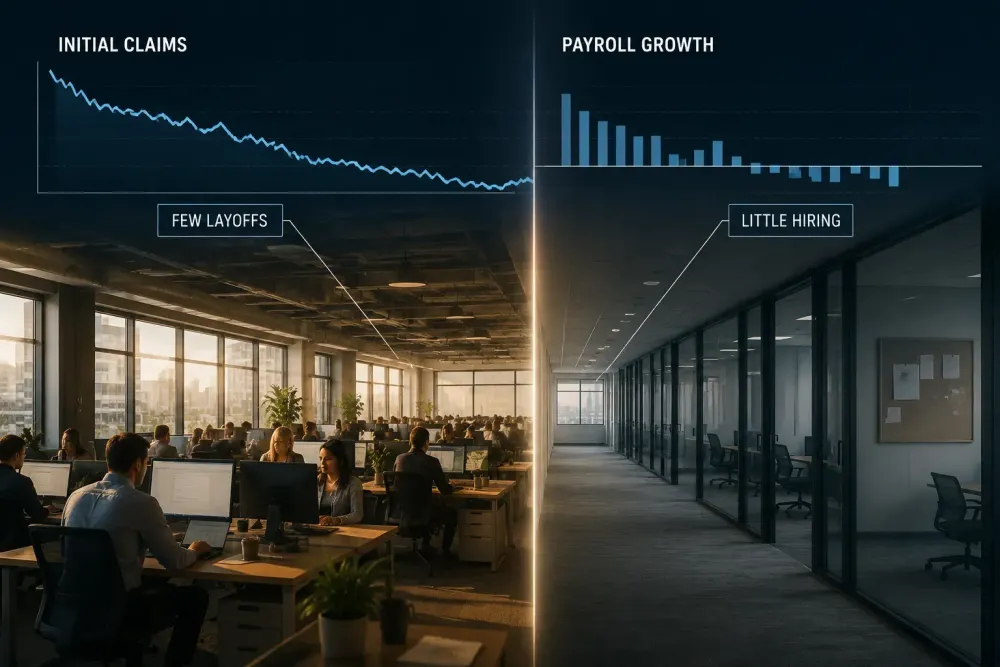
New applications for U.S. unemployment benefits fell by 6,000 to 206,000 last week, even though the economy lost 23,000 payroll jobs in July, producing an increasingly unusual labor-market combination: employers are not hiring rapidly, but they are not laying off large numbers of workers either. The latest Labor Department figures put initial claims near the low end of their 2026 range, while July's employment report showed the first monthly payroll decline of the year and an unemployment rate of 4.1%.
The coexistence of low unemployment claims and weak job creation complicates the traditional interpretation of labor-market data. A strong economy normally combines brisk hiring with limited layoffs. A recession typically produces the opposite. The current market increasingly fits neither description. Workers who already have jobs are generally keeping them, but people attempting to enter the labor market or change employers are finding fewer openings and slower hiring.
That distinction matters for households and for the Federal Reserve. Low claims reduce evidence that the economy is experiencing a broad wave of job losses, while weak payroll growth reduces evidence of an overheated labor market. If that balance persists, policymakers may be able to concentrate more heavily on inflation without facing the kind of rapidly deteriorating employment conditions that ordinarily force a change in monetary policy.
Layoffs remain unusually low even as payroll growth has nearly disappeared
Initial unemployment claims have generally remained between roughly 190,000 and 230,000 this year, levels that are historically consistent with a relatively stable labor market. Claims measure people who recently lost jobs and applied for unemployment insurance; they do not directly measure hiring.
That distinction explains how claims can decline during the same period that payroll employment weakens.
The BLS reported that nonfarm payrolls fell by 23,000 in July after averaging gains of only 34,000 per month over the previous year. Government employment declined by 53,000, leisure and hospitality lost 40,000 jobs and retail trade fell by 19,400. Construction added 22,000 jobs, while private education and health services added 25,000.
A payroll decline can occur without a surge in layoffs if employers reduce hiring, leave vacant positions unfilled, rely less on temporary labor or allow normal attrition to shrink their workforces. A company that loses five workers to retirement or resignation and replaces only two has reduced employment without laying anyone off.
That mechanism increasingly appears relevant to the current U.S. economy.
A shrinking labor force changes how many jobs the economy needs to create
The unemployment rate remained 4.1% in July, even though payroll employment declined, partly because the labor force itself contracted. The Bureau of Labor Statistics reported that the civilian labor force fell by 264,000 in July and the participation rate stood at 61.4%, according to its latest labor data.
That matters because the number of jobs required to keep unemployment stable depends on how quickly the available workforce is growing.
During periods of rapid population and labor-force growth, the economy may need to create well over 100,000 jobs each month simply to absorb new workers. If labor-force growth slows because of an aging population, reduced immigration, retirement or declining participation, substantially fewer new jobs may be required to prevent unemployment from rising.
That does not make weak job creation economically irrelevant. Workers entering the market still need opportunities, and slower hiring can disproportionately affect recent graduates, people returning to work and employees attempting to switch careers.
But it does mean a monthly payroll gain that would once have been considered weak can coexist with a comparatively stable unemployment rate.
Continuing claims show that finding the next job may be harder than keeping the current one
While initial claims fell, the number of people continuing to receive unemployment benefits rose to about 1.8 million, according to Reuters. That measure can provide a different signal from first-time applications because it reflects how long displaced workers remain on unemployment rolls.
A labor market can therefore become less fluid before it becomes visibly recessionary.
If employers are reluctant to fire existing workers but equally reluctant to hire replacements, employees experience very different conditions depending on which side of the market they occupy. Someone with a stable job may see little reason for concern. Someone who has just lost a position can face a much longer search.
That pattern is sometimes described as a low-hiring, low-firing labor market. It is more stable than a broad layoff cycle but less dynamic than a strong expansion.
It can also suppress wage competition. When companies aggressively hire, they frequently need to raise pay or improve conditions to attract workers from other employers. When openings become scarcer, employees have less leverage to move between firms.
Weekly claims should not be read as proof that July's payroll decline was harmless
Unemployment claims and monthly payroll estimates measure different things and operate on different timelines. Neither should be used to dismiss the other.
The July payroll report itself is subject to revision. BLS surveys approximately 119,000 businesses and government agencies representing about 622,000 worksites, then updates preliminary estimates as additional responses arrive, according to its CES methodology.
Weekly claims are also volatile and can be affected by holidays, seasonal adjustments and temporary events.
The stronger conclusion comes from examining them together.
The United States is not presently showing the sharp increase in unemployment claims ordinarily associated with a layoff-driven recession. At the same time, employment growth has weakened markedly from the pace seen earlier in the economic expansion.
The labor market is therefore giving two messages that are not actually contradictory: companies remain reluctant to dismiss the workers they already have, while becoming increasingly reluctant to add new ones.
Whether that equilibrium proves durable will depend on what happens next to consumer demand, business investment, labor-force participation and interest rates. A renewed acceleration in hiring would make July look like a temporary soft patch. A sustained rise in claims would signal that weak hiring had progressed into something more serious.
For now, 206,000 unemployment claims and a 23,000-job payroll decline describe a labor market that is slowing without yet breaking.