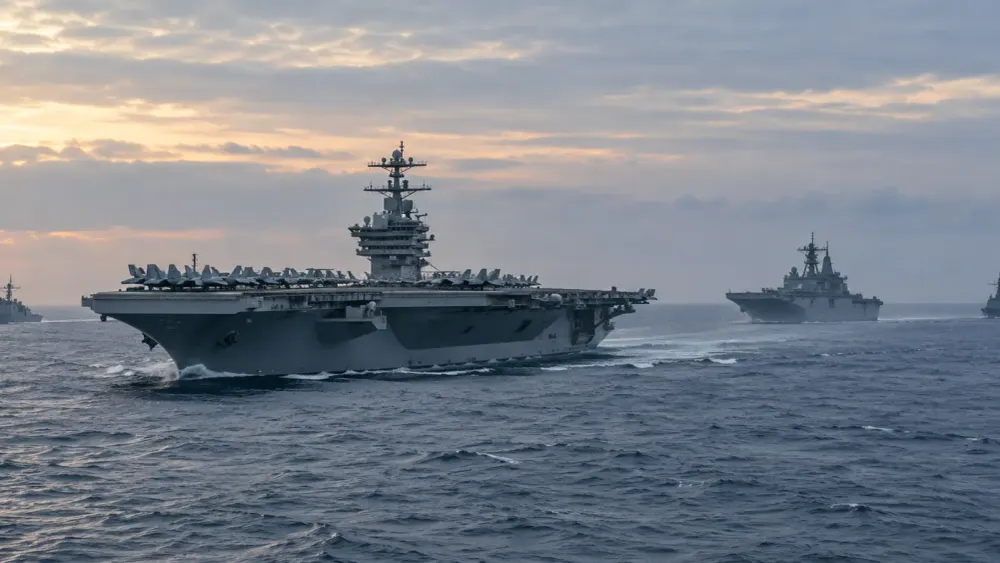
The United States is sending an aircraft-carrier strike group and an amphibious force carrying roughly 9,000 sailors and Marines toward the Middle East, a deployment that could temporarily place three American carriers in the region as President Donald Trump weighs renewed strikes on Iran.
The movement includes the USS Theodore Roosevelt carrier strike group and the USS Makin Island Amphibious Ready Group, according to Associated Press reporting published October 1. The ships together carry more than 7,000 sailors and about 2,000 Marines. The carrier group includes the cruiser USS Chosin, while the amphibious formation includes the landing ships USS John P. Murtha and USS Anchorage.
The Wall Street Journal independently reported that U.S. officials described the deployment as adding 9,000 to 10,000 personnel, jet fighters and Marine forces. The difference is a matter of rounding and timing, not evidence of separate deployments. These are mostly ship crews, aviation personnel and an embarked Marine expeditionary unit—not 9,000 ground troops being assigned to a land campaign.
A surge, a rotation or both
Two carriers—the USS George H.W. Bush and USS George Washington—are already operating in the broader region, along with the USS Boxer Amphibious Ready Group. If the Roosevelt arrives before either carrier departs, the Navy could again have three carrier strike groups in the Middle East. AP reported that such an overlap could occur by late October; the Journal said the arriving ships and forces could be in place by the end of November.
That timing remains fluid because naval movements can serve two purposes at once. They can increase the forces available to commanders for a limited period, then relieve ships and crews already on extended deployments. The Washington Post reported that Pentagon planning is intended to create flexibility for the president and regional commanders, while also noting that the Roosevelt and Makin Island groups could ultimately replace the George Washington and Boxer formations.
The distinction matters. Three carriers at once would represent a short-term concentration of air power, surveillance, missile defense and strike capacity. A one-for-one rotation would preserve much of the existing posture while allowing overworked crews and ships to return home. The Navy last placed three carrier strike groups in the region in April, the first such concentration there since 2003, according to AP.
A carrier surge also imposes costs beyond the visible ships. Each strike group depends on escort vessels, logistics ships, maintenance capacity, munitions and aircraft crews. The recently relieved USS Abraham Lincoln spent more than 260 consecutive days at sea, AP reported, illustrating the burden created when operational demand outpaces normal port and maintenance schedules. The Post separately reported that the conflict has strained ship maintenance and troop morale. Those pressures make the duration of any three-carrier overlap as important as the number of carriers present on a given day.
What the arriving forces add
The Navy describes the Theodore Roosevelt as a Nimitz-class nuclear-powered carrier built to conduct sustained carrier-air operations. Its associated air wing can provide fighter, electronic-warfare, airborne-command and helicopter capabilities, while escort ships contribute air and missile defense and long-range strike options.
The Makin Island group provides a different set of tools. The 13th Marine Expeditionary Unit’s official mission includes amphibious operations, crisis response and other sea-based missions. Its combination of Marines, helicopters, tiltrotor aircraft, landing craft and support units gives commanders options for evacuations, maritime security, raids or limited operations ashore. That flexibility does not establish that any specific mission has been ordered.
Together, the formations could push the U.S. naval presence in the region above 20,000 sailors and Marines, AP reported, in addition to other American troops based ashore. The Post estimated that three carrier strike groups alone could bring nearly 20,000 personnel and as many as 150 fighter aircraft, though the actual force would depend on which ships overlap and for how long.
The public reporting is based largely on officials who discussed sensitive movements anonymously, and the Pentagon has not released a detailed deployment order listing arrival dates or final stations. That leaves room for schedules to change as ships transit long distances, commanders reassess threats or existing forces begin their return voyages. The corroboration across several outlets establishes the movement; it does not make every projected arrival date certain.
Iran tensions shape the deployment
The buildup follows the collapse of the latest diplomatic effort between Washington and Tehran. Trump has said it is possible the United States will intensify bombing after the November 3 elections, while offering few operational details. Iran, meanwhile, is preparing options for a broader response if large-scale U.S. attacks resume, according to Reuters interviews with Iranian officials and other sources. Reuters reported that Tehran is still pursuing indirect diplomacy but sees limited prospects for an agreement.
The deployment therefore raises deterrence and escalation risks at the same time. More ships and aircraft can protect U.S. forces, keep sea lanes open and give commanders additional defensive capacity. The same forces also expand the range and scale of potential strikes, which could lead Iran to disperse assets, prepare missile and drone responses or widen its target list.
For now, the movement is best understood as military positioning rather than confirmation of a new attack plan. The most important indicators will be whether the existing carriers remain after the Roosevelt arrives, where the Makin Island group operates, and whether the Pentagon publicly identifies a defensive mission, a replacement rotation or preparations for renewed combat.