
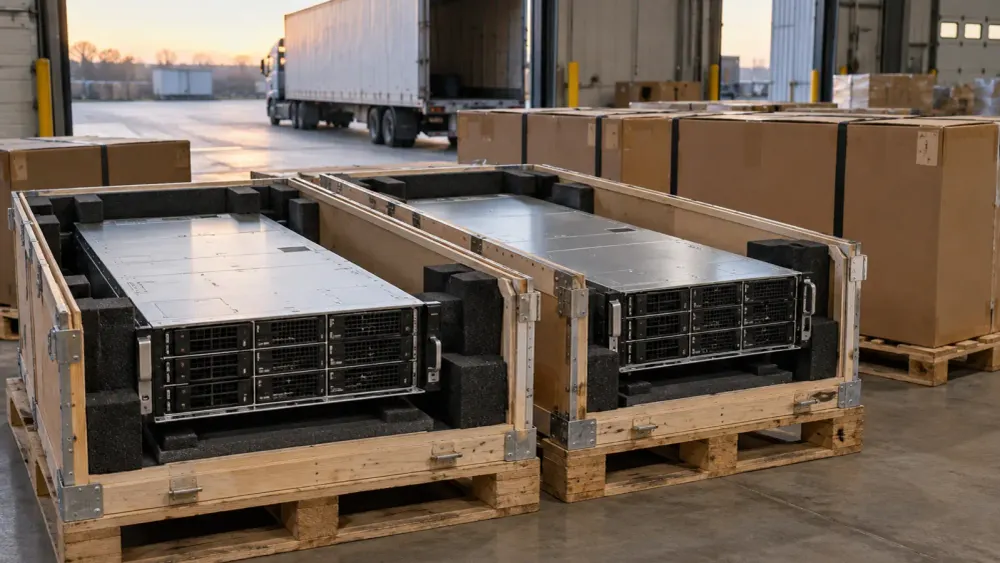
A federal criminal case unsealed Thursday alleges that a Southern California technology-company owner used false end-user records and third-country shipping routes to move more than $300 million in export-controlled computer servers to China. The case is one of the largest public U.S. prosecutions centered on the diversion of complete artificial-intelligence server systems rather than individual chips, and it puts renewed attention on the logistics networks that can sit between American hardware vendors and restricted buyers.
The Justice Department said on October 1 that Greg Lui, 38, also known as Yiu Kong Lui, was arrested on a three-count indictment returned September 29. Lui, who owns City of Industry-based Earthmade Computer Inc., is charged with conspiracy to violate the Export Control Reform Act and Export Administration Regulations, outbound smuggling and conspiracy to commit money laundering. The charges are allegations, and Lui is presumed innocent unless proved guilty beyond a reasonable doubt.
Prosecutors describe a transshipment pipeline
According to prosecutors, Earthmade bought high-end servers containing U.S.-made graphics processing units between 2023 and 2024 while representing that the equipment would go to permissible customers. The government alleges the servers were first shipped from Los Angeles to Malaysia or Singapore, then re-exported to China without the Commerce Department licenses required for the true destination and end users. A Reuters report independently summarized the charges and said neither Lui nor Earthmade could immediately be reached for comment.
The indictment, as described by the Justice Department, includes a January 2024 order for 27 servers worth about $7.6 million. Prosecutors say a co-conspirator later told a Malaysian official that those machines had been forwarded to a China-based buyer. The government also alleges that Earthmade received more than $176 million from two Malaysia-based shipping companies between January and October 2024. CBS Los Angeles reported the same three charges and the alleged use of Malaysia and Singapore as intermediate destinations.
The alleged route matters because export controls follow the item and the ultimate recipient, not simply the first port named on a bill of lading. In guidance issued in May, the Commerce Department’s Bureau of Industry and Security said licenses remain required for specified advanced-computing items supplied to entities headquartered in China and other restricted destinations even when those entities are located elsewhere. Current federal regulations governing advanced-computing license exceptions also distinguish between less-sensitive products and data-center equipment that meets the strictest performance thresholds.
That framework is designed to prevent a nominally lawful sale to an overseas intermediary from becoming a back door to a restricted customer. It does not make every shipment of advanced hardware to Malaysia or Singapore unlawful. Instead, the licensing question turns on the equipment’s technical classification, the destination, the parties involved and the intended end use. BIS guidance places responsibility on exporters to look beyond the address on an order when they know, or have reason to know, that a restricted entity may ultimately receive or control the equipment.
Why complete servers are the enforcement focus
AI accelerators are usually discussed as chips, but complete servers combine those processors with memory, networking, power and cooling components in systems ready for data-center deployment. That makes finished servers both valuable and comparatively difficult to conceal at scale. It also means manufacturers, distributors, freight forwarders and overseas resellers each occupy a potential compliance checkpoint.
Courthouse News Service reported that prosecutors accuse Lui of procuring servers with Nvidia GPUs and using paperwork that identified customers in countries where an export license was not required. The outlet noted that the federal docket did not yet identify an attorney for Lui. The government’s public release did not name the U.S. manufacturers or the alleged China-based buyers, limiting what can now be concluded about how supplier screening operated or where it may have failed.
The case therefore tests more than whether one exporter followed the rules. It highlights the practical challenge in controls built around declared destinations when high-value computing systems can be sold through layers of intermediaries. Verification of beneficial ownership, intended end use, payment flows and freight movements becomes central, especially when an overseas purchaser’s business profile does not match the quantity or type of hardware ordered.
For hardware suppliers and logistics companies, the warning signs described in the public allegations are familiar compliance concerns: large orders routed through newly introduced counterparties, payment from companies other than the named customer, end-use statements that conflict with shipping instructions, or requests to redirect equipment after it leaves the United States. No single indicator proves diversion. Taken together, however, they can justify enhanced screening, direct confirmation with the stated customer and, where required, a license application or refusal to ship.
The government’s theory also shows why enforcement increasingly follows money as well as hardware. Prosecutors included a money-laundering conspiracy count and highlighted the $176 million allegedly received from Malaysia-based companies. Financial records can help investigators connect purchase orders, freight movements and final recipients even when the physical goods pass through multiple jurisdictions. The indictment will have to prove that those transactions were tied to unlawful exports and that Lui knowingly participated.
A major allegation, not a final finding
The scale announced by prosecutors is substantial, but several key facts remain to be established in court: which shipments reached China, which end users received them, what the defendant knew at each stage and how the government calculated the more-than-$300 million total. Public reporting has so far relied heavily on the indictment summary rather than evidence tested before a judge or jury. That distinction is especially important in a case that combines national-security policy with conventional criminal allegations.
If convicted on all counts, Lui faces statutory maximum sentences totaling 50 years, though any sentence would depend on the charges proved and federal sentencing rules. For the technology sector, the immediate lesson is narrower and more concrete: the government is treating the international movement of full AI computing systems as an enforcement priority, and it is scrutinizing third-country transactions that appear routine on paper but may conceal a restricted final destination.