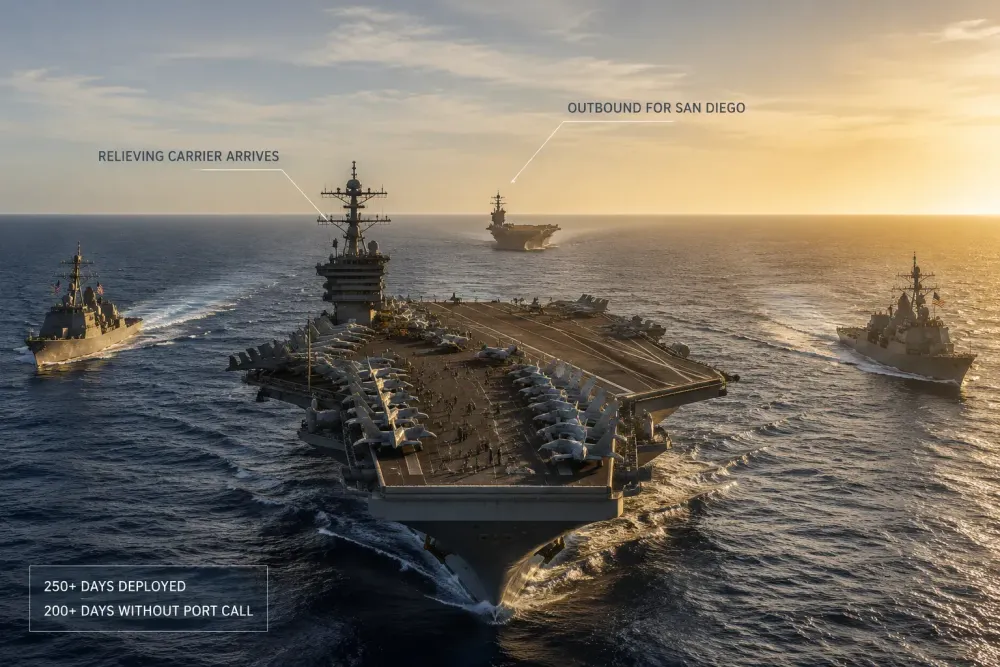
The USS George Washington has arrived in the Middle East to relieve the USS Abraham Lincoln after the Lincoln spent more than 250 days deployed and more than 200 consecutive days without a port call, ending an extraordinary operational stretch that triggered scrutiny of crew conditions, family strain, maintenance demands and the Navy's ability to sustain prolonged carrier operations. The George Washington now joins the USS George H.W. Bush in the region while the Lincoln begins a return voyage to San Diego expected to take more than a month, according to AP.
The rotation accomplishes the Navy's immediate objective: maintaining carrier aviation capacity in the Middle East while allowing one of the longest-deployed crews in the fleet to begin going home.
But it does not eliminate the underlying strain. It transfers the operational requirement from one carrier strike group to another.
For sailors and military families, that difference is substantial. For force planners, it highlights the central arithmetic of naval readiness: a carrier can be in only one place at a time, and every additional month spent on station must eventually be paid for through maintenance, training, family separation or reduced availability somewhere else.
The Lincoln's deployment stretched well beyond its original schedule
The Lincoln departed Naval Base San Diego on November 21, 2025. A congressional Senate letter says the deployment had originally been expected to last about seven months but had exceeded 250 days by August, with more than 200 consecutive days without a port visit.
Port calls are not simply recreational breaks.
They allow sailors opportunities to leave the ship, communicate with families under less constrained circumstances and recover from the repetitive environment of extended operations at sea. They also allow replenishment and maintenance work that can be more difficult while continuously underway.
Aircraft carriers are designed for sustained operations, and crews train for extended deployments. That does not make duration irrelevant.
A nuclear-powered carrier can remain at sea without regularly refueling its propulsion plant, but its sailors still require food, water, medical care, spare parts, mail and rest. Its aircraft must be maintained. Mechanical systems accumulate operating hours.
The limiting factor is therefore not the reactor alone.
It is the entire human and mechanical system built around it.
Reports of conditions aboard the Lincoln remain contested
Democratic members of the Senate Armed Services Committee and other lawmakers have cited reports of shortages of basic supplies, water-quality concerns, plumbing problems, delayed mail and deteriorating mental health aboard the ship, according to a committee letter.
Those claims require careful attribution because the Defense Department has disputed the characterization.
Defense Secretary Pete Hegseth has said accounts portraying conditions aboard the Lincoln as a crisis were substantially misrepresented, while President Donald Trump publicly downplayed the duration of the deployment. AP reported both the concerns raised about sailors and the administration's response in its coverage.
The existence of a long deployment is documented.
Specific claims about conditions, causation and the severity of mental-health effects are not equivalent to independently verified findings for every sailor aboard.
That distinction matters because thousands of people serve on a carrier strike group. Experiences can vary sharply by department, rank, workload and individual circumstances.
It is possible for a ship to continue performing its mission effectively while portions of its crew experience significant strain.
Those propositions are not mutually exclusive.
Family readiness is part of military readiness
Deployment discussions often focus on ships, aircraft and weapons because those are the most visible measures of military capability.
Families experience the schedule differently.
A seven-month deployment extended by weeks or months can disrupt childcare, employment decisions, school plans, medical appointments and expectations surrounding reunification. Families prepare for separation using an expected return window even when everyone understands that operational requirements can change it.
Uncertainty can be harder to manage than length alone.
A family that knows a sailor will be gone nine months can plan around nine months. A family expecting seven months and repeatedly learning that the return has moved can find the same total separation more disruptive.
That is why predictable deployment cycles have become part of broader force-management policy.
Retention also matters. Sailors deciding whether to remain in the Navy weigh compensation and professional opportunity alongside deployment tempo and family effects. A force can meet today's operational requirement by extending deployments while simultaneously creating tomorrow's personnel problem if experienced sailors decide the tempo is unsustainable.
Relieving one carrier creates a strategic trade-off somewhere else
The George Washington is normally associated with the Indo-Pacific, where U.S. strategy emphasizes maintaining naval presence amid China's growing military capability.
Moving the carrier toward the Middle East therefore solves one geographic problem by reducing capacity elsewhere.
AP reported that the deployment leaves the Asia-Pacific region without the same carrier presence while the George Washington operates alongside the George H.W. Bush in the Middle East, according to its reporting.
That does not mean the United States lacks military capability in Asia. Submarines, land-based aircraft, allied forces, surface ships and other assets continue operating throughout the region.
Aircraft carriers nevertheless provide a particular combination of mobility, strike aviation, surveillance and visible presence.
There are only a limited number available at any one time because ships cycle through deployment, training and major maintenance.
A carrier undergoing overhaul cannot simply be activated because another region becomes unstable.
Strategic flexibility therefore depends as much on readiness cycles as on the total number of carriers in the fleet.
The rotation preserves the mission while beginning to restore the force
The George Washington's arrival means the Navy can continue current operations without keeping the Lincoln indefinitely on station.
For the Lincoln crew, that begins the process of returning home rather than completing it. The ship still faces a voyage of more than a month before reaching San Diego.
After arrival, sailors receive time with families, but the ship itself enters another demanding phase. Maintenance teams must inspect equipment after extended high-tempo operations. Aircraft and systems accumulate wear that must be addressed before the carrier can regenerate readiness for a future deployment.
That is the other side of naval presence.
Every day a carrier is available to national leaders today affects how quickly it can be available again tomorrow.
The United States has historically managed that tension through rotational deployments, maintenance schedules and multiple carrier strike groups. Extended conflict compresses the system by increasing how many ships are needed forward and how long they must remain there.
The 250-day deployment is therefore more than a record
For military families, the most immediate story is straightforward: thousands of Lincoln sailors are finally heading toward home.
For defense planners, the same development is evidence about force sustainability.
The Navy succeeded in keeping a carrier operating through an exceptionally long deployment. The crew continued executing missions. Another carrier arrived before the Lincoln departed, preserving regional capability.
Those are measures of resilience.
The duration, congressional concern and decision to move an Indo-Pacific carrier to provide relief are also measures of strain.
Neither interpretation needs to cancel the other.
Military readiness is not demonstrated solely by how long a crew can remain deployed. It is demonstrated by whether the United States can repeatedly generate trained people, maintained ships and combat-capable aircraft without exhausting the force required for the next contingency.
The George Washington's arrival answers the immediate operational question in the Middle East.
The Lincoln's more than 250 days deployed and more than 200 days without a port call leave a larger one for the Navy: how long can exceptional deployment tempos remain exceptional before they become the force-generation model itself?