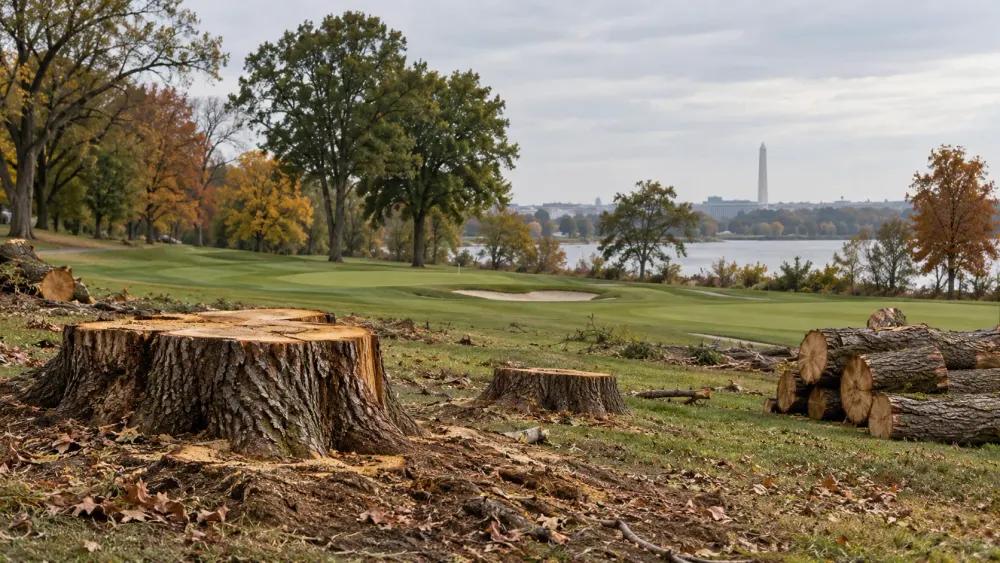
A federal judge ordered a 24-hour halt to tree cutting at Washington’s East Potomac Golf Links on Monday after court accounts put the weekend removal at roughly 430 to 500 trees. U.S. District Judge Ana Reyes said the pause could be extended to 14 days while she determines who authorized the work and why the government provided so little warning, according to the AP.
The emergency order does not decide whether the National Park Service may ultimately remove the trees or whether President Donald Trump’s proposed redesign of the century-old public course can proceed. It temporarily stops irreversible work while the court examines the government’s notice, the project’s legal basis and whether tree removal is independent maintenance or an early phase of a larger redevelopment.
That distinction matters because the Park Service says the work implements a preservation plan that predates Trump’s second term. The plaintiffs — the DC Preservation League and two local golfers — argue the government is dividing a broader transformation into smaller actions to avoid comprehensive environmental and historic-preservation review. The next hearings will test those competing accounts.
A weekend operation triggers an emergency hearing
The cutting began after the government filed notice late Friday before a holiday weekend. At Monday’s hearing, government lawyers said about 430 trees had been removed and 299 more were targeted, the Post reported. Reuters described about 500 trees as having been removed. The different figures appear to reflect changing inventories and the pace of work, but both accounts establish that the operation was far larger than a handful of safety removals.
Reyes had previously told government lawyers that the court and plaintiffs should receive advance notice of substantive or irreversible work. Because that instruction had not been entered as a formal written order, she did not immediately begin contempt proceedings. She nevertheless warned that violating the new order would expose officials to contempt and said the government’s handling of the notice had damaged its credibility, according to Reuters.
The judge scheduled further proceedings and sought testimony from senior Interior Department and Park Service officials. The central factual question is not only who approved the cutting, but why a plan described as long-term landscape management became urgent enough to execute over a weekend while related litigation was active.
The Park Service’s restoration case
The government’s strongest support comes from a 2019 National Park Service cultural landscape report. That report treats East Potomac, Langston and Rock Creek as historic golf landscapes and recommends preserving the design principles that shaped them. East Potomac was conceived as a links-style course with open fairways, long views and relatively little interior tree cover.
The agency’s current project page says decades of planting and unmanaged growth obscured vistas, changed golf strategy and shifted the course toward a more wooded, parkland character. Its proposed work includes selective removal of invasive, hazardous and “non-contributing” trees, protection of historic vegetation, restoration of views and targeted replacement planting.
The Park Service also says the tree project will not change the course’s public use, construct buildings, expand its footprint or authorize major ground disturbance. That is a narrower undertaking than the championship-caliber redesign Trump has promoted. The agency’s position is therefore that cutting can proceed as cultural-landscape rehabilitation even while any larger renovation remains conceptual.
Why preservationists dispute that separation
The plaintiffs say the timing and scale make the maintenance explanation incomplete. Their lawsuit, filed in February, challenges earlier actions at East Potomac and alleges that the administration is moving toward a more exclusive course without completing the reviews required for federal land and historic resources. The case record maintained by Democracy Forward, which represents the plaintiffs, identifies environmental review, public access and preservation as the core disputes.
The plaintiffs do not contend that every tree must remain. Their argument is that the government cannot treat tree cutting, soil placement and other physical work as isolated projects if they are functionally connected to a larger redesign. Under that theory, segmentation would allow irreversible changes before the cumulative environmental and historic consequences were analyzed.
The government disputes that characterization. Officials testified that the tree plan rests on the 2019 report, and one Park Service official said he had not seen an internal design for Trump’s proposed course. That testimony leaves a factual gap the court is now trying to close: whether the restoration program was independently revived because money and personnel became available, or accelerated to support the president’s broader vision.
The court has paused work, not resolved the case
The short duration of Reyes’s order is important. A temporary halt preserves the remaining landscape while the court collects testimony; it does not establish that federal environmental or preservation law was violated. The plaintiffs will still need to show that the challenged activity required additional review or was improperly separated from a broader federal action.
The government, meanwhile, will need to reconcile its description of the redesign as preliminary with the speed and scale of physical work already completed. It must also explain why the court received limited notice despite the judge’s earlier warnings and why East Potomac advanced ahead of the other historic courses covered by the same 2019 report.
What the next hearings will determine
The immediate issue is whether the halt remains in place and whether the government must provide advance notice before any further irreversible work. Testimony from senior officials could clarify the chain of command, the funding source, the tree inventory and the relationship between the landscape plan and Trump’s proposed championship course.
The broader significance reaches beyond golf. East Potomac is federally owned parkland near the National Mall, and the dispute tests how quickly an administration may alter a historic public site while plans remain under development and litigation is pending. For now, the court has established only a pause. Whether the remaining trees can be removed, and under what review process, depends on evidence the government has been ordered to produce.