
Last updated: August 13, 2026
Quick Answer
Three U.S. states are set to carry out executions on Thursday, August 13, 2026, the first same-day triple execution in the country since 2010, according to the Death Penalty Information Center. The phrase "Triple Executions: Three States Schedule Rare Same-Day Procedures This Week" describes a scheduling coincidence, not a coordinated federal action: each death warrant was signed separately by a different state authority. Florida, Texas, and Tennessee are the three states with warrants active for that date, and each case rests on a capital murder conviction that is decades old.
Key Takeaways
- Three states share an execution date of August 13, 2026, the first such convergence in the U.S. in about 16 years.
- The states involved are Florida, Texas, and Tennessee, three of the most active death-penalty jurisdictions in the country.
- Robin Maher, executive director of the Death Penalty Information Center, has called double and triple execution days "incredibly rare" and the product of separate state calendars overlapping.
- Florida carried out a double execution on July 28, 2026, part of a broader ramp-up in executions this year.
- 27 states retain capital punishment in statute, though several have long-standing moratoriums.
- Roughly 2,100 people remain under sentence of death nationwide, and the average wait before execution now exceeds 20 years.
- Since 1973, more than 200 people sentenced to death have been exonerated.
What Are Triple Executions, and Why Are They Rare?
A "triple execution" day means three separate states carry out death sentences within the same 24-hour period. It is rare because nothing links the schedules. Governors, state supreme courts, and attorneys general set execution dates independently, based on when appeals run out in each individual case.
Several factors make same-day clustering unlikely:
- Only a handful of states execute anyone in a given year.
- Death warrants are usually issued 30 to 90 days in advance, on separate state timetables.
- Courts routinely stay executions, so dates move.
Maher has been direct that no state coordinates with another. Analysts tracking the 2026 calendar describe the August 13 overlap as arithmetic, not policy: when a small number of states each schedule several executions in one summer, collisions eventually happen.
Which Three States Are Scheduling Executions This Week?
Florida, Texas, and Tennessee hold the active warrants for August 13, 2026. All three men scheduled to die were convicted of aggravated murder, the only crime category for which the U.S. Supreme Court permits a death sentence.
The underlying cases share a common profile:
- Convictions from the 1980s and 1990s, meaning each case has moved through state appeals, federal habeas review, and clemency petitions.
- Aggravating factors required by state law, such as murder committed during a robbery or sexual assault, murder of multiple victims, or killing a child.
- Long-litigated claims including intellectual disability, ineffective counsel, and challenges to lethal injection protocols.
Tennessee's case carries added history. The state's execution program was suspended for three years after an independent review found the corrections department failed to test lethal injection chemicals as its own protocol required, a failure that led to one execution being called off minutes before it was scheduled to begin. Democracy Now and other outlets have pointed to that record in questioning whether the state is prepared to proceed.
"Double or triple executions are incredibly rare," Maher has said, describing the overlap as a scheduling coincidence rather than a deliberate policy.
How Often Do Multiple States Execute Prisoners on the Same Day?
Same-day multiple executions happen a few times per decade; three states on one day has not occurred since 2010. Two-state days are somewhat more common, especially in years when total executions rise.
2026 has produced repeated clusters. Florida's July 28 double execution, two men put to death in a single day in one state, was itself the first of its kind in Florida in decades. Reporting from AP and USA Today has documented other pairs of executions falling within 24 to 48 hours of each other across different states this year.
Decision rule for readers assessing the trend: treat a rise in same-day executions as a symptom of volume, not coordination. When one or two states issue warrants in rapid succession, the national calendar compresses on its own.
How Do Execution Methods Differ Between States?
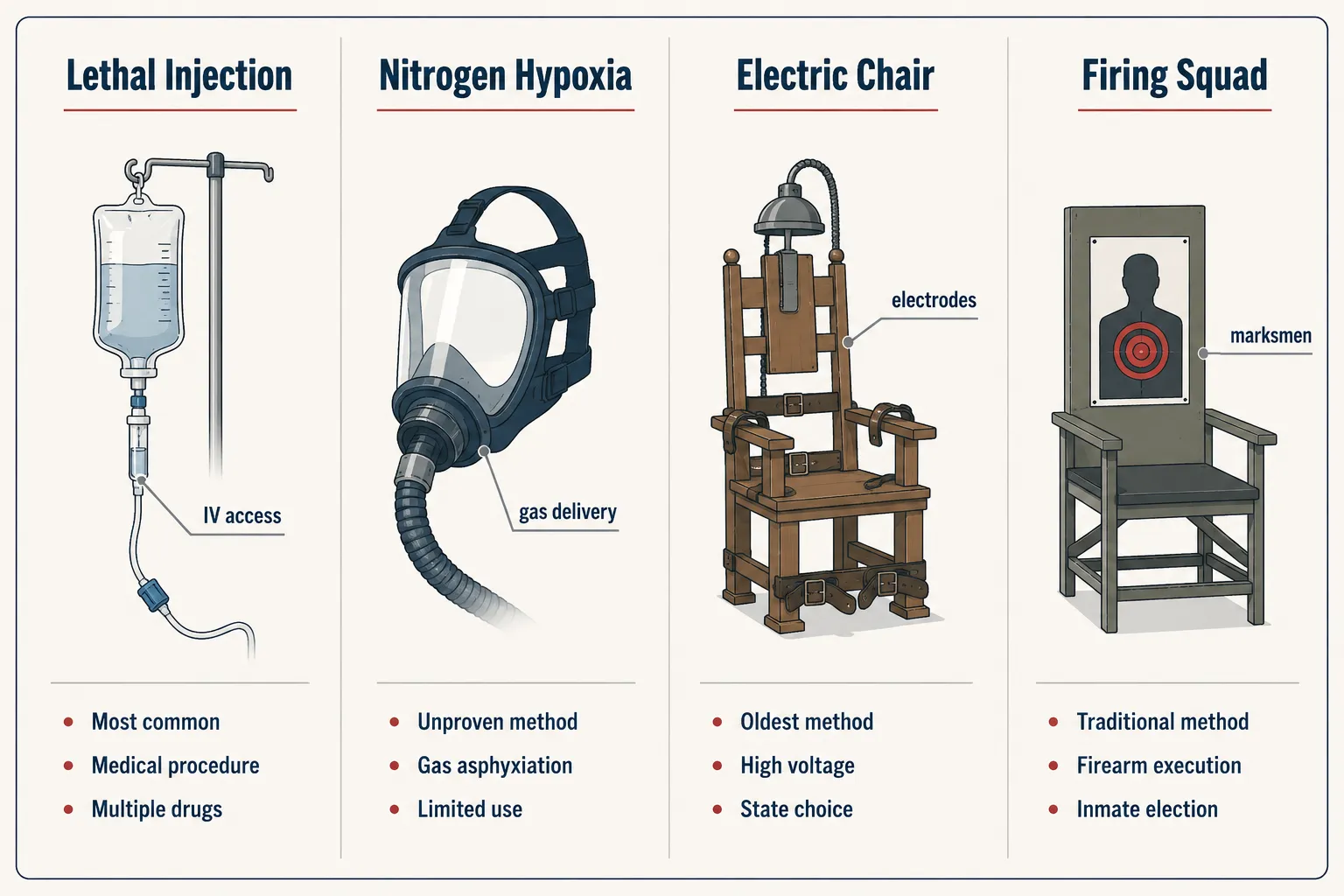
Lethal injection remains the primary method in every state that executes, but authorized alternatives vary widely.
| Method | Where authorized | How it is used |
|---|---|---|
| Lethal injection | All active death-penalty states | Primary method; single-drug and three-drug protocols both in use |
| Nitrogen hypoxia | Alabama, Mississippi, Oklahoma, Louisiana | Backup or elected method; first used in Alabama in 2024 |
| Electrocution | Several Southern states | Usually by inmate election or if injection is unavailable |
| Firing squad | Idaho, Mississippi, Oklahoma, South Carolina, Utah | By election or as a statutory backup |
| Lethal gas (other) | A small number of states | Largely dormant statutes |
Litigation this year has focused heavily on the mechanics of lethal injection, particularly IV access in prisoners with damaged veins or serious medical conditions. Those claims rarely stop an execution outright, but they have forced states to disclose more about their procedures.
What Is the Legal Process Before an Execution, and Can It Be Stopped at the Last Minute?
Yes, executions can be halted within minutes of the scheduled time, and it happens most years. Stays come from state or federal courts, or clemency from a governor or parole board.
The sequence in a typical case:
- Conviction and automatic direct appeal to the state's highest court.
- State post-conviction review, raising claims trial counsel missed.
- Federal habeas corpus review in district court, then the circuit court, then a certiorari petition to the U.S. Supreme Court.
- Death warrant issued, setting a date.
- Final-stage litigation, method-of-execution challenges, competency claims, intellectual disability claims.
- Clemency petition to the governor or a board of pardons.
- Emergency applications to the U.S. Supreme Court, often filed the day of execution.
If new evidence emerges late, defense lawyers file a successive petition or a state motion for a new trial. The bar is high: most states require the evidence to be newly discovered, credible, and strong enough that no reasonable juror would have voted to convict. Courts have granted stays for DNA testing and for recanted eyewitness testimony, but procedural deadlines defeat many claims before a judge examines the merits.
How Many People Are on Death Row, and How Long Do They Wait?
About 2,100 people are under sentence of death in the United States, and 27 states still authorize capital punishment. Death row populations have declined for more than two decades as new death sentences fell to roughly two dozen per year.
- States with active executions: a small group led by Texas, Florida, Alabama, Oklahoma, Missouri, and Tennessee.
- States with capital punishment but a moratorium: including California, Oregon, and Pennsylvania.
- Average time from sentence to execution: more than 20 years, up from about six years in the 1980s.
That delay is structural. It reflects mandatory appellate review, chronic underfunding of capital defense, and prolonged federal habeas litigation, a pattern both parties' judicial appointees have described in opinions.
What Are the Arguments For and Against Capital Punishment?
Supporters argue the death penalty delivers proportional punishment for the worst crimes, provides finality for victims' families, and is constitutionally permitted. Opponents argue it is applied unevenly, costs more than life imprisonment, and carries an irreducible risk of executing an innocent person.
In favor:
- Retribution proportional to aggravated murder
- Reserved by statute for a narrow class of offenses
- Repeatedly upheld by the U.S. Supreme Court
Against:
- More than 200 death-row exonerations since 1973
- Racial and geographic disparities in who is sentenced
- Higher total cost than life without parole in most state studies
- Botched procedures, including failed IV placements and aborted executions
Documented wrongful executions are contested by nature, because courts rarely reopen a case after death. Researchers and journalists have raised serious doubts in several closed cases, and abolitionist groups have described 2026's execution pace as a "gruesome" escalation. State officials counter that each case cleared decades of judicial review.
Conclusion: What to Watch After August 13
Triple Executions: Three States Schedule Rare Same-Day Procedures This Week is a story about volume and timing, not a change in law. Nothing about August 13 alters who can be sentenced to death or how.
Practical next steps for readers following the issue:
- Track the Death Penalty Information Center execution database for stays issued the same day.
- Watch whether Tennessee's protocol litigation produces new disclosure orders.
- Compare 2026's year-end execution total against the 2015-2024 average to judge whether the ramp-up holds.
- Follow state legislative sessions in 2027, where method statutes and moratorium bills are most likely to move.
FAQ
What is a triple execution? Three separate states carrying out executions within the same 24-hour period. It is not a single event and involves no coordination between states.
When was the last same-day triple execution in the U.S.? 2010. The August 13, 2026 schedule is the first since then.
Which states are involved this week? Florida, Texas, and Tennessee.
Can all three executions still be stopped? Yes. Any of them can be stayed by a state court, a federal court, the U.S. Supreme Court, or by executive clemency, including minutes before the scheduled time.
How many states still have the death penalty? 27 states retain it by statute. A minority of those have carried out an execution in the past five years.
What method will be used? Lethal injection is the primary method in all three states, though each authorizes at least one alternative.
How long had these men been on death row? Each was convicted in the 1980s or 1990s, consistent with a national average wait exceeding 20 years.
Does new evidence automatically stop an execution? No. Courts require the evidence to be newly discovered, credible, and strong enough to undermine the conviction, and procedural rules bar many late claims.
Tags: capital punishment, death penalty, triple executions, Florida executions, Texas death row, Tennessee lethal injection, Death Penalty Information Center, execution methods, clemency, wrongful convictions, criminal justice policy, U.S. courts