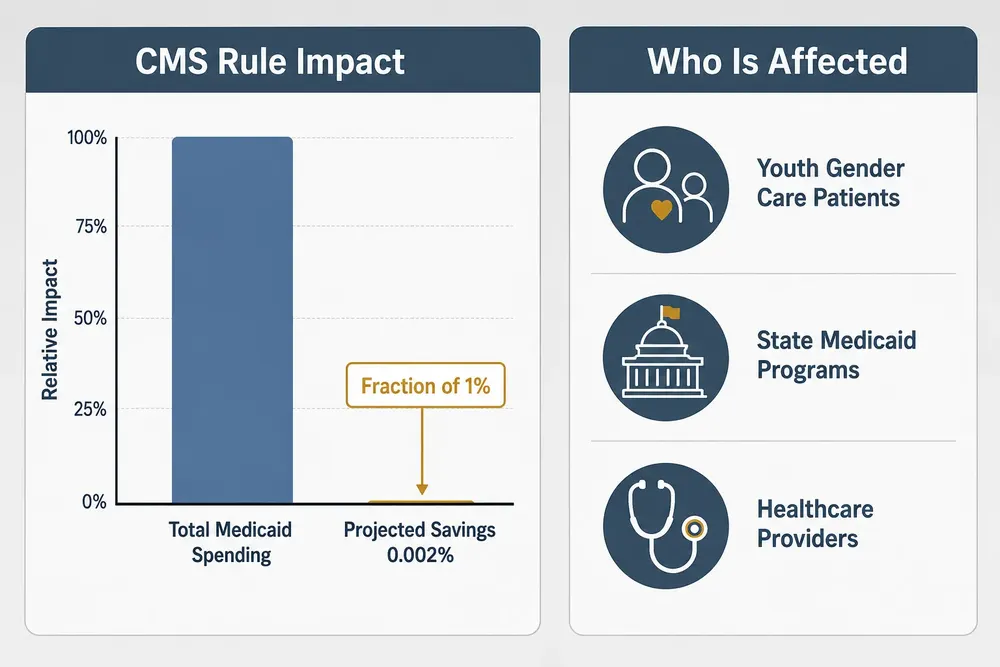
The Centers for Medicare & Medicaid Services finalized a rule on August 11 that will end federal Medicaid and CHIP funding for gender-affirming medical care in minors, a policy CMS itself projects will trim combined federal and state spending in the two programs by only about $235 million over ten years, roughly two-thousandths of one percent of what the programs spend annually, according to Reuters. The mismatch between the rule's narrow fiscal footprint and its sweeping reach into insurance coverage for a population of 35.5 million Medicaid- and CHIP-enrolled children illustrates how a federal health program's eligibility levers can be used to accomplish policy goals that have little to do with cost containment, and it sets up one of the more closely watched health-law disputes of the fall.
What the rule actually does
The final rule, formally titled "Medicaid Program: Prohibition on Federal Medicaid and Children's Health Insurance Program Funding for Sex-Rejecting Procedures Furnished to Children," bars states from drawing down federal Medicaid matching funds to pay for puberty blockers, cross-sex hormone therapy, and related surgical procedures for beneficiaries under 18, and bars CHIP programs from using federal dollars for the same care for enrollees under 19, according to a CMS release. HHS Secretary Robert F. Kennedy Jr. said in a companion statement that the interventions "carry serious risks and can cause irreversible harm," while CMS Administrator Mehmet Oz framed the move as following "the science" and protecting children from what the agency calls "sex-rejecting procedures," according to the same CMS release. The rule is scheduled for formal publication in the Federal Register on August 13 and takes effect on October 13, according to The Hill.
Critically, the policy does not ban clinicians from providing this care, nor does it prevent states from paying for it with their own money. It removes only the federal matching-fund component, shifting the financing burden entirely to states, families, or private insurers, according to Reuters. Because Medicaid is a joint federal-state program in which Washington typically covers 50% to 77% of costs depending on the state, withdrawing the federal share functions less like an outright prohibition and more like an unfunded mandate: states that want to preserve access must now backfill the federal contribution themselves. Children currently on hormone therapy get a six-month taper-off window after the effective date, though that grace period excludes puberty blockers and surgical care, according to transequality.org. Mental health services related to gender dysphoria remain covered under Medicaid's Early and Periodic Screening, Diagnostic, and Treatment provisions and CHIP's parallel mandate, according to CMS.
How CMS built its legal case
The rule leans on a specific, previously underused provision of the 1965 Medicaid statute requiring that covered services serve a beneficiary's "best interests," an interpretation CMS is using to argue it has authority to exclude an entire category of care rather than simply setting coverage rates or utilization limits, according to Reuters. That reading is contested: opponents argue the statute was designed to guarantee access to physician-recommended care, not to let the federal government override individualized medical judgments across an entire diagnostic category. CMS's own regulatory history shows the rule was not a sudden move. The agency first proposed it in December 2025 alongside a separate, broader proposal that would have stripped Medicare and Medicaid participation from any hospital performing this care on minors, according to KFF analysis. That hospital-conditions-of-participation rule, which would have applied to nearly all of the country's 4,832 Medicare/Medicaid-certified hospitals regardless of a patient's insurer, was reported by NPR in July to have been shelved, with the administration's own regulatory agenda pushing a final action date to December 2028, according to NPR. The narrower Medicaid-funding-only rule finalized this week is a smaller intervention by comparison, limited to a funding mechanism rather than a facility-licensing requirement, and CMS softened it during review by adding the six-month tapering provision absent from the original proposal.
The numbers behind the policy
CMS's own regulatory impact analysis, cited across multiple outlets that reviewed the rule, estimated that Medicaid and CHIP spent approximately $31 million on the affected services nationwide in 2023, with about 76% of that spending occurring in states that had not already restricted such coverage, according to Becker's. KFF's earlier review of the underlying data found that 92% of that $31 million went toward nonsurgical care such as hormone therapy, underscoring that the care in question is overwhelmingly pharmacological rather than operative, according to KFF. Reuters reported the finalized rule's ten-year savings estimate of $235 million splits into roughly $138 million in federal savings and $97 million in state savings, a sum so small relative to total federal outlays that CMS itself stated the rule "is not meant as a means of achieving budgetary savings," according to Reuters. That framing matters procedurally: because the Administrative Procedure Act requires agencies to justify major rules with a rational basis tied to their stated purpose, a rule explicitly disclaiming a budgetary rationale while relying on contested medical evidence is especially exposed to challenge on arbitrary-and-capricious grounds.
Independent research groups, including the Williams Institute, have estimated roughly 724,000 transgender-identifying youth ages 13 to 17 live in the United States, and KFF's coverage modeling suggests approximately 270,000 trans youth nationally are enrolled in Medicaid or CHIP, with perhaps half of those living in states without existing state-level restrictions and therefore potentially affected by the new federal funding gap, according to KFF.
Reaction and the coming legal fight
The rule lands atop a shifting state-level landscape: at least 27 states already restrict gender-affirming care for minors through their own statutes, meaning the federal funding change is redundant in much of the country and consequential mainly in the roughly two dozen states, plus the District of Columbia, that had not already acted, according to Moneycontrol. Advocacy organizations, including Advocates for Trans Equality, characterized the rule as discriminatory because it does not restrict the same hormonal or surgical interventions when performed for reasons unrelated to gender transition, and the group noted it helped coordinate nearly 35,000 public comments opposing the earlier proposal, according to transequality.org. The American Academy of Pediatrics criticized the underlying proposal when it was first introduced as "a baseless intrusion into the patient-physician relationship," a position the organization has maintained through finalization, according to KFF brief.
Litigation is widely expected. A coalition of state attorneys general has already sued over a related December 2025 HHS declaration that similarly targeted gender-affirming care by asserting the treatments fail to meet "professionally recognized standards of health care," a case that remains active, according to KFF. Reuters reported that Democratic officials are already signaling plans to challenge the newly finalized Medicaid rule in court, arguing CMS exceeded its statutory authority by using a beneficiary-protection clause to eliminate an entire treatment category rather than to police individual claims, according to Reuters. Federal courts have already stayed or vacated portions of other 2026 CMS rules, including provisions of the ACA marketplace rule and the Medicaid work-requirements interim final rule, on Administrative Procedure Act grounds, so the coming challenge is likely to turn on similar questions about whether the agency adequately justified a major coverage change using an evidentiary record that professional medical societies dispute.
For state Medicaid agencies, the immediate operational task is narrower than the political debate suggests: reprogram claims systems to deny federal matching for a defined set of billing codes by October 13, while deciding, state by state, whether to replace the lost federal share with state general funds. That administrative choice, replicated separately by each of the fifty states, is where the rule's real-world impact will ultimately be decided.