Last updated: August 13, 2026
Quick Answer
On August 11, 2026, the Fourth Criminal Court in Damascus sentenced former Syrian president Bashar al-Assad to death in absentia for killings, torture, arbitrary arrest, and crimes against humanity committed during Syria's 14-year conflict, according to Reuters [2]. His brother Maher al-Assad and former security official Atef Najib received the same sentence [2]. Assad is living in Russia under asylum granted after his government collapsed in December 2024, so the sentence cannot currently be carried out [2].
Key Takeaways
- The verdict came down on August 11, 2026 from Damascus's Fourth Criminal Court, the first Syrian conviction of Assad since the family's rule ended in December 2024 [2].
- Judge Fakhareddine al-Aryan said Assad "used state agencies to commit war crimes and crimes against humanity," according to AP [1].
- A death sentence in absentia means the defendant was convicted without appearing in court and without being in custody.
- Enforcement requires physical custody. Russia has refused extradition, and Assad remains in Moscow [2].
- Syria's justice ministry says defendants have 30 days to appeal, per The New Arab.
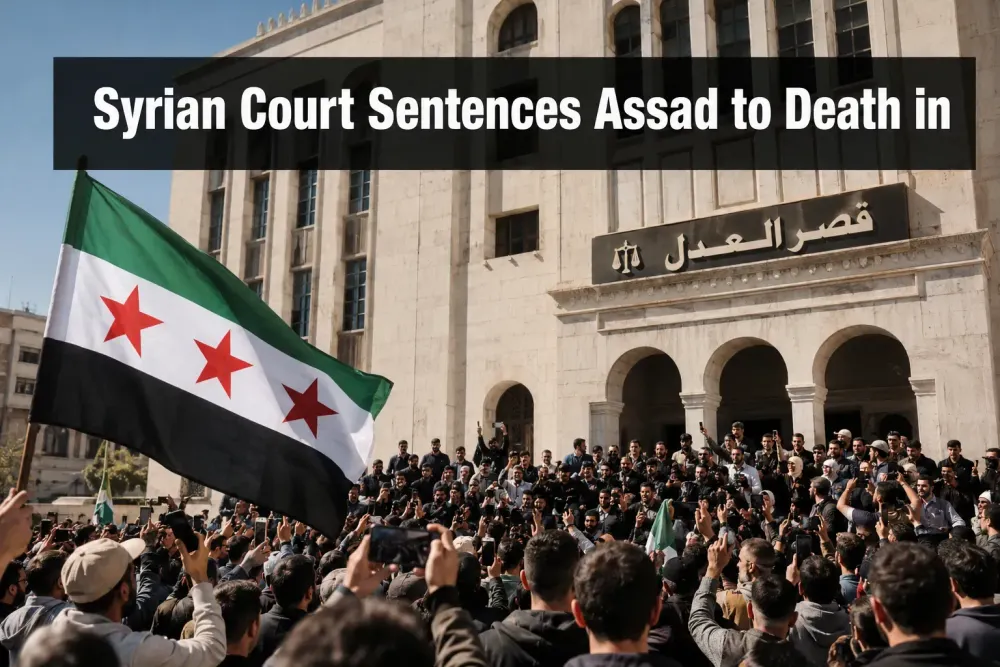
- Crowds gathered outside the Damascus courthouse chanting and clapping; celebrations were also reported in Daraa, where the 2011 protests began [2].
- Syrian human rights lawyer Anwar al-Bunni called the ruling "performative justice, not transitional justice" [2].
- The capital sentence itself may block cooperation, since many states refuse to extradite to countries that apply the death penalty.
What does death in absentia mean, and what crimes is Assad convicted of?
A death sentence in absentia is a capital conviction handed down when the accused is neither present in the courtroom nor in state custody. The court hears evidence, appoints or accepts defense counsel, and issues a verdict that sits on the books until the defendant is arrested or surrenders.
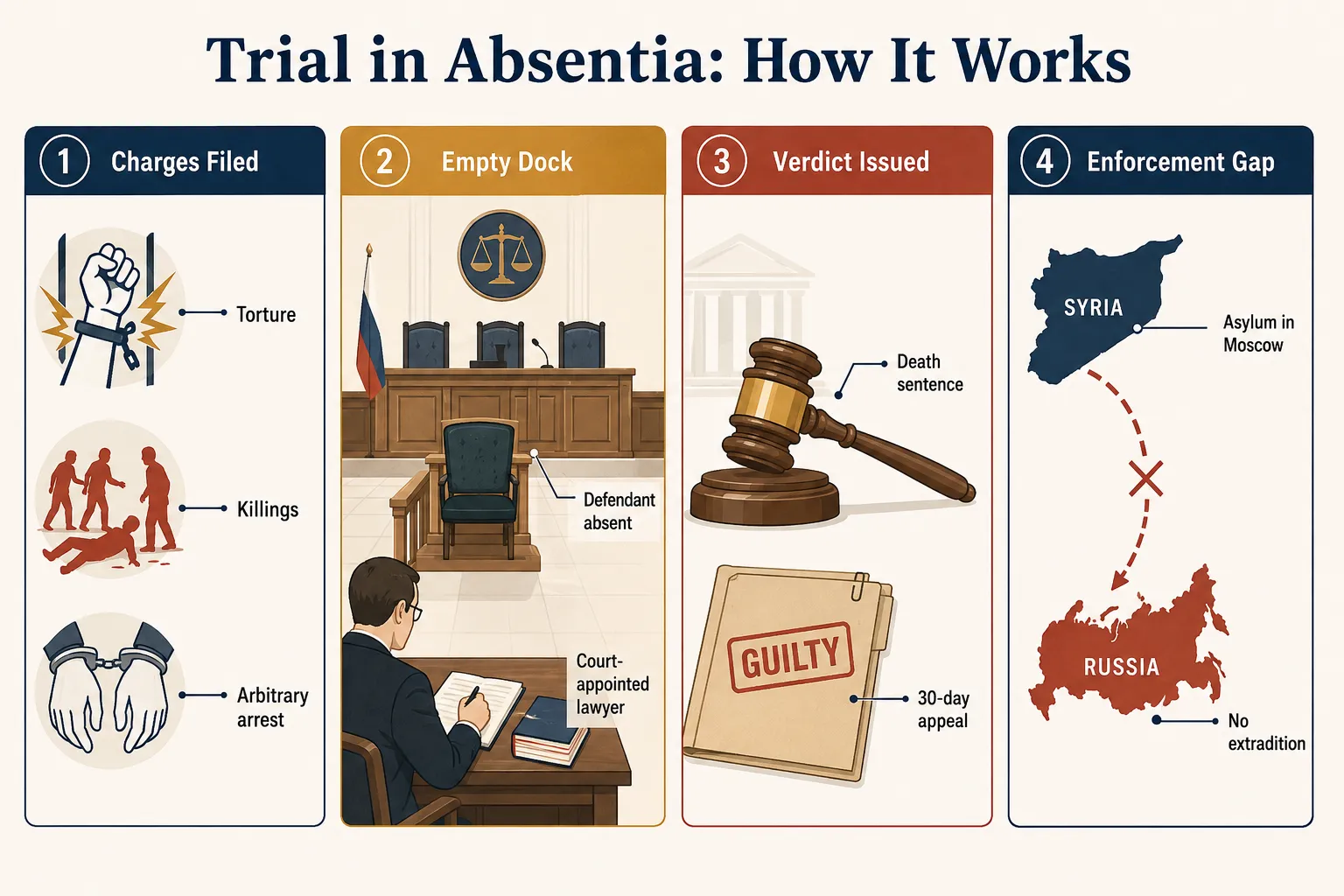
The Damascus court convicted Assad on charges tied to the machinery of the state itself, according to Reuters and AP [2][1]:
- Killings carried out by security forces and military units
- Torture inside detention facilities
- Arbitrary arrest and enforced disappearance
- Crimes against humanity and war crimes over the 14-year conflict
Judge Fakhareddine al-Aryan framed the finding around command responsibility rather than individual acts, saying Assad "used state agencies to commit war crimes and crimes against humanity" [1]. That framing matters legally: it targets the chain of authority, not a single order.
Why is Bashar al-Assad being tried now, and who is the new Syrian government trying him?
He is being tried now because the government that shielded him no longer exists. Assad's rule collapsed in December 2024, and the transitional authorities that followed took control of Syria's courts, security archives, and prosecution files [2].
The case was heard by the Fourth Criminal Court in Damascus, an ordinary domestic criminal court rather than a special tribunal or hybrid international body [2]. That choice is significant. It means the proceeding ran under Syrian criminal law, with Syrian judges, and Syrian sentencing options that include capital punishment.
Abdul Basit Abdul Latif, who heads Syria's transitional justice commission, called the verdict an "important milestone" in a post on X. Syria's justice ministry publicly defended the process after Amnesty International raised objections, and confirmed the standard 30-day appeal window applies.
"Performative justice, not transitional justice.", Anwar al-Bunni, head of the Syrian Centre for Legal Studies and Research, quoted by Reuters [2]
Al-Bunni's objection is practical, not sentimental: a death sentence gives foreign governments a legal reason to refuse cooperation.
Can a death sentence in absentia be enforced, and where is Assad now?
No, not while the convicted person stays outside the sentencing state's reach. Assad is in Russia, where he and his family were granted asylum after fleeing Damascus, and Reuters reported that his location makes enforcement uncertain [2].
Enforcement of any custodial or capital sentence needs three things:
- Physical custody of the defendant
- A state willing to hand him over, or a lawful arrest on territory that will
- A final, non-appealable judgment under domestic law
Syria currently has none of the three. Assad's exact residence in Russia is not publicly confirmed by any of the wire reports, and Moscow has not published details. What is documented is the asylum grant and Russia's refusal to extradite [2].
Decision rule: if a convicted head of state remains in a country that grants him asylum and rejects extradition, the sentence functions as a legal record and travel constraint, not an execution order.
Can Syria extradite Bashar al-Assad from Russia?
Not realistically. Russia granted asylum and has declined to send him back, and no extradition mechanism can override a host state's refusal without its consent [2].
Three barriers stack up:
| Barrier | Effect on extradition |
|---|---|
| Russian asylum grant | Legal shield inside Russia; removal is Moscow's discretion |
| No enforceable transfer obligation | Syria cannot compel surrender through courts |
| Death penalty in the verdict | Many states, and most European partners, bar transfer to capital-punishment jurisdictions |
The third barrier is self-inflicted and applies far beyond Russia. The Foundation for Defense of Democracies argued that while the ruling is a milestone, it exposes the ceiling on Syria's accountability push precisely because Assad sits in Moscow and Russia refuses extradition. Al-Bunni made the same point about capital punishment narrowing Syria's options with other governments [2].
Edge case: if Assad ever travels outside Russia, an arrest becomes theoretically possible, which is why in-absentia convictions still constrain movement even when unenforced.
How does international law handle death sentences in absentia?
International human rights law tolerates trials in absentia only under narrow conditions, and treats capital punishment as an area demanding the strictest procedural guarantees. Fair-trial standards generally require that a defendant be notified, be represented, and have a genuine route to a retrial or full appeal once located.
Amnesty International criticized the Syrian case, and Syria's justice ministry responded by defending the proceedings and pointing to the 30-day appeal period. The core contested questions in any in-absentia capital case are consistent:
- Was the accused properly notified and given effective counsel?
- Was the evidence tested, or accepted largely unchallenged?
- Does domestic law guarantee a retrial if the defendant is later arrested?
- Is capital punishment compatible with the state's international commitments?
Common mistake: treating an in-absentia verdict as an international arrest warrant. It is not. It is a domestic judgment, and its cross-border force depends on separate cooperation instruments.
What's the difference between this trial and international investigations of Syria?
This was a domestic Syrian criminal trial under Syrian law, decided in Damascus, with the death penalty available as a sentence [2]. International accountability efforts operate on different tracks, with different limits.
- Damascus trial (August 2026): national jurisdiction, Syrian judges, capital sentencing, enforcement blocked by Assad's location [2].
- International investigative bodies and European prosecutions: built on universal jurisdiction and evidence-preservation mandates, typically resulting in prison terms rather than death sentences, and usually targeting officials who can actually be arrested.
- The International Criminal Court: has no automatic jurisdiction over Syria, since Syria is not a state party and no UN Security Council referral has been made. The ICC also cannot impose death sentences.
That last point creates a paradox. A Syrian court reached a verdict against Assad faster than any international forum, but chose a punishment that international partners will not help enforce.
Will this sentence change anything for Syria, and how do Syrians feel about it?
Publicly, the reaction inside Syria was celebratory. Reuters reported Syrians gathering around the Damascus courthouse chanting and clapping as word spread, with celebrations also breaking out in Daraa, the southern city where the 2011 protests started [2].
What the verdict plausibly delivers:
- Official acknowledgment that state institutions were used to commit atrocities, on the record from a Syrian bench [1]
- A documentary base of evidence and findings future cases can draw on
- Political legitimacy for the transitional justice process, as Abdul Latif's "important milestone" framing suggests
What it does not deliver: custody, restitution, or answers for families of the disappeared. Al-Bunni's "performative justice" critique reflects a concern shared by rights groups that symbolic verdicts can substitute for the slower work of documentation, reparations, and prosecuting mid-level perpetrators who remain inside Syria [2].
Can this sentence be appealed or overturned?
Yes. Syria's justice ministry stated that defendants have 30 days to appeal the ruling. Appeals in absentia are typically lodged by defense counsel, and many legal systems also grant an automatic retrial once a convicted person in absentia is arrested or voluntarily appears.
Three routes could alter the outcome:
- Direct appeal within the 30-day window on procedural or evidentiary grounds
- Retrial upon custody, if Syrian law provides it, restarting the case with the defendant present
- Legislative or executive change, including any future abolition or suspension of capital punishment in Syria
Frequently asked questions
When exactly was Assad sentenced? August 11, 2026, by the Fourth Criminal Court in Damascus [2].
Who else was sentenced to death in the same case? Maher al-Assad, Bashar's brother, and former security official Atef Najib, according to Reuters [2].
Was this Syria's first conviction of Assad? Yes. Reuters described it as the first Syrian conviction against Assad after the fall of the family's rule in December 2024 [2].
Can Assad be executed? Not unless Syria takes physical custody of him. He is in Russia under asylum [2].
Who was the presiding judge? Fakhareddine al-Aryan, who said Assad used state agencies to commit war crimes and crimes against humanity [1].
Does the ICC have jurisdiction over Assad? Not automatically. Syria is not an ICC state party, and there has been no Security Council referral.
Did rights groups support the verdict? Reaction was split. Syria's transitional justice commission welcomed it, while Amnesty International criticized the process and lawyer Anwar al-Bunni called it performative [2].
How long is the appeal window? 30 days, per Syria's justice ministry.
Conclusion
The Damascus verdict of August 11, 2026 put a named Syrian court on record finding that Bashar al-Assad directed state institutions to kill, torture, and disappear civilians [1][2]. The legal record now exists. The custody does not.
For readers tracking what happens next, three markers are worth watching: whether an appeal is filed inside the 30-day window; whether Russia's position on Assad's status shifts; and whether Syria's transitional authorities move from headline convictions of absent figures to prosecutions of officials already inside the country. Compare the Damascus track against European universal-jurisdiction cases, which produce enforceable prison terms, to judge whether Syria's accountability process is converting verdicts into consequences.
References
[1] Former Syrian President Assad Sentenced Death Absentia 135538421 - https://abcnews.com/International/wireStory/former-syrian-president-assad-sentenced-death-absentia-135538421 [2] Syria Sentences Absent Bashar Al Assad Death Over Killings Torture 2026 08 11 - https://www.reuters.com/world/syria-sentences-absent-bashar-al-assad-death-over-killings-torture-2026-08-11/ [3] Bashar Al Assad Sentenced Vrtc - https://www.cnn.com/2026/08/11/world/video/bashar-al-assad-sentenced-vrtc [4] Syrian Court Sentences Bashar Al Assad To Death In Absentia - https://www.aljazeera.com/video/newsfeed/2026/8/11/syrian-court-sentences-bashar-al-assad-to-death-in-absentia [5] Former Syrian Dictator Bashar Al Assad Is Sentenced Death Absentia - https://www.washingtonpost.com/world/2026/08/11/former-syrian-dictator-bashar-al-assad-is-sentenced-death-absentia/ [9] Syria Bashar Al Assad Death Sentence - https://www.nytimes.com/2026/08/11/world/middleeast/syria-bashar-al-assad-death-sentence.html [10] Bashar Al Assad Death Sentence - https://www.diplomacyandlaw.com/post/bashar-al-assad-death-sentence