
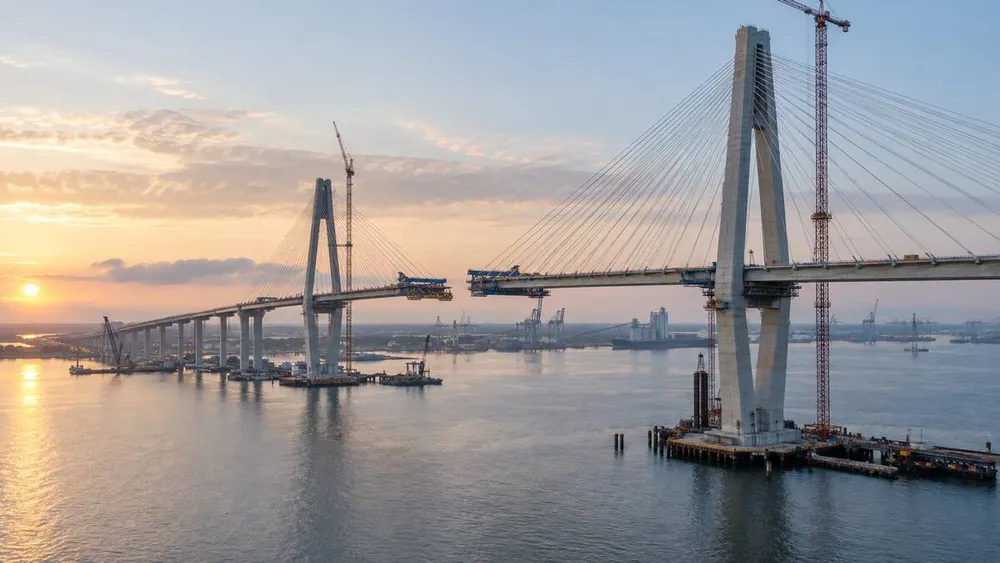
Alabama’s long-planned Mobile River Bridge and Bayway project has secured a federal loan of up to $2.52 billion, supplying the final major financing piece for a first phase that state officials expect to begin building before the end of 2026.
The U.S. Department of Transportation announced the loan September 18 through its Transportation Infrastructure Finance and Innovation Act program. The Alabama Toll Road, Bridge and Tunnel Authority will receive the financing, while the Alabama Department of Transportation will build and manage the project.
The revised first phase centers on a new six-lane, cable-stayed bridge over the Mobile River. It also includes interchange and traffic-flow work in Mobile and Baldwin counties, reconstruction of about one mile of the existing Bayway and restriping the entire 7.5-mile Bayway from two lanes to three in each direction. Federal officials said the changes could cut travel times by as much as 30 minutes and provide a direct interstate route for hazardous-material trucks that cannot use the George Wallace Tunnel.
What the loan changes
The commitment turns an anticipated financing source into an approved federal credit line. Alabama’s current project fact sheet puts first-phase construction at about $3.2 billion, meaning the federal loan can cover most of the stated construction cost, although it remains debt rather than a grant and must be repaid.
TIFIA loans are designed for large projects that struggle to fit conventional financing. The Build America Bureau says the program offers fixed Treasury-rate financing, flexible amortization and repayment periods of up to 35 years, with longer terms possible in some cases. The exact terms for each borrower are negotiated around project economics and pledged revenues.
The project already has a separate $550 million federal bridge grant. The new loan announcement says the first phase will also improve freight access to the Port of Mobile and expand hurricane-evacuation capacity, two functions that make the corridor more than a local commuting project.
Tolls, free routes and timing
Drivers will not pay project tolls until the new bridge opens, currently projected around 2031. ALDOT’s published toll framework lists a $60 unlimited monthly commuter pass, a $3 per-trip ALGO Pass rate and a $7.70 rate for compatible transponders. Pay-by-plate users would be able to open an ALGO account and receive the lower rate.
The causeway, Wallace Tunnel, Bankhead Tunnel and Africatown Bridge are slated to remain toll-free. That distinction matters because the new bridge is intended to add a faster paid option, not remove existing free crossings.
The full Bayway replacement remains a second phase. Under the revised plan, the state will initially restripe the existing structure and build a replacement later, using toll revenue under the same rate framework. Construction inflation and geotechnical problems made simultaneous delivery of both the bridge and a new Bayway financially unworkable, according to the state project documents.
The loan does not eliminate construction, engineering or revenue risk. It does, however, move the largest transportation project in state history from a financing plan toward an executable construction program, with the next public milestones likely to be final loan closing, contract activity and a groundbreaking schedule.