Missouri is directing $10 million in state grants to 350 local governments and one school district that qualified for its 2026 Blue Shield public-safety program, giving each approved jurisdiction up to $29,070 for law-enforcement equipment or training. The award package announced by Gov. Mike Kehoe on Sept. 14 reaches 95 counties, 252 cities, two towns and one school district.
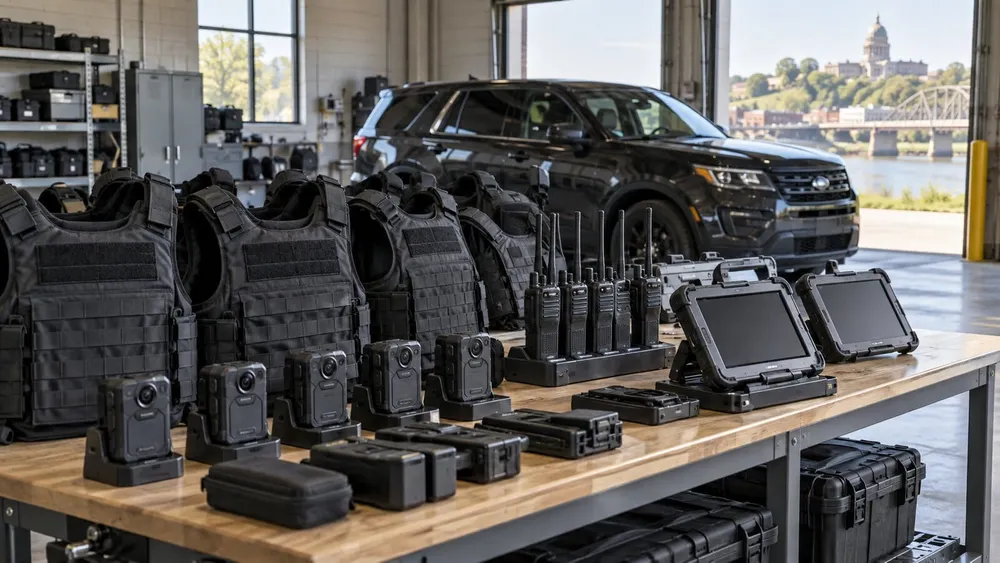
The money is being divided equally rather than allocated by population or agency size. The administration said the approved purchases include 351 mobile data terminals, 232 body cameras, 313 ballistic vests, 170 interoperable radios, 81 vehicles and 23 utility-terrain vehicles. Those totals reflect what communities requested; the state release did not provide a jurisdiction-by-jurisdiction dollar ledger.
For local agencies, the practical consequence is a relatively small but flexible equipment award. A grant of roughly $29,000 can cover a limited fleet of body-worn cameras or radios, contribute toward a vehicle, or support specialized training. Communities were notified of their awards by the Missouri Department of Public Safety in the week before the public announcement, according to the governor’s office.
Participation rose, while grants per community fell
The program expanded sharply in its second year. Missouri reported 350 approved jurisdictions for 2026, up 74% from 201 in 2025. Because the statewide pool remained $10 million, the equal share fell from the $50,000 available to each approved community last year to $29,070 this year. The state’s 2025 program summary said last year’s grants could support ballistic vests, body cameras, surveillance systems, gunshot-detection technology and crime-analysis software.
The Department of Public Safety began designating this year’s participants in February, initially naming 15 repeat communities. Its Feb. 20 program notice said 2025 awards funded 388 mobile data terminals, 351 body cameras, 151 license-plate readers, 102 ballistic vests, 91 interoperable radios and 56 vehicles. DPS administers the program and requires approved communities to maintain their commitments through annual reporting.
Qualification requires more than an application
To receive the designation, jurisdictions had to document public-safety commitments such as a local resolution aimed at reducing violent crime, increased public-safety investment, community-policing partnerships, recruitment or retention programs, participation in regional anti-crime task forces, or measurable crime-reduction efforts. They also had to comply with Missouri crime-reporting and traffic-stop-data requirements and secure the designation by June 1.
The criteria mean the grants are not a general allocation to every police or sheriff’s department. They reward jurisdictions that met the administration’s specified policy and reporting conditions. State officials describe the program as support for smaller agencies with limited purchasing capacity, but the materials released with the awards do not include independent outcome measures tying the designation or equipment purchases to changes in crime. The immediate, verifiable result is narrower: 350 approved jurisdictions now have state-backed purchasing authority for a defined set of equipment and training costs.