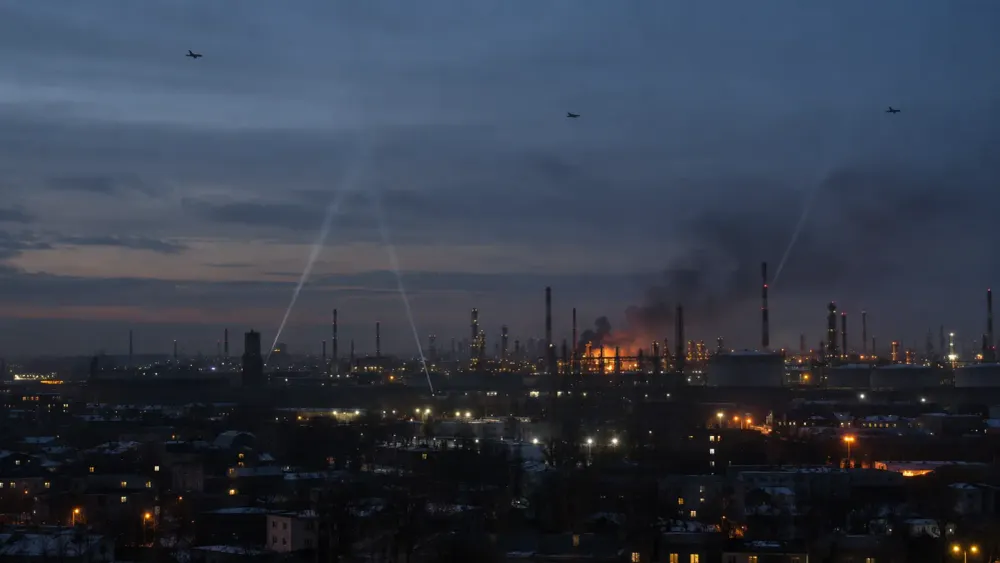
Russian authorities said they destroyed 1,110 Ukrainian drones across Russia, occupied Crimea and the Black Sea overnight Sunday, including 450 headed toward Moscow, in what the capital’s mayor called the largest drone attack the city has faced during the war. At least two people were killed and 20 wounded in the wider Moscow region, while drones damaged the Moscow Oil Refinery and residential property.
The scale remains difficult to verify independently. The figures came from Russia’s Defense Ministry and Moscow Mayor Sergei Sobyanin, whose Telegram channel said more than 1,600 drones had been downed since Saturday. The different totals appear to cover different periods, and neither government released evidence sufficient to confirm every launch or interception.
Even with that uncertainty, physical damage and casualties were documented across the region. Reuters reported that its witnesses heard blasts and saw smoke rising from the refinery, while regional officials said 400 residents, including 70 children, were evacuated from a 21-story apartment building in Ramenskoye.
A Strike Designed to Overwhelm
The reported numbers matter because mass attacks can force air defenses to divide attention among many low-cost targets. Drones traveling on different routes and at different altitudes can compel defenders to expend interceptors, deploy electronic warfare and accept that some aircraft may get through. The AP reported that the assault involved more than 1,000 drones nationwide, while Moscow officials said several reached the refinery and one struck an apartment building.
Ukraine’s own account indicates a mixed weapons package rather than a drone-only raid. President Volodymyr Zelenskyy said in an official post that domestically produced drones, Flamingo cruise missiles and Pelican ballistic missiles were used against oil and logistics facilities. He did not identify every target or provide a launch total, leaving Russian claims about the size of the attack uncorroborated.
Oil Infrastructure Remains Central
The Moscow refinery is strategically important because it supplies fuel to Russia’s largest metropolitan area. The plant processed 11.6 million metric tons of crude in 2024 and produced 2.9 million tons of gasoline and 3.2 million tons of diesel, according to data cited by Reuters. Sobyanin confirmed damage to a facility on the refinery grounds but did not specify the affected unit or the duration of any outage.
That distinction is important. Smoke and structural damage do not by themselves establish a lasting reduction in output, and refinery operators can sometimes isolate damaged equipment. Still, repeated Ukrainian strikes have reduced Russian refining capacity in recent months, contributing to regional shortages, higher fuel prices and long lines at filling stations. Ukraine’s strategy is to raise the cost of the war by disrupting the industry that supplies both military operations and domestic consumers.
Ukraine Expands Its Domestic Arsenal
The acknowledged use of both cruise and ballistic missiles may be more consequential than the raw drone count. The Guardian reported that the Pelican has an estimated range of roughly 350 kilometers, too short to reach Moscow directly, suggesting it was used elsewhere in the broader operation. The Flamingo has longer range, and images circulated online purportedly showing its debris in the Moscow region, although those images were not independently verified.
Ballistic missiles are harder to intercept than cruise missiles or drones because they descend at far higher speeds. Ukraine long depended heavily on foreign-supplied long-range weapons and faced restrictions on their use inside Russia. A larger domestically produced arsenal gives Kyiv more operational freedom, but Sunday’s attack does not establish how many of the new missiles Ukraine can manufacture or whether they can consistently penetrate Russian defenses.
An Election-Day Offensive
The barrage coincided with the final day of Russia’s parliamentary election, the first since the full-scale invasion began in 2022. Voting also took place in Ukrainian territory occupied and claimed by Moscow, a process Kyiv rejects as illegal. Sobyanin said the attack was intended to disrupt the vote, but he offered no evidence for that motive, and Ukraine framed the operation primarily as an attack on war-supporting infrastructure.
The timing nonetheless gave the strike political weight. It brought the war visibly to the capital as the Kremlin sought to demonstrate stability and support for its policies. The election offered little organized opposition: antiwar candidates were largely excluded, and the governing United Russia party was expected to retain control.
Civilian Harm Cuts Both Ways
The attack killed a 74-year-old man and a 44-year-old woman in separate locations, according to Moscow regional officials. Both Russia and Ukraine say they do not target civilians, but long-range attacks routinely produce civilian deaths through direct hits, falling debris and failed interceptions. The casualty count may still change as damaged buildings are searched.
Russian strikes also killed civilians in Ukraine over the same period. A drone attack in the Kyiv region killed a mother and three children, and another strike on a monastery in the Kherson region killed a clergy member, according to Ukrainian officials cited by the AP. Those deaths do not lessen the harm in Moscow; together, they show how the expanding aerial campaign is distributing risk far beyond the front line.
What the Attack Establishes
Sunday’s operation demonstrates that Ukraine can coordinate a large, mixed long-range attack and reach sensitive infrastructure around Moscow despite dense defenses. It does not prove that every reported drone was launched, that every Russian interception occurred or that the refinery suffered a sustained production loss. Those questions require satellite imagery, operating data and more detailed official disclosures.
The clearest change is strategic: Kyiv is combining mass-produced drones with domestically developed missiles to pressure Russia’s energy system and population centers. Moscow will now have to decide whether to disperse more air defenses around the capital and refineries, leaving other regions thinner, or accept continued penetrations. The next measurable test will be the refinery’s operating status and whether similarly scaled attacks can be repeated.