WASHINGTON — President Donald Trump said Sunday that the 250-foot triumphal arch he wants built near Arlington National Cemetery would double as a military complex capable of hosting drones and snipers and storing ammunition. The announcement adds an operational defense mission to a project that federal agencies have so far presented publicly as a commemorative monument and visitor destination.
Trump said in a social-media post that he agreed to the change at the “strong request” of the military. A Reuters report published Sunday said he did not identify a specific threat and that neither the White House nor the Defense Department immediately responded to requests for comment. The gap between the president’s statement and the public planning record leaves basic questions about mission, design, authority and cost unanswered.
A new mission not shown in federal plans
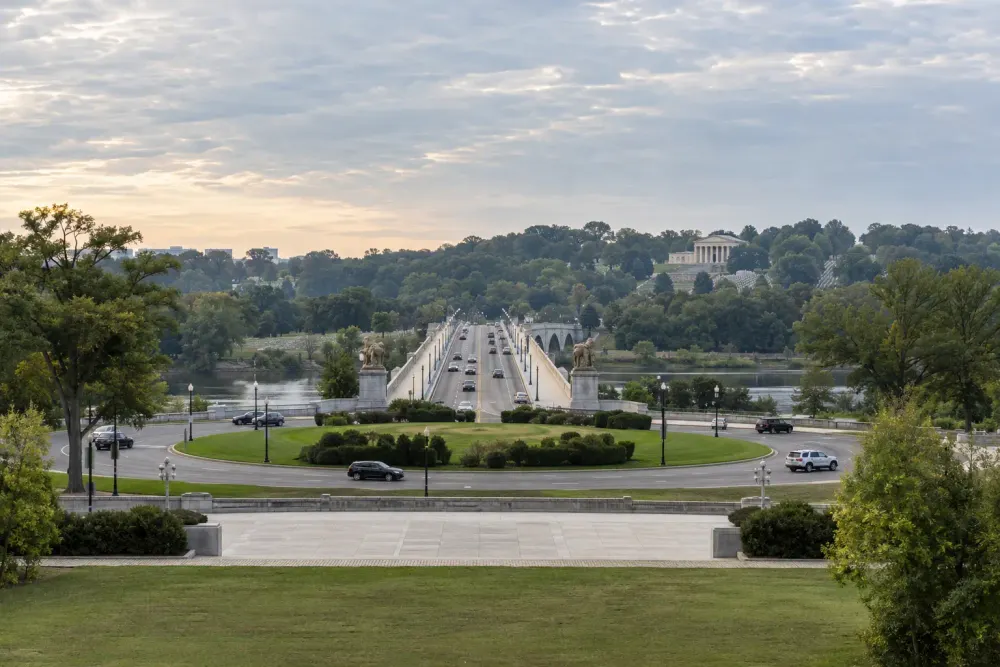
The new description is significant because the existing plans portray the structure as a civic monument with public-facing uses. The Park Service says the arch would commemorate the nation’s 250th anniversary and sit inside Memorial Circle, at the western end of Arlington Memorial Bridge. Its stated purpose is to honor founding principles and reinforce the corridor’s role as a ceremonial gateway to Arlington National Cemetery.
The most detailed public floor plans also describe a visitor attraction, not a military installation. Commission minutes from May show ticketing and security on the ground floor, possible café, gift-shop and exhibit space above, an observation deck, and offices and support rooms for National Park Service staff. They do not describe drone operations, sniper positions or ammunition storage.
That means Trump’s statement should be understood as a newly announced policy direction, not evidence that a revised military design has already passed review. No updated drawings, operating plan or agency decision reflecting the military use were publicly available Sunday morning.
The arch has preliminary, not final, approval
The proposed location is Memorial Circle on Columbia Island, within the George Washington Memorial Parkway. The 300-foot-wide landscaped circle lies on the ceremonial axis connecting the Lincoln Memorial, Arlington Memorial Bridge and Arlington House. The planned arch would rise 250 feet including rooftop statuary, more than twice the Lincoln Memorial’s height.
The National Capital Planning Commission approved preliminary site and building plans in July, but attached comments that must be addressed before final review. Its project record says the Interior Department submitted the proposal and describes the structure as a monument celebrating national achievement. The commission is expected to revisit the project this fall.
The Associated Press reported Sunday that a September groundbreaking had been contemplated, but final planning approval has not been issued. The Commission of Fine Arts previously approved the concept, which is one step in a broader federal review process rather than permission by itself to begin construction.
Security claims remain uncorroborated
Trump’s post supplied the first public outline of the proposed military function: space for rapid drone use, sniper positions on the roof and plaza, and storage for sniper ammunition. It did not identify a service branch, command structure, staffing level, defensive scenario or legal authority for operating weapons from the site. It also did not say whether the public observation areas would remain in the project.
Those omissions matter because placing an armed military mission inside a public monument would create questions different from those considered in the architectural reviews. Ammunition storage, drone launch capability and armed positions would require agencies to address access controls, public safety, airspace coordination and compatibility with an active visitor site. Without revised documents, it is not possible to determine whether the proposal is intended as a permanent operational installation, a contingency capability or a concept that may still change.
Historic concerns could grow
The arch already faces opposition over its scale, legal basis and effect on a nationally significant landscape. At the May fine-arts meeting, officials said they had received roughly 600 additional public comments and that about 99.5 percent opposed the project. The most common concern was the sightline between the Lincoln Memorial and Arlington National Cemetery. Supporters argued that a monumental gateway would complete a long-discussed design idea and appropriately mark the anniversary.
Three veterans and an architectural historian have also sued to block the project, arguing that congressional authorization is required, according to the Associated Press. The administration has continued to advance the design while that legal challenge proceeds. The newly announced military purpose may become part of the policy debate, but it does not resolve the underlying dispute over who can authorize construction on federal parkland.
What the administration must explain next
The immediate test is whether the administration converts Trump’s announcement into a formal federal submission. Revised plans would need to reconcile the military functions with the publicly reviewed visitor program and explain any changes to circulation, emergency access, structural requirements and security boundaries. Agencies would also need to disclose a funding source and clarify whether environmental and historic-preservation reviews must be updated.
For now, the record supports two conclusions. The arch remains a proposal with preliminary approvals, not a completed or fully authorized project. And its newly declared military mission exists in the president’s statement but not yet in the federal plans available to the public. Until those two tracks are aligned, the operational scope, cost and approval path remain uncertain.