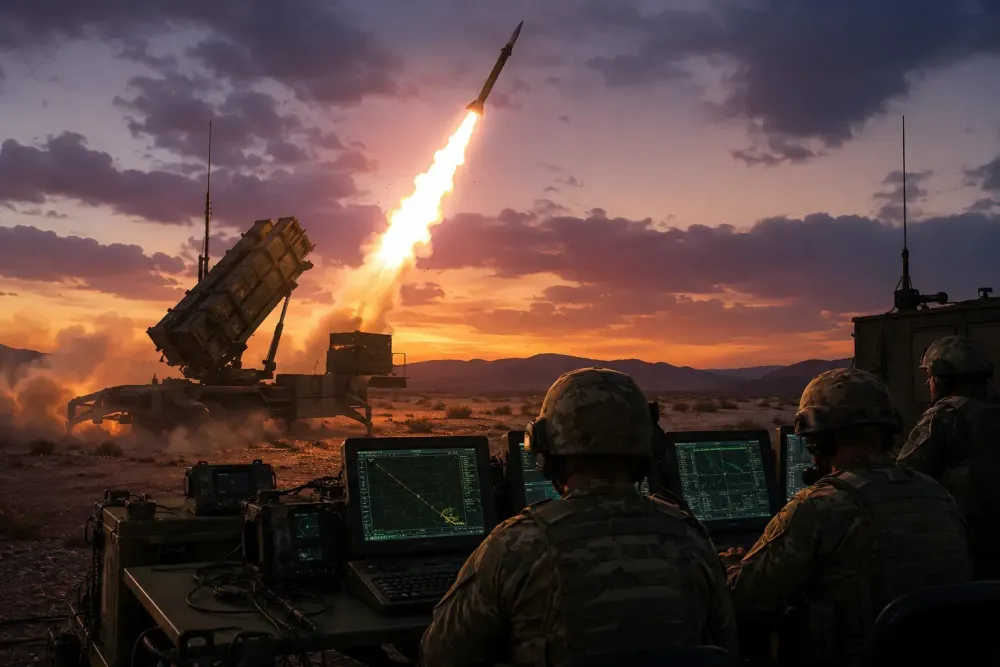
The Pentagon is pursuing what Secretary of War Pete Hegseth called a "2X, 3X, 4X" increase in production of critical war munitions even as independent analysis estimates that several missile inventories heavily used in the Iran war will require at least three years to return to prewar levels. Speaking in Wisconsin on August 24, Hegseth said the production drive would continue even if Congress does not approve the administration's full $1.5 trillion fiscal 2027 defense request, arguing that multiyear agreements already give contractors reason to expand factories and supply chains.
The statement comes after months of increasingly public concern about missile inventories. The United States has used large quantities of Patriot, Terminal High Altitude Area Defense, Tomahawk and long-range Army missiles during the Iran conflict while continuing to meet commitments elsewhere. Reuters reported earlier in August, citing people familiar with inventory data, that the Army had used "virtually all" of some long-range precision missile stocks, particularly ATACMS and Precision Strike Missiles. The Pentagon has disputed broader suggestions that the military lacks the munitions required for current operations.
The gap between those positions is partly a matter of time horizon. Having enough weapons to continue an existing operation is not the same as having enough reserve depth for another major war. The most consequential issue is therefore not whether the United States is literally out of missiles, but whether current inventories, production rates and replenishment timelines leave less margin for simultaneous contingencies.
The production target is unusually large because the drawdown was unusually large
Hegseth used his August 24 stop at Oshkosh Corp. to frame the problem as an industrial-base challenge. The War Department's account said the administration wants stable, long-term demand signals so manufacturers can invest in plants, equipment and workers rather than treating each procurement increase as temporary.
That approach reflects a basic feature of weapons manufacturing. A missile production line cannot multiply output immediately merely because Congress appropriates more money. Rocket motors, seekers, guidance electronics, energetic materials, castings and specialized machine tools come from supply chains that may have only one or two qualified sources. Building a second source requires capital, engineering work, testing and certification before it produces usable hardware.
The Pentagon has already begun converting higher demand into contracts. In early August, it announced a framework designed to triple production capacity for Patriot PAC-3 components and quadruple capacity for THAAD interceptor components. Reuters reported that the agreement with Lockheed Martin and Northrop Grumman also seeks a second source for PAC-3 rocket motors and higher production of other critical components.
Those are capacity commitments, not immediate deliveries. The distinction is essential. A factory able to produce four times as many components several years from now does not retroactively refill launchers today, and announced industrial capacity should not be treated as equivalent to delivered missiles.
Independent estimates show the binding constraint is time
The Center for Strategic and International Studies has modeled replacement times using public inventory estimates and planned deliveries. Its analysis concluded that Tomahawk, THAAD and Patriot inventories would take three years or more to return to prewar levels under then-current delivery plans. Standard Missile inventories could take around two years, while JASSM and Precision Strike Missile stocks could recover more quickly.
CSIS updated its assessment after fighting resumed. A July estimate put Patriot inventory below 1,000 interceptors and THAAD inventory near 250. The organization said the remaining stocks were still sufficient for plausible Iran scenarios but warned that depleted reserves could create greater risk in a separate conflict, particularly in the western Pacific.
Those figures are estimates, not official inventory disclosures. The Pentagon does not publicly release detailed current stockpile numbers for many high-end munitions, which means outside analysts reconstruct inventories from procurement records, reported expenditures and delivery schedules. The uncertainty should limit precision, but it does not eliminate the underlying industrial problem: replacing complex missiles takes years.
A separate CSIS assessment estimated that the United States had used about half of the prewar inventory of Patriot, THAAD and PrSM and roughly one-third of several other major munitions. The authors emphasized that shortages predated the Iran war because U.S. requirements had already expanded through support for Ukraine and planning for a possible Indo-Pacific conflict.
Missile defense has fewer substitutes than strike weapons
Not all depleted weapons create the same operational risk. A military can sometimes replace one strike weapon with another by accepting changes in range, aircraft exposure or target effect. Missile defense is less flexible.
Patriot and THAAD are designed to intercept ballistic missiles, a mission for which alternatives are limited. Naval Standard Missiles can provide some overlapping capability, but ships must be positioned within range and cannot substitute for every land-based defensive requirement. That makes interceptor inventories especially important when the United States is protecting bases, allies and deployed forces from ballistic attack.
CSIS estimated in April that four of seven critical munitions examined may have lost more than half their prewar inventory during the first phase of the Iran conflict. Its report concluded that the United States retained enough for plausible continuation of the war but faced a multiyear rebuilding burden and competition among U.S. requirements, Ukraine and other allies seeking the same weapons.
This is where Hegseth's production push becomes strategically relevant. Increasing output threefold or fourfold would reduce future replacement time and create deeper steady-state inventories, but only after the new capacity is operating. During the transition, planners must manage existing stocks more carefully.
That can affect how commanders choose targets and which incoming threats they intercept. Scarcity does not necessarily mean missions stop; it can mean decision thresholds change because every missile fired has a larger opportunity cost.
Congress can provide money faster than industry can provide missiles
The administration has requested a $1.5 trillion defense budget for fiscal 2027 and large additional sums for munitions. Hegseth said in Wisconsin that the Pentagon would protect weapons-production priorities even if lawmakers ultimately approve a lower topline. His claim is credible in the narrow sense that the department can prioritize within an enacted budget, but congressional funding still determines how much capacity can be contracted and sustained.
Congress has increasingly favored multiyear procurement for selected munitions because long-term contracts give manufacturers confidence that expanded facilities will have orders after the immediate crisis passes. That matters because a contractor is unlikely to build a new production line if it expects wartime demand to disappear before the investment is recovered.
Money cannot eliminate manufacturing lead times, however. Task & Purpose reported expert estimates that Patriot and THAAD contract-to-delivery cycles can extend well beyond three years and noted that many production expansions now being financed will themselves take three to seven years to reach full effect. Those estimates vary by component and contract structure, but they reinforce the same mechanism identified by the Pentagon: the bottleneck is industrial capacity, not simply procurement authority.
The current effort is therefore best understood as an attempt to alter the future production curve. It can accelerate deliveries, create alternate suppliers and reduce vulnerability to a single failed component source. It cannot produce an instant inventory reset.
The readiness question is about simultaneous wars
Pentagon officials are correct that a depleted stockpile is not synonymous with an incapable military. The United States retains large inventories across many weapon categories, can change tactics and can prioritize munitions by theater. Outside estimates also generally conclude that enough weapons remain for current Iran operations.
Critics are asking a different question: what happens if the United States must sustain another high-intensity conflict before inventories are rebuilt? A western Pacific war would rely heavily on long-range strike weapons and missile defense, several of the same categories being consumed in the Middle East. The strategic cost of depletion is therefore measured in reduced options and higher risk rather than an immediate inability to fight.
The August 24 production pledge addresses the correct mechanism. If the problem is that years of relatively low peacetime orders left factories too small for wartime consumption, multiyear demand and multiple-source production are logical responses. The unresolved issue is timing.
A 2X-to-4X production goal sounds like a rapid solution, but the evidence shows why it is better understood as a multiyear industrial program. Patriot, THAAD and Tomahawk inventories can remain below prior levels for years even while new contracts are signed and factories expand. The Pentagon's challenge is to sustain present operations, preserve enough reserve for other contingencies and build industrial capacity quickly enough that the gap closes before another major demand shock arrives.