North Korea fired multiple ballistic missiles of different types from near Pyongyang on Monday morning, creating a live test for the allied sensor network that tracks launches across Northeast Asia. South Korea’s military said one weapon traveled more than 900 kilometers before falling into the sea, while Japan detected at least two launches separated by about 17 minutes. No damage was reported, but the sequence underscored why missile warning depends on rapid coordination among South Korea, Japan and the United States.
A varied launch sequence
The launches began at about 9:20 a.m. local time, according to Reuters, which cited South Korea’s Joint Chiefs of Staff. Seoul said the weapons appeared to be of different types and assessed the event as a possible show of force after South Korea’s recent hypersonic-missile test. Japan said the projectiles fell outside its exclusive economic zone.
Japan’s defense ministry offered a broader measure of the pace. A deputy minister said North Korea has conducted 11 launch events involving at least 18 ballistic missiles or similar projectiles this year, including Monday’s launches. That is already more than twice the number of launch events and roughly three times the number of projectiles recorded last year, according to the ministry’s briefing.
The exact number and type of missiles remained under analysis. That uncertainty is operationally important. A mixed salvo can force surveillance systems to distinguish trajectories, speeds and possible targets quickly, but the public information does not establish that any missile defeated an allied sensor or interceptor. Reports that a weapon displayed hypersonic characteristics describe its flight behavior; they do not by themselves prove a specific sustained speed, maneuver profile or ability to penetrate defenses.
Tracking is a three-country task
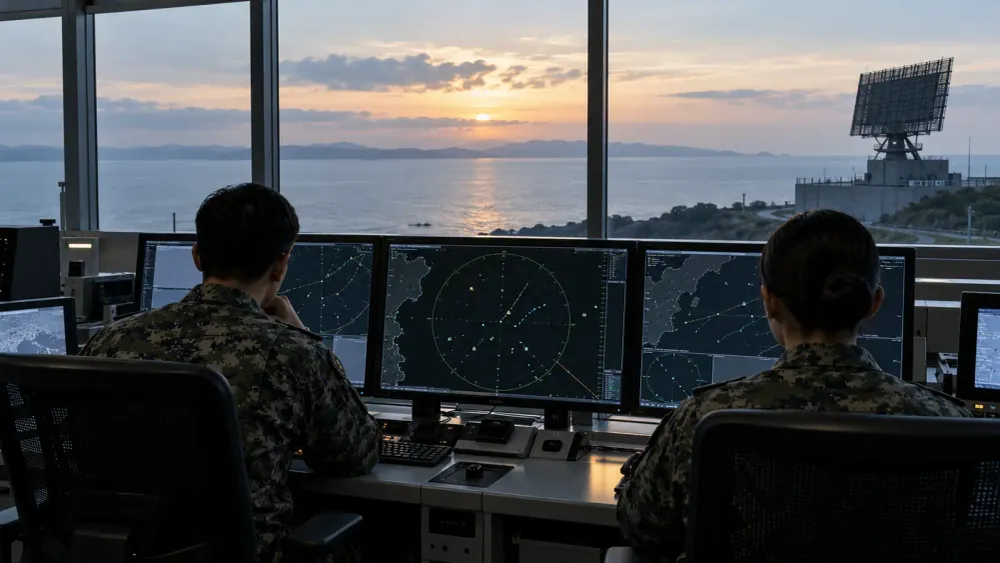
South Korean and Japanese sensors observe the peninsula from different locations, while U.S. space, sea and land systems add warning and analysis. That geographic spread can improve coverage, especially when a missile follows a low, maneuvering or otherwise unusual path. It also makes secure data exchange and common classification procedures as important as the radar hardware itself.
South Korea’s defense plan calls for expanded surveillance, a multilayered missile-defense system and a strategic command as part of its response to North Korean nuclear and missile threats. The official framework describes an “intelligent” three-part defense structure that combines detection, interception and options against launch infrastructure. The document is a statement of intent, not proof that every layer can defeat every weapon.
Monday’s sequence therefore provides data as well as risk. Analysts can compare what separate sensors saw, reconcile estimated launch and impact points, and test how quickly warnings moved between governments. Those lessons can reveal blind spots without requiring an attempted interception. They can also reduce the chance that conflicting early reports produce an unnecessary escalation.
A regional missile competition
The launch came days after South Korean President Lee Jae Myung oversaw a public test of a domestically developed hypersonic missile. That test emphasized speed, maneuverability and technological independence, according to separate reporting. Seoul presented the weapon as a deterrent; Pyongyang has portrayed allied exercises and weapons development as threats used to justify its own arsenal.
That action-and-response pattern does not mean the systems are equivalent or that every test is directly caused by the one before it. North Korea’s program includes short-, intermediate- and longer-range weapons built around nuclear deterrence and coercion. South Korea’s program is embedded in an alliance with the United States and is publicly framed around defense against the North. Still, repeated demonstrations on both sides shorten political reaction time and increase the importance of disciplined military communication.
The legal line remains clear
North Korea’s ballistic-missile activity is prohibited by multiple U.N. Security Council measures. Resolution 1718 requires Pyongyang to suspend its ballistic-missile program and not conduct further launches. The original resolution, adopted in 2006 after North Korea’s first nuclear test, also created the sanctions framework that later resolutions expanded.
South Korea condemned Monday’s launches as violations of those obligations, and Japan lodged a protest. Enforcement has weakened as the Security Council’s major powers have split over additional sanctions, but the underlying restrictions remain in force. A stalled diplomatic process likewise does not change the military requirement to maintain warning systems while avoiding claims that preliminary flight data cannot support.
What the launch does and does not show
Monday’s event demonstrates that North Korea can keep producing varied launch sequences at a rising tempo. Fresh reporting placed it within a month of repeated demonstrations and a prolonged freeze in nuclear diplomacy. It does not show that war is imminent, that a tested weapon is operationally reliable, or that allied defenses would succeed or fail in combat.
The immediate military task is narrower: identify what flew, compare the three countries’ tracking records and adjust warning procedures if the data expose gaps. The strategic task is harder. Washington, Seoul and Tokyo must preserve deterrence and readiness without allowing every test to become a step in an uncontrolled cycle. Accurate classification, shared data and measured public statements are central to both goals.