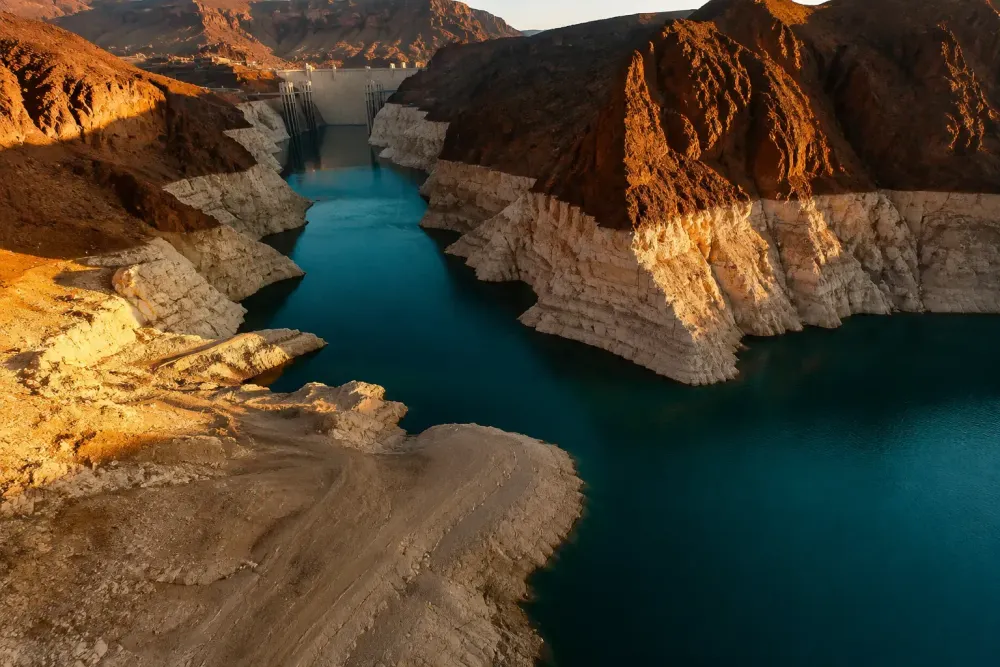
Lake Mead dropped to approximately 1,040 feet above sea level in early August 2026, according to Time, placing the nation's largest reservoir within striking distance of levels that would functionally shut down most of Hoover Dam's power-generating capacity, a threshold that carries direct consequences for millions of utility customers across Nevada, Arizona, and California.
That single elevation figure sits at the center of what The American Quorum has tracked across multiple federal and regional reporting streams this summer: a convergence of prolonged drought, rising demand, and aging infrastructure that has brought the Colorado River system to a structural inflection point. The story of Lake Mead's 1,040-Foot Plunge Signals an Imminent Hydropower Crisis for the American West is not a future-tense warning; it is a present-tense operational emergency unfolding in real time.
Key Takeaways
- Lake Mead reached roughly 1,040 feet above sea level in August 2026, near record-low territory and dangerously close to the elevation at which Hoover Dam loses most of its turbine capacity.
- Hoover Dam currently generates about 4 billion kilowatt-hours of electricity per year, power that is contractually allocated to Nevada, Arizona, and California, and that output falls sharply as water elevation drops.
- Rural Nevada counties face disproportionate exposure because they lack the grid redundancy available to larger metropolitan markets.
- The Bureau of Reclamation's post-2026 operational framework is under active environmental review, with multiple competing proposals for flow management and shortage-sharing.
- Boulder City, Nevada has already moved to block a new data center from connecting to the local grid, citing Hoover Dam power constraints as a direct factor.
How Hoover Dam's Output Collapses With Elevation
Hoover Dam's hydropower generation is not a binary switch; it declines along a curve directly tied to water pressure, which is itself a function of reservoir elevation. At full pool (1,229 feet), the dam's 17 turbines can produce up to 2,080 megawatts. As the lake drops, the hydraulic head, the vertical distance water falls before reaching the turbines, shrinks, and generating capacity falls with it.
According to Circle of Blue, the dam approaches what engineers call a "hydropower cliff" below 1,050 feet, at which point several turbine intakes are no longer submerged deep enough to operate reliably. The vozpopuli analysis is more specific: at approximately 1,040 feet, the reservoir sits within ten feet of shutting down most of the dam's turbines, and critically, that power "does not come back quickly" once lost, because refilling the reservoir to operational levels requires years of above-average snowpack in the Rocky Mountain headwaters.
The Bureau of Reclamation's own technical appendices, published as part of its post-2026 operational framework, model multiple shortage scenarios and their corresponding power output reductions, confirming that the relationship between elevation and generation is non-linear; losses accelerate as the lake approaches the 1,040-foot mark.
The Communities Most Exposed to a Hoover Dam Power Shortfall
Hoover Dam's electricity is not sold on the open market. It flows through long-term federal contracts to specific utilities and government entities in three states, with the Southern Nevada Water Authority, the cities of Los Angeles and Boulder City, and Arizona utilities among the primary contract holders. That contractual structure means shortfalls cannot simply be offset by purchasing replacement power at the same price; substitute generation, typically from natural gas peakers or interstate grid purchases, costs significantly more.
Rural Nevada counties face the sharpest exposure, according to Nevada Current. Unlike Las Vegas, which has diversified grid connections and municipal reserves, smaller communities in Clark, Mohave, and adjacent counties have fewer alternative supply pathways. A sustained reduction in Hoover Dam output translates more directly into rate increases and, in stress scenarios, reliability risks for those customers.
The tension has already materialized at the local planning level. Boulder City, which sits immediately downstream from Hoover Dam and holds its own federal power allocation, voted in mid-July 2026 to oppose a proposed data center development, citing the facility's power demands against a backdrop of declining hydroelectric supply, according to Fox5 Vegas. That decision reflects a broader tension playing out across the American West, where AI infrastructure buildout and data center expansion are colliding with constrained power supply at exactly the moment grid resilience is most at risk.
Lake Mead's 1,040-Foot Plunge and the Structural Drivers Behind It
The reservoir's current elevation is the product of two decades of demand exceeding supply on the Colorado River. The river is legally over-allocated; the 1922 Colorado River Compact divided water rights based on flow estimates that subsequent decades have shown were optimistic; and climate-driven aridification has reduced average annual flow by roughly 20 percent compared to 20th-century baselines, according to CNN.
Lake Mead and Lake Powell together form a two-reservoir buffer system. When Powell, upstream in Utah and Arizona, drops, less water reaches Mead. Both reservoirs have been in simultaneous decline, according to ABC News, compressing the system's operational flexibility. Real-time elevation data tracked by West Water Watch shows the lake has spent most of 2026 oscillating near its lowest recorded levels, with only modest recovery from spring snowmelt.
Experts quoted by San Diego Union-Tribune caution that individual elevation benchmarks require context: a single record low in a wet year followed by recovery tells a different story than a sustained multi-year trough. The current situation falls into the latter category; the reservoir has remained at critically low elevations for the better part of four years, and the 2026 reading represents the continuation of a structural deficit rather than an anomalous spike.
The Bureau of Reclamation's post-2026 draft environmental impact statement is evaluating operational alternatives ranging from accelerated demand-reduction agreements among the seven Colorado River Basin states to modified release schedules designed to protect minimum power pool elevations. No final rule has been issued as of August 2026.
What the Hydropower Cliff Means for Western Energy Policy
The immediate policy question is replacement cost. Hoover Dam's contracted power is priced at rates set decades ago under federal cost-recovery formulas, making it among the cheapest electricity available to its contract holders. Market replacement power, particularly during peak summer demand in the desert Southwest, can cost four to ten times as much per megawatt-hour.
State utility commissions in Nevada and Arizona will face pressure to approve rate adjustments if the shortfall deepens. California, which holds a smaller share of Hoover Dam's output relative to its total grid, has more buffer, but its own hydroelectric system in the Sierra Nevada has faced parallel drought stress.
The federal government's role is structural and bipartisan in origin: the over-allocation problem predates any single administration, and the infrastructure at risk, Hoover Dam, the All-American Canal, the Central Arizona Project, was built with federal dollars and operates under federal law. Resolving the crisis requires renegotiation of interstate compacts, updated Bureau of Reclamation operating criteria, and potentially new storage or conveyance infrastructure, all of which require Congressional authorization and multi-state agreement.
Conclusion
The elevation reading at Lake Mead in August 2026 is a measurable, documented threshold, not a projection. At 1,040 feet, the reservoir sits at the edge of a hydropower output collapse that would raise electricity costs, stress rural grids, and force utilities across three states to find replacement generation in an already tight market. The Bureau of Reclamation's post-2026 framework review is the most immediate federal mechanism for response, and its outcome will shape water and power policy in the American West for the next several decades. Policymakers, utility planners, and state regulators who track the Daily Briefing on U.S. infrastructure should monitor the Bureau's final rule timeline, the seven-state compact renegotiation process, and Lake Mead's elevation data through the fall drawdown season. The next six months will determine whether the system stabilizes or crosses into the turbine-shutdown zone with no near-term recovery path.
Tags: Lake Mead, Hoover Dam, hydropower crisis, Colorado River, water shortage, Western drought, Bureau of Reclamation, energy policy, Nevada power grid, drought infrastructure, reservoir levels, American West water