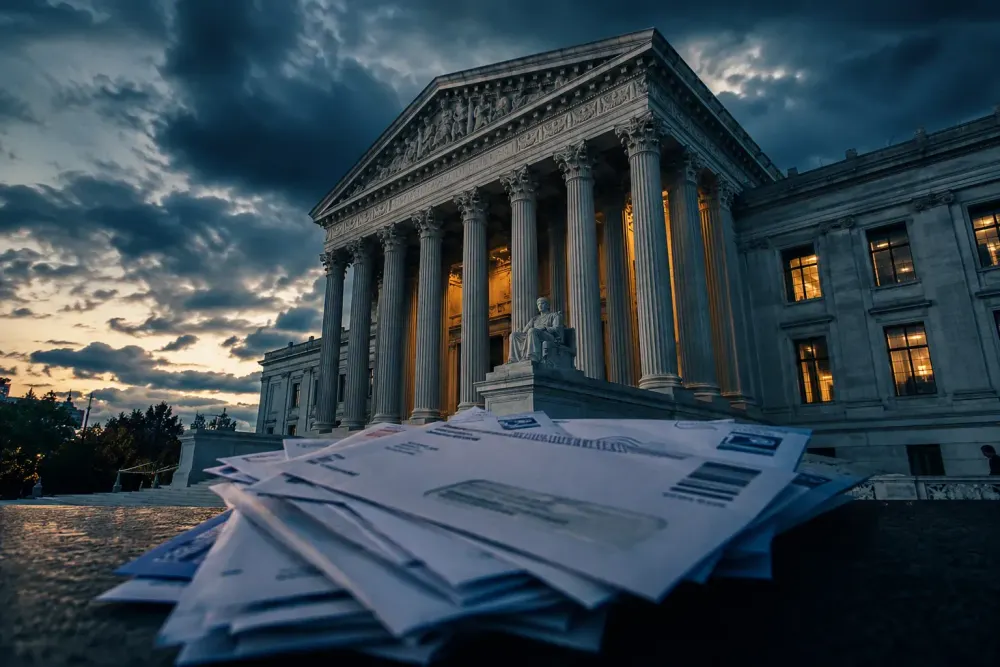
Across the 2020 and 2022 federal election cycles, more than 46 million Americans cast ballots by mail, according to the U.S. Election Assistance Commission, a volume that transformed mail-in voting from a niche accommodation into a structural pillar of American electoral participation, and a persistent flashpoint in the constitutional struggle between the executive and judicial branches over who controls the rules governing that participation.
The American Quorum's Politics Daily Briefing examines a defining tension in U.S. election law: the federal judiciary's repeated intervention to block executive branch directives that courts have found exceed statutory or constitutional authority over mail-in voting procedures. These rulings do not favor one party's electoral interests over another's. They trace to a structural argument that Congress, not the White House or executive agencies, holds primary authority over federal election administration and that the courts exist to enforce that boundary.
Key Takeaways
- Federal courts have consistently ruled that executive branch agencies lack unilateral authority to alter mail-in ballot receipt deadlines, signature verification standards, or postal delivery timelines without congressional authorization.
- The legal foundation for judicial intervention rests primarily on the Elections Clause of Article I and the Help America Vote Act of 2002, both of which vest election administration authority in Congress and the states, not the executive.
- Multiple administrations, across both parties, have faced judicial pushback when issuing executive directives that courts determined encroached on legislatively established voting procedures.
- The U.S. Postal Service's operational decisions that affect ballot delivery have been treated by federal courts as subject to judicial review under the Administrative Procedure Act.
- State authority over mail-in voting rules remains constitutionally distinct from federal executive authority, and courts have been careful to preserve that distinction in their rulings.
The Constitutional Architecture Behind Judicial Limits on Executive Power
The Elections Clause of Article I, Section 4 of the U.S. Constitution grants Congress, not the president, the authority to regulate the "times, places, and manner" of federal elections. That textual assignment is the load-bearing wall in every federal court ruling that has blocked the executive branch's attempts to unilaterally reshape mail-in voting procedures.
When the executive branch issues directives, whether through the U.S. Postal Service, the Department of Homeland Security, or executive orders, that alter how mail ballots are processed, received, or counted, courts apply a two-part test: whether the action contradicts existing statutory law, and whether it intrudes on the constitutional domain assigned to Congress. Federal district judges and circuit courts have, with notable consistency, found executive actions in this space wanting on at least one of those grounds.
The Help America Vote Act of 2002 codified specific procedural protections for voters, including requirements for provisional ballots and minimum standards for election administration. Courts have cited HAVA repeatedly as evidence that Congress intended to occupy this regulatory field, leaving executive agencies with implementation duties rather than policymaking discretion.
How the Federal Judiciary Restricts Executive Branch Authority Over Mail-In Voting Procedures Plays Out in Practice
The most litigated flashpoint has been ballot receipt deadlines, specifically, whether the executive branch can instruct postal facilities to prioritize or deprioritize election mail in ways that effectively determine which ballots arrive in time to be counted.
In 2020, U.S. District Judge Emmet Sullivan of the District of Columbia issued an injunction ordering the U.S. Postal Service to reverse operational changes implemented under Postmaster General Louis DeJoy, finding that the changes, which included removing mail-sorting machines and restricting overtime, created a "substantial risk" of disenfranchisement. Sullivan's order, reported by Reuters, required USPS to treat all election mail as first-class regardless of postage paid, a directive the court grounded in the agency's own statutory obligations rather than any partisan preference.
That ruling was not an isolated event. Federal judges in Pennsylvania, Michigan, and Washington issued parallel orders in the same election cycle, each citing the Administrative Procedure Act as the mechanism for reviewing USPS operational decisions that bore on ballot delivery. The APA requires federal agencies to follow notice-and-comment rulemaking before making significant policy changes, a procedural safeguard that USPS had bypassed, according to the courts.
Signature verification standards have generated a separate but related line of litigation. When state election officials sought federal executive guidance that would have imposed uniform rejection thresholds for mismatched signatures on mail ballots, courts blocked implementation, holding that such standards constituted rulemaking authority Congress had not delegated to the executive branch. The Brennan Center for Justice has documented more than a dozen such cases since 2016 in which federal courts drew this line.
The Structural Argument: Why Courts Treat This as Bipartisan Boundary-Setting
A critical and frequently misread dimension of this jurisprudence is that it does not align with partisan electoral interests in any fixed direction. The judicial limits on executive authority over mail-in voting have been applied against actions taken by both Republican and Democratic administrations, and the underlying constitutional principle, separation of powers, is structurally neutral.
Federal judges appointed by presidents of both parties have authored opinions restricting executive reach into election administration. The Ninth Circuit, the D.C. Circuit, and the Third Circuit have each issued rulings that constrain executive discretion in this space, and those rulings cite the same constitutional and statutory foundations regardless of which administration's action is under review.
What the courts are enforcing, as the Congressional Research Service has explained in multiple analyses, is a federalism and separation-of-powers framework in which Congress sets the rules, states administer them within federal minimums, and the executive branch executes, but does not rewrite, the statutory scheme. When executive agencies exceed that execution role, courts treat it as a justiciable injury to the statutory rights of voters and election administrators alike.
This framing matters for how the American Quorum's Politics coverage approaches the issue: the story is not about which party benefits from mail-in voting, but about which branch of government holds lawful authority to govern it.
Federal Judiciary Restricts Executive Branch Authority, Implications for 2026 and Beyond
With midterm elections approaching in November 2026, the legal architecture around mail-in voting remains actively contested. Several pending cases in federal district courts address whether executive agencies can condition mail ballot processing on new identification requirements not authorized by Congress, and whether presidential emergency powers extend to altering election mail protocols during declared national emergencies.
The Supreme Court's 2023 decision in Moore v. Harper, which rejected the "independent state legislature theory," reinforced the principle that state courts, and by extension federal courts, retain authority to review election administration decisions for compliance with existing law. That ruling, covered in depth by SCOTUSblog, strengthened the judicial hand in any future executive attempt to override established mail-in voting procedures.
Election law scholars at institutions including the University of California, Irvine School of Law have noted that the judiciary's posture in this area reflects a deliberate institutional choice: courts have been more willing to issue injunctions in election cases when the harm is irreversible, a cast ballot that cannot be retroactively counted, than in other administrative law contexts where remedies can be applied after the fact.
Conclusion
The federal judiciary's record of restricting executive branch authority over mail-in voting procedures is not a product of ideological alignment; it is a product of constitutional text, statutory construction, and the irreversibility of electoral harm. Readers tracking U.S. election policy in 2026 should watch three specific developments: the resolution of pending APA challenges to executive agency guidance on mail ballot processing, the Supreme Court's treatment of any emergency-powers arguments applied to election administration, and whether Congress moves to codify or modify existing mail-in voting standards before the November 2026 election cycle. Each of those developments will test whether the boundary the courts have drawn holds or requires further judicial reinforcement.
Tags: mail-in voting, federal judiciary, executive branch authority, election administration, separation of powers, Help America Vote Act, U.S. Postal Service, ballot procedures, Elections Clause, voting rights, federal courts, election law