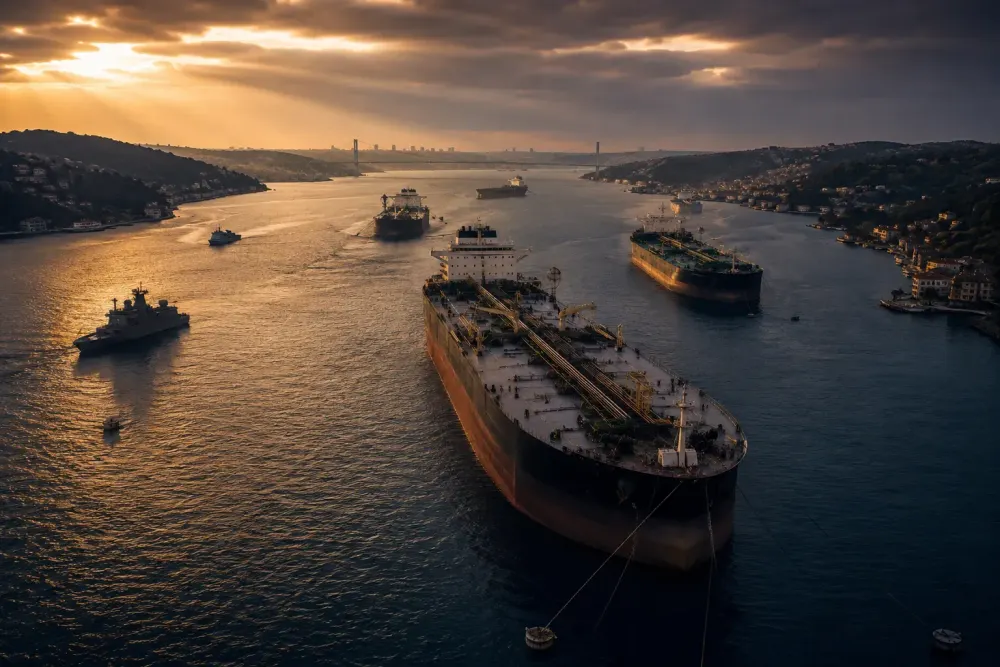
Only 8 commercial vessels transited the Strait of Hormuz on August 8, 2026, roughly 11 percent of the 73 daily transits recorded on a typical pre-crisis day, according to IMF PortWatch data, a figure that captures, in a single number, how thoroughly the world's most critical oil chokepoint has been severed from normal commerce. The story of why the strait remains closed is no longer primarily a military one. As The American Quorum's World Daily Briefing has tracked since the crisis began, the central obstacle as of mid-August 2026 is a collision between two governments' competing financial reparations demands, each conditioning any reopening on the other side paying first.
Key Takeaways
- Iran's Supreme National Security Council has issued six formal conditions for reopening Hormuz, including full compensation for what it calls decades of U.S.-inflicted damage.
- President Trump responded by demanding Iran pay the U.S. for "damage done over a 50-year period," introducing a counter-reparations claim that had not featured in earlier negotiations.
- A June 2026 memorandum of understanding between Trump and Iranian President Pezeshkian briefly eased the blockade but collapsed within weeks after renewed attacks on commercial shipping.
- Iran and Oman have reached the "final stages" of a technical shipping-lane agreement, but political and financial conditions on Washington remain unresolved.
- Commercial vessel counts remain at roughly 6-11 percent of pre-crisis norms, with war-risk insurance effectively barring most operators from attempting a transit.
How a June MOU Collapsed Into August's Deadlock
The current impasse traces directly to a diplomatic agreement that appeared, for a brief window, to have resolved the worst of the crisis. On June 17, 2026, President Trump and Iranian President Masoud Pezeshkian signed a memorandum of understanding declaring the removal of the U.S. naval blockade and establishing Iranian arrangements for safe passage of commercial vessels at no charge for 60 days, with longer-term administration of the strait to be decided alongside Oman and other Gulf states, according to a Congressional Research Service analysis of the legal framework governing the waterway.
That arrangement did not hold. By early August, the U.S. had reimposed its naval blockade following renewed attacks on commercial vessels and Arab states attributed to Iranian-aligned forces. Tehran accused Washington of violating its MOU obligations; Washington cited the resumed attacks as justification. The result, tracked daily by Euro Oil Watch, is a strait that has not meaningfully reopened, with recent weekends recording single-digit commodity vessel counts against a pre-crisis norm of approximately 138 per day.
The Straits Times reported that vessel traffic through Hormuz dwindled sharply in the first week of August as markets watched Iran-Oman talks, with Reuters confirming the sharp reduction in transits as both sides hardened their positions.
Iran's Six Conditions and the Compensation Demand at Their Core
On August 8-9, 2026, Iran's Supreme National Security Council secretary Mohammad Bagher Zolghadr publicly enumerated six conditions for any reopening of Hormuz, according to France 24 and Chosun. The list includes: a permanent end to U.S. threats against Iran; a halt to what Iran characterizes as wars against Lebanon, Palestine, Yemen, and Iraq; lifting of the maritime blockade and withdrawal of U.S. naval and air forces from the region; full financial compensation for damages from "two invasions and imposed wars"; complete removal of all sanctions described as "unjust and illegal"; and the unconditional return of frozen Iranian assets.
The compensation demand, the fourth condition, is the most structurally difficult to satisfy. Iran has not published a dollar figure, but the framing of "two invasions and imposed wars" spanning decades signals a claim that would run into the hundreds of billions by any reasonable accounting. The IRGC has separately declared the strait closed "until further notice" and stated it will not reopen until "the end of America's evils," a formulation that Politico described as a dramatic escalation of Iran's negotiating posture.
Iranian Foreign Minister Abbas Araghchi added a technical dimension to the political demands around August 9-10, stating that Iran and Oman were in the "final stages" of a pact establishing new shipping lanes through the strait, according to the Straits Times. Araghchi stressed, however, that the U.S. must compensate Iran for "widespread attacks," end sanctions and military threats, and remove the naval blockade before Hormuz is fully reopened. The Oman arrangement, in other words, is technically near-complete; the political and financial conditions in Washington are the remaining barrier.
Trump's Counter-Demand Widens the Gap
The dynamic that has most directly derailed what appeared to be an imminent reopening is President Trump's introduction of a U.S. counter-reparations claim. On August 9-10, 2026, Trump stated publicly that the U.S. would demand Iran pay compensation for "damage they've done over a 50-year period," citing deaths of civilian demonstrators and U.S. military personnel in the region, according to Reuters.
This demand had not appeared in earlier rounds of negotiation. Its introduction creates a structural problem: both parties are now conditioning reopening on the other side making a financial payment first, with no agreed mechanism for simultaneous or sequenced settlement. Analysts tracking the Competing Compensation Demands Derail Imminent Reopening of the Strait of Hormuz story note that this kind of mirrored reparations standoff has no recent precedent in international maritime diplomacy; the closest analogous involves post-war settlement processes that took years to resolve.
The gap between the two positions is not merely financial. Iran's conditions include structural changes to U.S. regional military posture, withdrawal of naval and air forces, and permanent non-aggression guarantees that go well beyond any transaction. The U.S. position, as stated, does not acknowledge Iran's six-point framework as a legitimate basis for negotiations.
What Closed Hormuz Means for Global Shipping and Energy Markets
The economic weight of the Strait's closure is measurable. Hormuz carries approximately 20 percent of global oil trade under normal conditions, according to the Wikipedia summary of the 2026 crisis. With transits running at 6-11 percent of pre-crisis norms, as straits.live tracks in real time, the effective disruption to energy supply chains has forced buyers in Asia and Europe to reroute shipments around the Cape of Good Hope, adding roughly 10-14 days of transit time and substantially higher freight costs.
War-risk insurance premiums for vessels attempting a transit through the Strait of Hormuz have made most commercial operators unwilling to attempt it, regardless of the waterway's legal status. The combination of Iranian restrictions, U.S. naval posture, and insurance market responses has produced a closure that is as much commercial as it is military.
Conclusion
As it stands in mid-August 2026, this is a case study in how financial and political preconditions can block a technically achievable agreement. Iran and Oman are near a shipping-lane deal. The June MOU demonstrated that both governments can reach written agreements. The obstacle is that each side has now staked a public position requiring the other to pay reparations first, a sequence that neither government has shown any willingness to accept.
Decision-makers in energy markets, shipping, and policy should track three specific indicators: whether the Iran-Oman technical agreement is formally signed and published; whether either government modifies its compensation framing in backchannel communications; and whether IMF PortWatch daily transit counts rise above 30 vessels, a threshold that would signal meaningful commercial reopening rather than isolated transits. Until those markers shift, the strait's status as effectively closed should be treated as the operative baseline for supply-chain and energy planning.
Tags: Strait of Hormuz, Iran sanctions, Hormuz crisis 2026, global oil supply, Iran-U.S. relations, shipping disruption, IRGC, energy markets, maritime blockade, Iran Oman deal, Trump Iran policy, war risk insurance