Last updated: August 14, 2026
Quick Answer
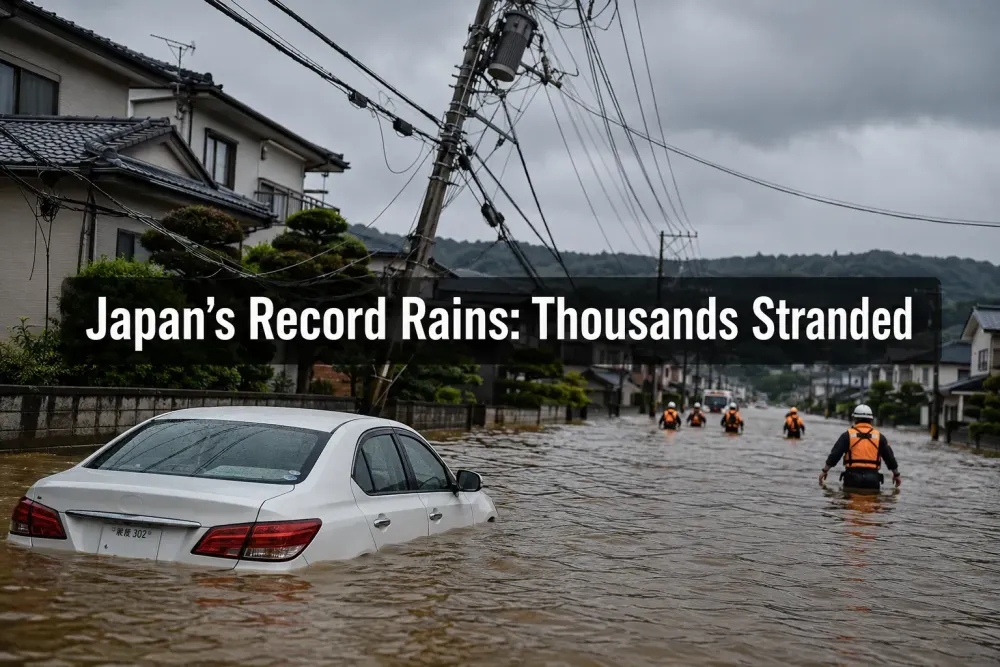
Japan's Record Rains: Thousands Stranded, Eight Dead in August 2026 refers to a torrential rainfall event that struck Chiba Prefecture, east of Tokyo, from the evening of Thursday, August 13 into the early hours of Friday, August 14, 2026. Roughly 367 mm (14.5 inches) of rain fell in 24 hours in parts of Chiba, breaking a local record of 309 mm set in October 2013, according to Reuters and Japan's Meteorological Agency (JMA) [1][5]. Eight people died, about 7,000 travellers were stranded overnight at Narita International Airport, and evacuation advisories covered more than 102,600 residents [1][3].
Key Takeaways
- Eight confirmed deaths were reported across Chiba City, Kashiwa, Ichikawa, Sakura and Yachiyo by August 14, 2026 [1][3][4].
- About 367 mm of rain in 24 hours in parts of Chiba beat the previous local record of 309 mm from October 2013 [1][5].
- Chiba City recorded 348 mm in 12 hours to 1:40 a.m. on August 14, roughly three times its normal rainfall for the whole month of August [3][5].
- Hourly intensity peaked at 115 mm in Chiba City and 97 mm in Sakura [3][5].
- Around 6,000 to 7,000 travellers were stranded at Narita Airport after floodwaters halted trains and buses; many slept on terminal floors [1][2][5].
- Evacuation orders and advisories reached more than 102,600 residents in Chiba Prefecture as of 11 a.m. on August 14 [3].
- The event lasted under 24 hours, but its intensity, not its duration, drove the damage.
- Timing was severe because it hit during Obon, one of Japan's busiest domestic travel weeks [1][5].
What Caused Japan's Record Rains in August 2026?
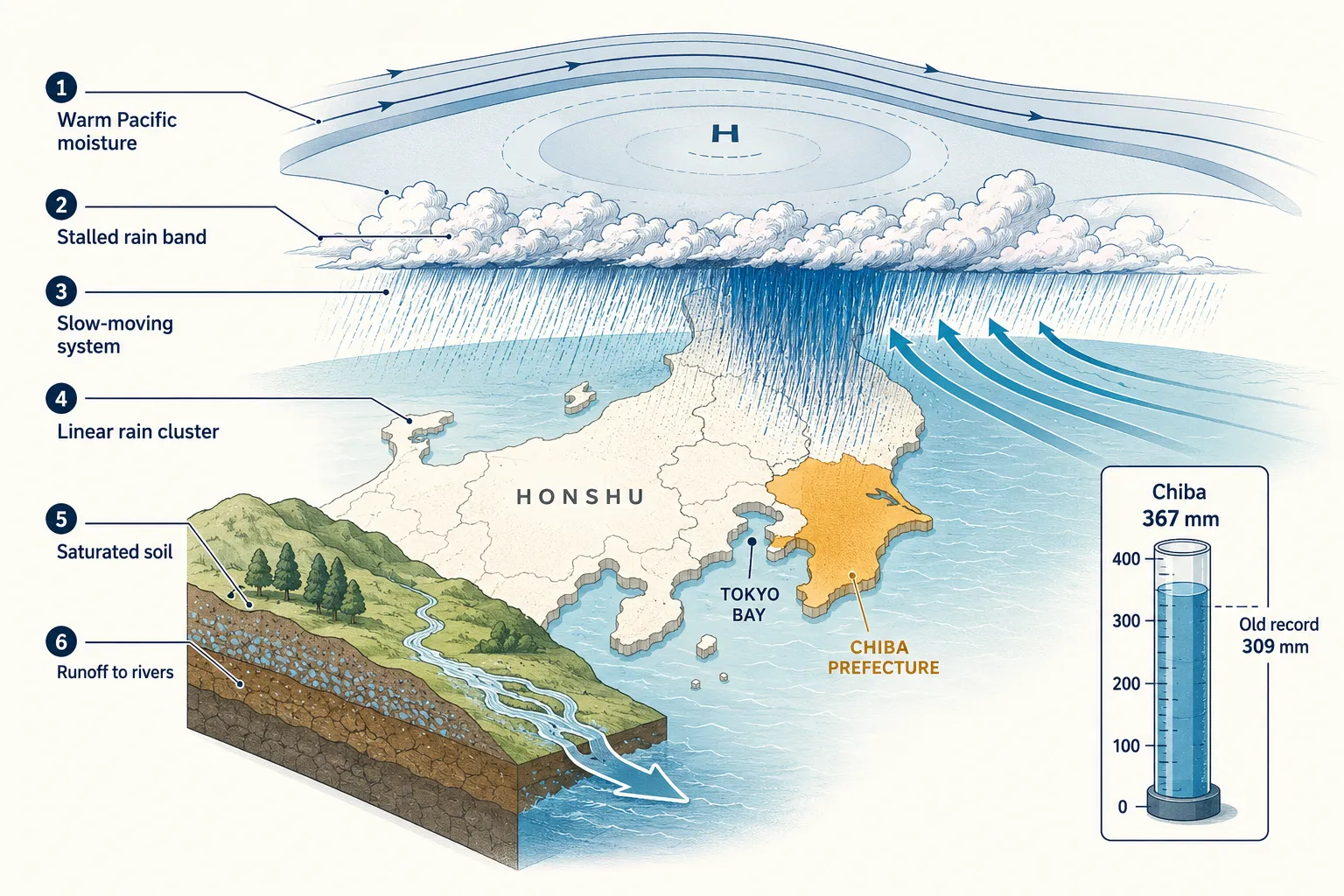
A slow-moving, moisture-loaded weather system parked over the Kanto region and dumped an August's worth of rain on Chiba Prefecture in half a day. JMA issued record-rainfall warnings as the band stalled east of Tokyo overnight on August 13-14, 2026 [1][5].
Three factors turned heavy rain into a deadly flood:
- Intensity over duration. Peak rates hit 115 mm in a single hour in Chiba City and 97 mm in Sakura [3][5]. Urban drainage in Japan is generally engineered for far lower hourly loads.
- Overnight timing. The heaviest rain fell between roughly 8 p.m. and 2 a.m., when residents were asleep and drivers had poor visibility. Several of the victims were found in or near vehicles [1][3][5].
- Saturated, built-up terrain. Chiba's mix of dense suburbs, low-lying farmland and cut slopes left water with nowhere to go, producing flash floods and slope failures.
Common mistake: treating this as a typhoon landfall. The reporting from Reuters, RTÉ and Japanese broadcasters describes a record rainfall event, not a named storm making landfall [1][2].
Where in Japan Were the Worst Floods in August 2026, and Which Cities Were Affected?
The worst flooding was concentrated in Chiba Prefecture, immediately east of Tokyo. The hardest-hit municipalities were Chiba City, Sakura, Ichikawa, Kashiwa and Yachiyo [1][3][4][5].
| City / Area | What happened |
|---|---|
| Chiba City | 348 mm in 12 hours; up to 115 mm in one hour; streets submerged, fatalities reported [3][5] |
| Sakura | 97 mm in a single hour; flash flooding and a confirmed death [3][5] |
| Ichikawa | Road inundation, a fatality, transport paralysis on Tokyo-bound lines [1][4] |
| Kashiwa | Flooding and a confirmed death [3][4] |
| Yachiyo | Flooding, evacuation activity, a confirmed death [3][5] |
| Narita | Airport access severed; roughly 7,000 travellers stranded overnight [1][5] |
Tokyo's core saw disruption from the same system, but the fatal flooding and the record gauge readings were in Chiba [4][7].
How Many People Were Stranded in the Japan Floods of August 2026?
Approximately 6,000 to 7,000 travellers were stranded overnight at Narita International Airport between August 13 and 14, 2026, after floodwater knocked out the rail and bus links that connect the airport to Tokyo [1][2][5].
Reuters put the figure at about 7,000, with passengers sleeping on terminal floors after trains and highway coaches were cancelled [1]. Narita is one of Tokyo's two main international gateways and has no meaningful alternative access when both rail and road are cut. The strandings landed in the middle of Obon, the mid-August period when millions of Japanese families travel, which magnified the backlog of stranded domestic and international passengers [1][5].
"Record rainfall in Japan killed eight people and stranded thousands of travellers," Reuters reported as assessments were completed on August 14 [8].
Edge case for travellers: a flight departing on time is worthless if ground access fails. During flash-flood warnings in the Kanto region, the ground leg is the fragile link, not the flight.
Japan's August 2026 Floods Death Toll: Latest Figures
The confirmed death toll stands at eight, reported across Chiba City, Kashiwa, Ichikawa, Sakura and Yachiyo as of August 14, 2026, per local authorities and NHK [1][3][4][5].
The count rose through the day as assessments progressed. Early wires, including RTÉ, reported four confirmed deaths with a fifth person feared dead and a sixth unaccounted for [2]. Later domestic and international reporting converged on eight [3][4].
Victims identified in reporting include:
- A man in his 60s or 70s found floating on a flooded road [1][5]
- A 66-year-old woman discovered in a submerged car [1][3]
- A man found collapsed in a street [3][5]
- At least one additional person trapped inside a submerged vehicle [2][3]
Bernama, citing Xinhua, also recorded four minor injuries and confirmed that evacuation orders remained active for more than 102,600 residents in Chiba Prefecture as of 11 a.m. on August 14 [3].
Japan's August 2026 Floods: Evacuation Orders, Landslides and Mudslides
Evacuation orders and advisories in Chiba Prefecture covered more than 102,600 residents as of 11 a.m. on August 14, with landslide and flash-flood warnings issued for slope-adjacent neighbourhoods across the affected cities [3].
Landslides and mudslides accompanied the flooding, a familiar pattern in Japan when rainfall rates exceed roughly 50 mm per hour on already-wet slopes [1][3]. Municipal authorities focused advisories on three risk categories:
- Slope-adjacent housing in Sakura, Yachiyo and inland Chiba City
- Low-lying riverside and canal-side districts prone to backflow
- Underpasses and basement parking, where flash flooding traps drivers within minutes
Decision rule for residents: if you live below a cut slope or embankment and an hourly rainfall figure above 50 mm is being reported nearby, move to higher ground before an order is issued. Evacuation orders often follow the rain rather than lead it.
How Long Did the Rains Last, and What Was the Rainfall Amount?
The core event lasted less than 24 hours, from Thursday evening, August 13, into the early hours of Friday, August 14, 2026 [1][5].
The headline numbers:
- 367 mm (14.5 in) in 24 hours in parts of Chiba Prefecture, a new local record [1][5]
- 309 mm (12.17 in), the previous local record, set in October 2013 [1][5]
- 348 mm in 12 hours in Chiba City, to 1:40 a.m. on August 14 [3][5]
- 115 mm in one hour in Chiba City; 97 mm in one hour in Sakura [3][5]
- Chiba City's 12-hour total was roughly three times its average for the entire month of August [3][5]
That compression is the point. A month of rain arriving in twelve overnight hours overwhelms drainage systems that would handle the same volume across thirty days without incident.
Was This Japan's Worst Flooding Ever, and How Does It Compare to Past Disasters?
No. Japan's August 2026 Chiba floods set a local rainfall record and killed eight people, but they were far from the country's deadliest flood disaster. Larger events have produced higher casualty counts and mass evacuations on a national scale.
For scale, previous Japanese rain disasters have involved at least 10 missing and about 400,000 people evacuated during a single heavy-rain episode, according to The Straits Times [10]. Torrential rains in southern Japan have separately killed 16 people in one episode, per GDN [9].
What distinguishes the August 2026 event is where it happened: the Greater Tokyo commuter belt, hitting an international airport and the rail spine that serves it during peak holiday travel [1][5].
Japan's August 2026 Floods: Climate Change Connection
Scientists do not attribute any single storm to climate change without a formal attribution study, and no such study existed for this event at the time of reporting. What the record itself shows is that a local 24-hour rainfall benchmark standing since October 2013 was broken by roughly 58 mm in 2026 [1][5].
The mechanism experts point to for rainfall extremes generally is straightforward: warmer air holds more water vapour, so when a system stalls, it has more moisture to release. Reporting on this event documented the record and the toll; it did not assign causation [1][4][5]. Readers should treat the climate link as a pattern-level question, not a settled finding about August 13-14, 2026.
How to Prepare for Heavy Rains During Japan's Typhoon Season
Japan's heaviest rain season runs from June through October, peaking with the rainy season and typhoon activity. Preparation is mostly about the first 90 minutes.
Residents:
- Check your municipality's hazard map for flood depth and landslide zones at your exact address.
- Register for JMA warnings and your city's emergency alerts.
- Keep a 72-hour kit: water, food, medication, power bank, cash, torch.
- Know two evacuation routes on foot, not by car.
- Never drive into standing water. Two of the deaths in this event involved submerged vehicles [1][3].
Travellers:
- Build a buffer night before international departures from Narita during Obon and typhoon season.
- Track ground transport status, not only flight status.
- Save the airport's rail and bus operator alert pages.
- Carry a charger and a change of clothes in cabin baggage.
FAQ
How many people died in Japan's record rains in August 2026? Eight people died, across Chiba City, Kashiwa, Ichikawa, Sakura and Yachiyo, as confirmed by August 14, 2026 [1][3][4].
How many travellers were stranded at Narita Airport? About 7,000, according to Reuters, after floodwater halted rail and bus services overnight on August 13-14, 2026 [1].
How much rain fell? Roughly 367 mm in 24 hours in parts of Chiba Prefecture, beating the previous local record of 309 mm from October 2013 [1][5].
Which prefecture was hit hardest? Chiba Prefecture, east of Tokyo [1][4].
How many people were told to evacuate? More than 102,600 residents of Chiba Prefecture were under evacuation orders or advisories as of 11 a.m. on August 14, 2026 [3].
Were there injuries? Bernama, citing Xinhua, reported four minor injuries [3].
Was Tokyo itself flooded? Tokyo saw disruption from the same system, but the record rainfall totals and fatalities were recorded in neighbouring Chiba [4][7].
Why did the death toll change during the day? Early wires reported four deaths with others feared dead or missing; the figure was revised to eight as searches concluded [2][3][4].
Was this a typhoon? Reporting describes a record rainfall event, not a typhoon landfall [1][2].
How long did it last? Under 24 hours, from Thursday evening August 13 into the early hours of Friday August 14, 2026 [1][5].
Conclusion
Japan's Record Rains: Thousands Stranded, Eight Dead in August 2026 turned on a single number, 348 mm of rain in twelve overnight hours in Chiba City, roughly three times the city's normal August total [3][5]. Eight people died, about 7,000 travellers spent the night on Narita's terminal floors, and more than 102,600 residents were placed under evacuation instruction [1][3].
Practical next steps: residents of Chiba, Ichikawa, Kashiwa, Sakura and Yachiyo should check municipal hazard maps against their own address and register for JMA push warnings before the next system. Travellers routing through Narita between June and October should build a buffer night into itineraries and monitor rail and bus operator status alongside flight boards. Recovery in the affected cities centres on drainage clearance, slope inspection and rail restoration, work that typically runs weeks after the water recedes, not days.
References
[1] Thousands Stranded Japans Narita Airport After Record Rain Kills Four - https://www.reuters.com/world/asia-pacific/thousands-stranded-japans-narita-airport-after-record-rain-kills-four-2026-08-14/ [2] Japan Rain World - https://www.rte.ie/news/world/2026/0814/1587827-japan-rain-world/ [3] News - https://www.bernama.com/en/news.php/?id=2594317 [4] Chiba Tokyo Flood Rain Deaths - https://www.nytimes.com/2026/08/14/world/asia/chiba-tokyo-flood-rain-deaths.html?eafs_enabled=false [5] Japan Chiba Record Rainfall Floods Tokyo Deaths August 2026 - https://www.indiatoday.in/amp/science/story/japan-chiba-record-rainfall-floods-tokyo-deaths-august-2971257-2026-08-14 [7] Torrential Rain Tokyo Causes Flooding Paralyzes Traffic - https://abcnews.com/International/wireStory/torrential-rain-tokyo-causes-flooding-paralyzes-traffic-killing-135615887 [8] Reuters post: Record rainfall in Japan killed eight people - https://www.facebook.com/Reuters/posts/record-rainfall-in-japan-killed-eight-people-stranded-thousands-of-travelers-at-/1640178284639564/ [9] Japan Braces For Return Of Torrential Southern Rains That Killed 16 - https://www.gdnonline.com/Details/836978/Japan-braces-for-return-of-torrential-southern-rains-that-killed-16 [10] At Least 10 Missing And 400000 Evacuated As Heavy Rain Pounds Japan - https://www.straitstimes.com/asia/east-asia/at-least-10-missing-and-400000-evacuated-as-heavy-rain-pounds-japan
Tags: Japan floods, Chiba Prefecture, Narita Airport, record rainfall, Japan Meteorological Agency, August 2026 floods, Tokyo weather, landslides Japan, evacuation orders, typhoon season Japan, Obon travel, extreme weather