The European Union imposed sanctions on 1,569 people and companies tied to Russia’s military-industrial complex on Monday, its largest single set of listings since Moscow’s full-scale invasion, as a U.S.-announced “energy ceasefire” remained unconfirmed and Ukraine reported fresh Russian strikes on power facilities.
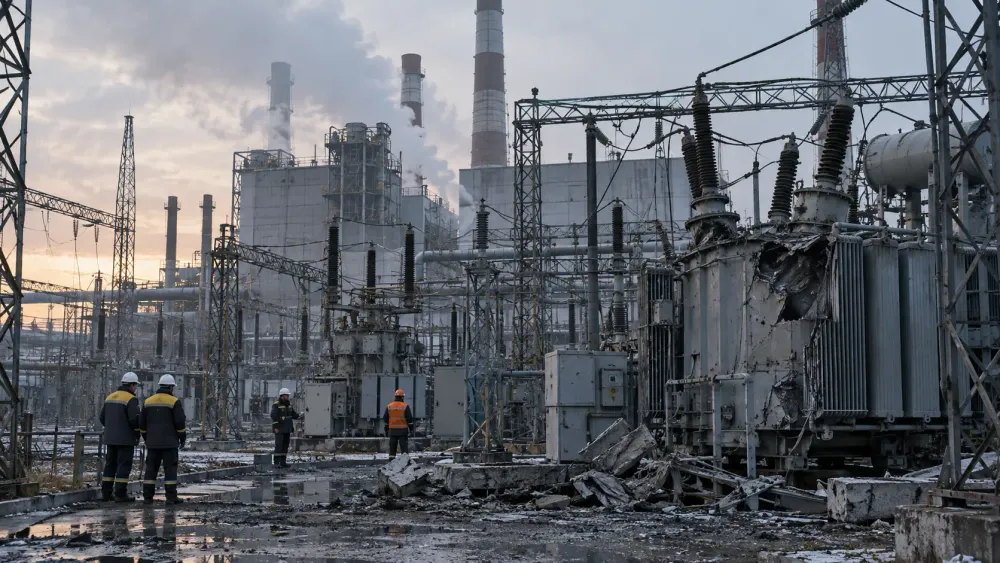
The two developments exposed the widening gap between diplomatic claims and events on the ground. President Donald Trump said Sunday that Russia and Ukraine had agreed to stop attacking each other’s energy infrastructure immediately. Ukraine welcomed the idea but said it had not received details, while the Kremlin declined to confirm that it had agreed. Within hours, Ukrainian officials reported attacks on a combined heat-and-power plant in Kharkiv and other energy sites.
The EU package targets 826 companies and 743 chief executives that the bloc says form the core of Russia’s weapons supply chain. The action does not itself disprove the ceasefire claim, but its timing shows that Europe is increasing economic pressure rather than treating a pause in energy attacks as an established agreement.
No shared ceasefire text has emerged
Trump’s brief announcement did not describe who negotiated the arrangement, what facilities it covered, how violations would be verified or what consequences would follow. Ukrainian President Volodymyr Zelenskyy said Kyiv learned of the purported deal through media reports and was prepared to stop attacks on Russian energy sites if Moscow reciprocated. In an official address, he presented Ukraine’s position as conditional rather than as confirmation that a mutual pact was already operating.
Moscow offered no matching public commitment. Kremlin spokesman Dmitry Peskov told reporters that contacts were continuing but would not say whether Russia had accepted the energy pause, according to the Associated Press. Without parallel statements, written terms or a monitoring mechanism, “ceasefire” describes a proposal and a U.S. claim, not a verified bilateral agreement.
Strikes continued after the announcement
Zelenskyy said Russian forces struck a joint heating-and-power plant in Kharkiv after Trump’s announcement. He also said Ukraine recorded more than 200 attacks on electricity-generating capacity and 17 strikes on oil and gas installations during the preceding week. Reuters reported those figures while noting that Russia had not yet publicly responded to the proposed pause.
The Kharkiv regional administration separately said Russian forces attacked the city and 22 communities across the region during the previous day. Its morning update did not independently establish the purpose of every strike, but it corroborated the continuing tempo of attacks. AP also reported damage to a Kharkiv power plant, a gas-production facility and a civilian gas station. Russia did not provide independent evidence addressing those specific allegations.
The broader truce dispute remains unresolved
The energy proposal is narrower than a general ceasefire and sits inside a larger argument over how fighting could stop. Zelenskyy asked Russia for a 60-day comprehensive pause that would allow Ukraine to organize a presidential election. Ukrainian law prohibits elections under martial law, and holding a national vote while millions are displaced and soldiers remain deployed would create major logistical and security problems.
The Kremlin rejected that proposal Monday. Peskov said Moscow does not want a temporary ceasefire and instead seeks a long-term peace settlement, according to a separate Reuters account. That position does not explain whether Russia accepts the more limited energy arrangement. The distinction matters because a pause protecting power plants could reduce civilian hardship without resolving territorial, military or political disputes.
Europe answers with its largest listings round
The EU’s new sanctions focus on mid-level suppliers of semiconductors, radar and communications equipment, aviation systems, explosives, ammunition, optics and navigation technology. The Council said the targeted companies generate at least €20 billion in annual turnover and employ more than 250,000 people. More than half of the listings address the ballistic-missile production chain, according to the bloc.
Listed companies and individuals face asset freezes, while EU persons and businesses are barred from providing them funds or economic resources. The 743 executives also face travel bans. The package raises the total number of listings under the EU’s Ukraine territorial-integrity regime to nearly 4,600, but designation is not the same as immediate economic paralysis. Its effect will depend on enforcement, the availability of substitute suppliers and whether third-country intermediaries help Russian firms obtain restricted components.
What would make the pause credible
A functioning energy ceasefire would require both governments to publish compatible commitments, define protected infrastructure and establish a method for attributing drone, missile and sabotage incidents. It would also need a clear start time and a channel for resolving alleged violations. None of those elements was publicly documented by Monday morning.
Ukraine says it is willing to suspend strikes on Russian refineries if Russia stops hitting Ukraine’s power network. Moscow’s public silence on that exchange, continued reports of attacks and the EU’s decision to widen sanctions leave the proposal untested. The next meaningful evidence will be operational: whether attacks on energy sites decline, whether Russia expressly accepts reciprocal terms and whether a monitoring system is created. Until then, the announcement remains a diplomatic claim rather than a demonstrated ceasefire.