Last updated: August 15, 2026
Quick Answer
Indiana Governor Eric Holcomb signed a statewide disaster emergency declaration covering all 92 counties, with the order announced and in force by August 14, 2026, as record rainfall pushed the White River and its tributaries out of their banks across central and eastern Indiana. Indiana Declares Statewide Disaster Emergency Amid Historic August 2026 Flooding is more than a headline: the declaration frees state funds, activates Indiana National Guard support, waives certain procurement and transport rules, and is the legal step required before the state can formally ask the federal government for a presidential major disaster declaration and FEMA Individual Assistance. It follows a separate Indiana disaster declaration issued in June 2026 for earlier severe storms.
Key Takeaways
- The statewide disaster emergency was declared August 13 and was operative and publicly announced by August 14, 2026, covering all 92 counties.
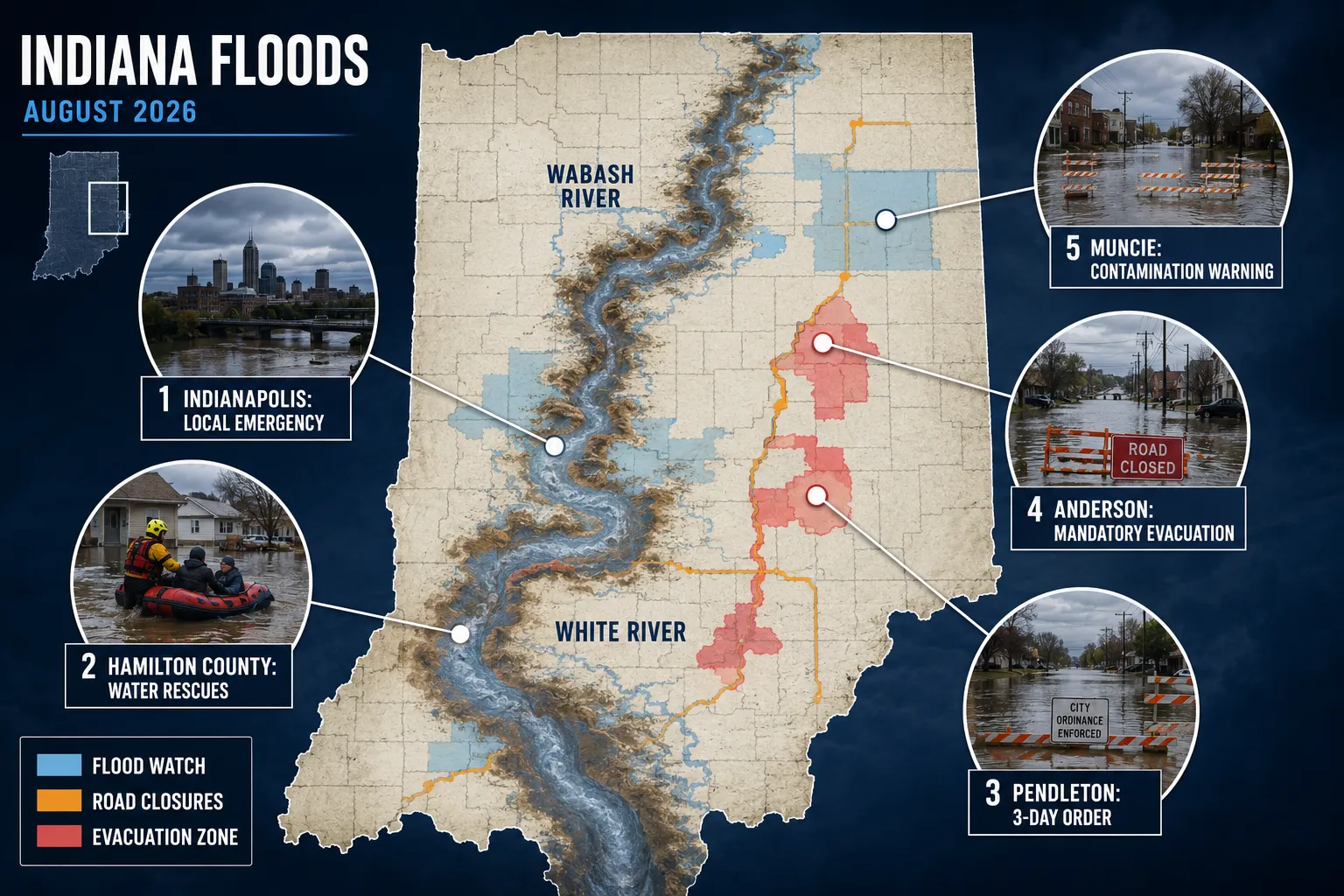
- Local emergencies stacked on top of it: Indianapolis, Muncie, Pendleton, and Hamilton County all issued their own declarations, and Anderson ordered mandatory evacuations along the White River.
- A state declaration is not the same as FEMA aid. Federal Individual Assistance requires a presidential major disaster declaration on top of it.
- Indiana disaster emergencies typically run for a set period (commonly 30 days) and can be renewed or ended early by the governor.
- Document everything before you clean up. Photos and video of standing water and damaged contents are what insurers and FEMA inspectors ask for first.
- Standard homeowners policies do not cover flood. Coverage comes from the National Flood Insurance Program or private flood carriers.
- Without flood insurance, the main options are FEMA grants, SBA disaster loans, and charitable relief through groups like the Red Cross and Team Rubicon.
- Delaware County officials warned that floodwater near industrial sites may carry toxic gases and contamination. Treat all floodwater as unsafe.
What caused the August 2026 Indiana flooding, and how bad was it?
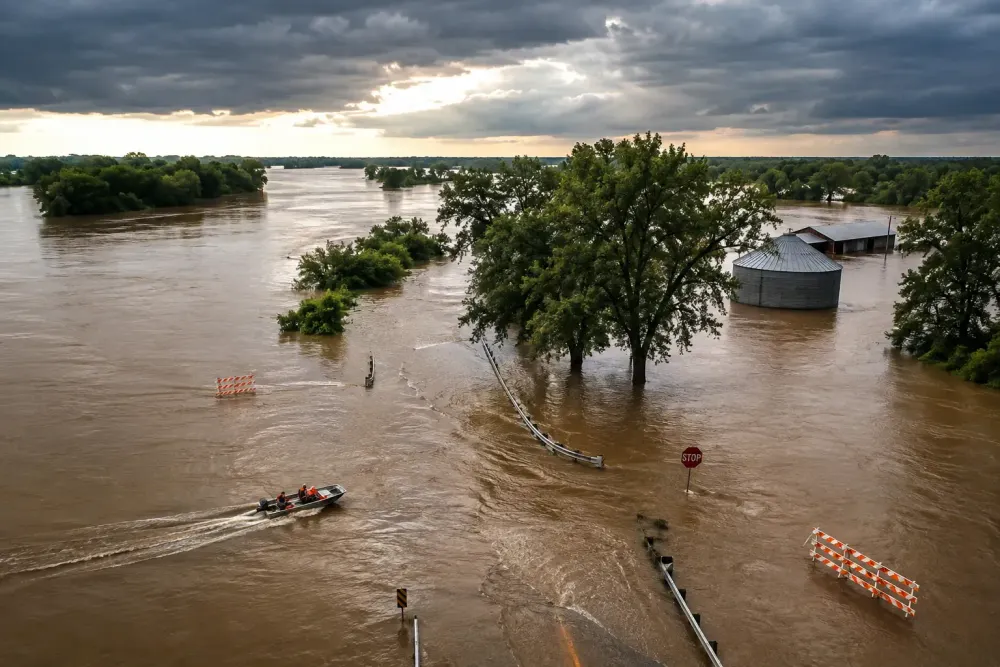
The flooding came from repeated, slow-moving thunderstorm complexes that dumped heavy rain on ground already saturated from an unusually wet summer, sending the White River and smaller tributaries over flood stage in a matter of hours. Continued flood watches and additional forecast rain through mid-August kept rivers from falling back.
Three factors compounded each other:
- Antecedent soil moisture. Indiana had already taken a disaster declaration in June 2026 after severe storms. Soils could not absorb more.
- Training storms. Cells moved along the same corridor repeatedly, concentrating rainfall over the upper White River basin instead of spreading it out.
- Urban runoff. Paved watersheds around Indianapolis, Anderson, and Muncie shed water fast, spiking creeks before mainstem rivers crested.
Compared with past events, this ranks with Indiana's most damaging flood episodes because of its geographic breadth. The January 1937 Ohio River flood and the June 2008 statewide floods remain the historical benchmarks. What distinguishes August 2026 is the number of simultaneous county and municipal emergency declarations and the speed of water rescues in fast-growing suburban areas like Hamilton County, where development has expanded into floodplain since 2008.
What areas of Indiana were affected by the flooding?
Central and east-central Indiana absorbed the worst of it, concentrated along the White River corridor from Indianapolis northeast through Hamilton, Madison, and Delaware counties. The statewide order covers all 92 counties, but response activity clustered in a handful of communities.
| Location | Action taken | Timing |
|---|---|---|
| Indianapolis | Local disaster emergency declared by Mayor Joe Hogsett | Aug. 14, 2026 |
| Hamilton County | County state of emergency; road closures and water rescues | Friday morning, Aug. 14 |
| Pendleton | Town emergency declaration, in effect up to three days | Noon, Aug. 14 |
| Anderson | Mandatory evacuation orders for flood-prone White River areas | Aug. 14 |
| Muncie / Delaware County | Local disaster emergency plus toxic-gas and contamination warning | Aug. 14 |
Rural stretches of Madison and Delaware counties saw agricultural losses, closed county bridges, and washed-out gravel roads that are slower to appear in damage totals than urban losses.
What is a statewide disaster emergency declaration, and how long does it last in Indiana?
A statewide disaster emergency is a formal executive order in which the governor finds that a disaster exists beyond the capacity of local governments, which then activates emergency powers under Indiana law. It lets the state spend contingency funds, deploy the Indiana National Guard, suspend rules that slow response (such as procurement steps and hours-of-service limits for utility and fuel trucks), and request federal help.
Indiana declarations are issued for a defined term, commonly 30 days, and the governor may extend them by subsequent order or end them early once conditions stabilize. Local declarations, like Pendleton's three-day order, run on their own shorter clocks. Decision rule: if you need to know whether a specific benefit still applies, check the order's expiration date rather than assuming aid ends when the water recedes. Some programs, including FEMA application windows, run for weeks after a declaration lapses.
What help is available for flood victims in Indiana, and who qualifies?
Immediate help is state and local: National Guard high-water vehicles and swift-water rescue teams, American Red Cross shelters, county health department well-testing, and debris removal by highway departments. Qualification for emergency response is based on need and location, not income.
Longer-term aid is tiered:
- State response assets (Guard, Indiana Department of Homeland Security, IDEM), available to any affected resident or community in the declared area.
- FEMA Individual Assistance, only after a presidential major disaster declaration naming your county. Requires proof of identity, occupancy, and uninsured loss.
- SBA disaster loans, homeowners, renters, and businesses in designated counties, subject to credit review.
- Charitable and faith-based relief, Red Cross, Salvation Army, Team Rubicon, Mennonite Disaster Service, and county United Way funds. Usually no income test for basic needs.
Can I get FEMA assistance for August 2026 Indiana flood damage, and how do I apply?
FEMA Individual Assistance is possible but not automatic. Indiana must first complete joint preliminary damage assessments with FEMA, then the governor requests a presidential major disaster declaration for specific counties. Only if that request is approved can residents in those named counties apply for FEMA grants.
How to apply, in order:
- Report damage to your county emergency management agency and to the state damage survey. This feeds the assessment that triggers federal aid.
- File your insurance claim first. FEMA cannot duplicate insurance benefits.
- Once your county is designated, register at DisasterAssistance.gov, through the FEMA app, or by phone.
- Keep receipts for hotel stays, pumps, dehumidifiers, and generators.
- Apply for an SBA loan even if you don't want one. A denial can open access to additional FEMA grant categories.
Are there alternatives to FEMA for disaster assistance?
Yes. If your county is never designated, or your FEMA award falls short, look to SBA low-interest disaster loans, USDA Farm Service Agency programs for crop and livestock losses, Indiana township trustee emergency assistance (rent, utilities, food), 211 Indiana for case management, and volunteer long-term recovery groups that do free muck-outs and rebuilds.
What should I do if my home was flooded in Indiana?
Prioritize safety, then documentation, then drying. Do not re-enter until local officials clear the area, especially in Delaware County, where officials flagged industrial contamination mixing with floodwater.
- Cut power at the breaker before entering standing water; have an electrician inspect submerged panels.
- Photograph every room, waterline height, appliance, and damaged item before removing anything.
- Wear boots, gloves, and an N95. Assume floodwater carries sewage, fuel, and chemicals.
- Remove wet drywall and insulation to at least a foot above the waterline within 24 to 48 hours to limit mold.
- Test private wells before drinking; use bottled water until results return.
- Save damaged items or a sample of each until an adjuster or inspector has seen them.
How do I file a flood insurance claim in Indiana, and what if I have none?
Call your insurance agent or the carrier that writes your flood policy immediately, ask for your claim number and adjuster contact, and file a Proof of Loss within the deadline stated in your policy. NFIP policyholders can start at FloodSmart. Renters' contents claims and homeowners' building claims are handled separately.
If you have no flood insurance, you are not shut out, but expect gaps. FEMA housing grants are capped and cover essential repairs, not full restoration. SBA loans must be repaid. Charitable rebuilds depend on volunteer capacity. Buying an NFIP policy now typically carries a 30-day waiting period, so it protects against the next event, not this one.
Common mistakes people make after floods
- Throwing out damaged property before photographing it.
- Assuming a homeowners policy covers flood. It almost never does.
- Waiting for FEMA before filing an insurance claim.
- Skipping the SBA application and losing access to other grant categories.
- Paying cash up front to unlicensed contractors who appear days after a flood.
- Restoring drywall over wet framing, which guarantees mold and a second gut job.
- Missing the application deadline, which usually closes 60 days after a federal declaration.
FAQ
When was the Indiana statewide disaster emergency declared? It was signed August 13, 2026, and was announced and operative by August 14, 2026, covering all 92 counties.
Does the statewide declaration mean FEMA money is available? No. A state declaration activates state resources. FEMA Individual Assistance requires a separate presidential major disaster declaration for named counties.
Which Indiana cities issued their own emergencies? Indianapolis, Muncie, and Pendleton declared local disaster emergencies, Hamilton County declared a county state of emergency, and Anderson issued mandatory evacuations.
How long does an Indiana disaster emergency last? Typically 30 days, renewable by the governor and revocable early once conditions improve.
Is floodwater in Muncie dangerous? Delaware County officials warned about toxic gases from industrial contamination mixing with floodwater. Avoid contact and follow local health guidance.
Who qualifies for Indiana disaster relief funds? Emergency response reaches anyone in the affected area. Grants and loans require documented, uninsured losses in a designated county.
Can renters get help? Yes. Renters can claim contents under a flood policy and may qualify for FEMA rental assistance and personal property grants.
What if my insurance claim is denied? Request the denial in writing, appeal through the carrier, and contact the Indiana Department of Insurance. NFIP policyholders can appeal to FEMA.
Conclusion
The declaration is the legal machinery that moves resources; it does not restore a single basement. Residents in Marion, Hamilton, Madison, and Delaware counties should do four things this week: report damage to county emergency management so it counts toward the federal assessment, file insurance claims before touching repairs, photograph everything, and monitor whether their county is added to a federal disaster designation. Watch for extended flood watches, because a second crest on the White River would reset the recovery clock. Track further updates in the Daily Briefing from The American Quorum, and confirm program eligibility directly with Indiana's Department of Homeland Security rather than relying on secondhand claims circulating on social media.
Tags: Indiana flooding, statewide disaster emergency, August 2026 flood, FEMA assistance, White River flooding, Muncie flood, Hamilton County emergency, flood insurance claim, disaster relief Indiana, Anderson evacuation, Indianapolis flooding, emergency declaration