The Pentagon has moved small autonomous surveillance boats from a Rio Grande pilot into the Gulf while studying a larger fleet, extending the military’s border mission into a test of persistent, low-cost maritime monitoring.
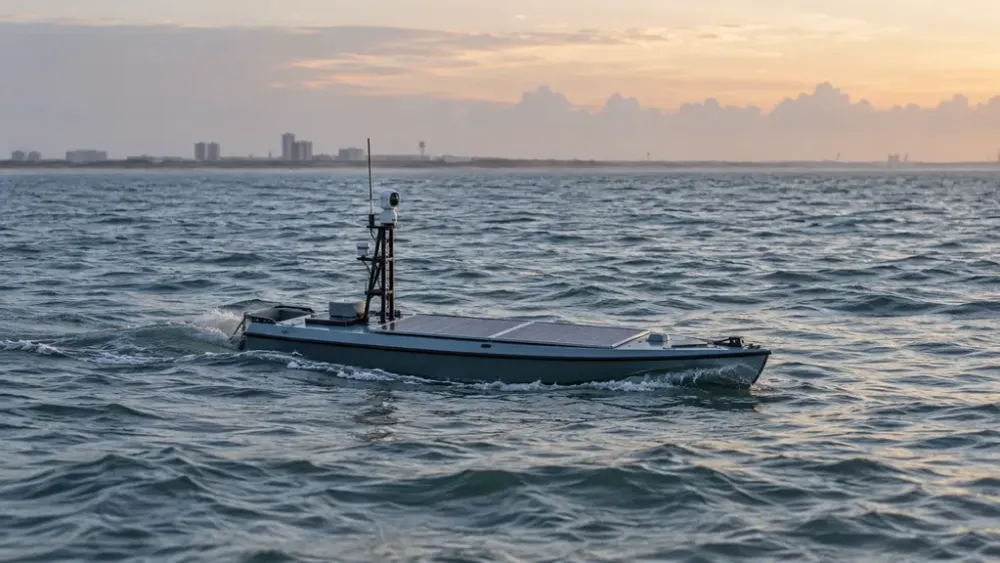
San Diego-based Seasats said Friday that a fleet of its solar-powered Lightfish unmanned surface vessels had launched from the Texas coast to watch for drug trafficking and unauthorized vessel movements. Reuters independently reported that defense officials are considering expanding the current test group of 10 vessels by as many as 50. The larger purchase is under study, not a completed contract, and officials said expansion would proceed in increments while the government evaluates competing systems.
The development is distinct from the Pentagon’s new carrier and troop deployments to the Middle East. It is a domestic military-support mission that also doubles as an operational laboratory for autonomous systems—technology the services expect to use more widely in contested waters.
From the river to open water
The Lightfish pilot began in January near Brownsville, Texas. An official military account published in March said the solar-powered vessels could operate for up to six months while feeding sensor data into shared interagency systems. Seasats’ current announcement likewise dates its Rio Grande operation to January and says the boats provided surveillance and early warning alongside crewed patrols.
In its Friday announcement, Seasats said the Gulf deployment extends that river operation into open water under the Pentagon office responsible for homeland defense. The company described each craft as roughly 11 feet long and 340 pounds, small enough for two people to launch from a boat ramp or pickup truck. Reuters reported the same dimensions and put the price near $240,000 per vessel.
The craft can carry electro-optical, infrared and sonar sensors. Reuters reported that their tracking feeds can flow into military software used to alert Customs and Border Protection and Coast Guard units. Pentagon officials told the news service that the boats have assisted, in an average month, with 452 detections, 350 apprehensions and 100 aborted crossings. Those are agency-reported operational figures; no independent audit of the counts was identified in the public material reviewed for this article.
Why the Pentagon sees an opening
The operational case rests on persistence. A crewed aircraft can cover a large area quickly but cannot remain over one patch of water for days. A slow solar craft can hold station, watch continuously and cue a crewed patrol when its sensors identify activity. That does not make the unmanned vessel an interceptor by itself; it is principally a detection and early-warning platform.
The Coast Guard’s capacity constraints add urgency. A 2025 GAO review found that cutter availability had generally declined since fiscal 2019 amid equipment failures, deferred maintenance and obsolete parts. GAO also found cutter and support-position vacancy rates had risen to about 13% in fiscal 2024. Autonomous boats cannot replace armed cutters, boarding teams or aircraft, but persistent sensors could reduce the time those assets spend searching empty water.
The military has already tested Lightfish beyond the border. In February, the Navy launched one from a Seychelles Coast Guard ship during a multinational exercise in the Indian Ocean, according to USNI News. That trial tested open-ocean operation with limited connectivity and placed the craft within a broader Navy effort to integrate robotic systems with allies.
Authority and accountability remain central
The boats’ immediate function is surveillance and cueing, while civilian agencies carry out apprehensions and maritime law enforcement. Even so, expanding a military sensor network along the border intensifies longstanding questions about the division between defense support and civilian policing.
Those questions are sharper in designated national defense areas along the border, where troops have received authority to temporarily detain alleged trespassers before transferring them to law enforcement. AP reported last year that the Texas zone extended roughly 250 miles along the Rio Grande and that legal challenges had produced mixed results. The autonomous boats do not independently make detention decisions, but the information they collect can guide personnel who do.
Public records reviewed for this article do not spell out all retention periods, access controls or performance standards for the Gulf deployment. Those details will matter if the test fleet becomes a durable network stretching from Texas toward Florida. Persistent coverage can close surveillance gaps, but it also creates a continuous stream of location and imagery data that requires clear rules on who may search it, how long it is stored and how false detections are corrected.
For now, the Gulf deployment shows the Pentagon moving beyond demonstrations toward daily use of commercial autonomous craft. The proposed addition of up to 50 boats would be a much larger commitment, but it remains a planning figure. The central question is whether the program can prove that inexpensive endurance produces reliable interdictions without shifting costs into oversight, data governance and expanded military involvement in domestic enforcement.