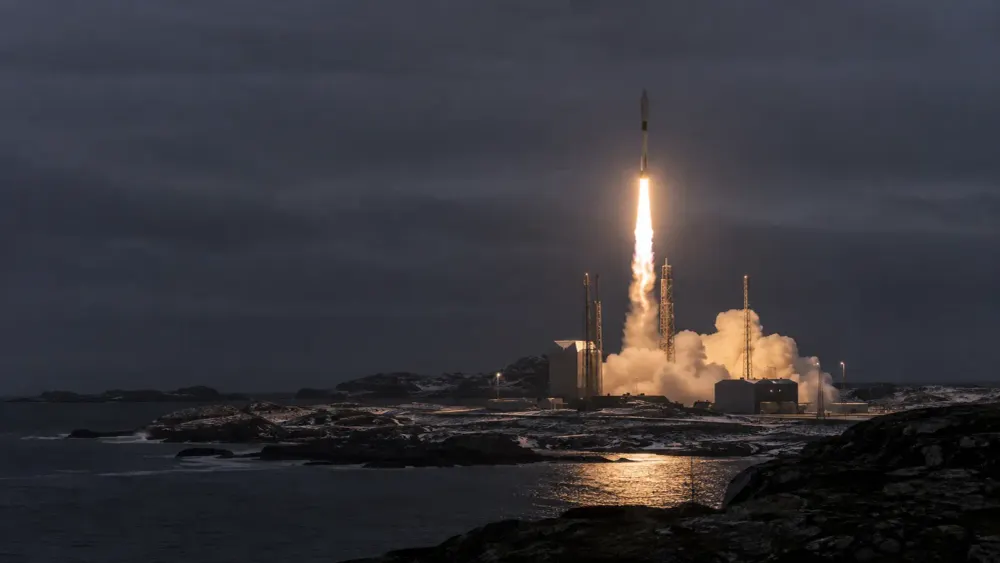
A 28-meter German-built rocket placed five CubeSats and one technology experiment into orbit from Arctic Norway on Saturday, completing the first orbital launch from continental Europe and giving European governments a new, domestically controlled route for small military and civilian spacecraft. Isar Aerospace’s two-stage Spectrum lifted off from Andøya Spaceport at 10:12 p.m. Central European Summer Time, crossed the 100-kilometer Kármán line, separated its stages and deployed the payloads after a circularization burn, according to the company’s mission account.
The European Space Agency independently confirmed that Spectrum reached low Earth orbit, making Isar the first participant to clear the central flight milestone in ESA’s European Launcher Challenge. The achievement came on the rocket’s second flight, 18 months after an inaugural test ended about 30 seconds after liftoff. Saturday’s mission therefore demonstrated a complete launch sequence rather than merely another test of engines or ground systems, although Isar said it was still working with customers to confirm the operating status of each satellite.
The payloads were commercial and educational, not weapons, and the launch does not by itself create a military capability. Its defense relevance lies in infrastructure: armed forces depend on satellites for communications, navigation, missile warning, weather data and surveillance, while replacing a disabled spacecraft requires access to a rocket, a launch site and a trained operating team. The flight gives Europe another potential supplier for that chain at a time when NATO is seeking more resilient constellations and faster launch options.
A qualification flight becomes an orbital service
Spectrum is designed to carry as much as 1,000 kilograms to low Earth orbit, a fraction of the lift offered by Europe’s Ariane 6 but enough for small satellites and clustered CubeSat missions. The launcher uses ten engines and measures two meters in diameter, according to the ESA profile. That scale positions it for dedicated flights in which a customer can choose an orbit and schedule, rather than waiting for capacity as a secondary payload on a larger rocket.
Saturday’s success followed a technically useful but visibly unsuccessful first flight in March 2025. That rocket cleared the pad before losing control and falling into the sea, with no injuries. Isar treated the short flight as a data-gathering test; this time the vehicle passed maximum aerodynamic pressure, completed main-engine cutoff and stage separation, ignited its upper stage, discarded the fairing and reached orbital velocity. Those steps are the practical threshold between having a promising rocket design and having demonstrated an orbital transportation system.
The result also validated Andøya as an operational orbital spaceport. The site’s operator said the launch was executed safely and as planned, while Reuters reported that Sweden’s Esrange and Britain’s SaxaVord facilities remain its nearest continental competitors. Europe has long launched Ariane and Vega rockets from French Guiana, an overseas department of France near the equator; the distinction here is a successful commercial orbital flight from the European mainland region itself.
Why small launchers matter to armed forces
Modern military operations use space systems continuously, even when no weapon is placed in orbit. NATO says satellites underpin precision navigation, secure communications, missile-launch warning, force tracking and mission planning. Its current space framework includes STARLIFT, a 15-nation project intended to assemble a resilient network of launch capabilities that can place assets in orbit at short notice from spaceports across the alliance.
That requirement favors diversity. A state relying on one rocket family, one pad or one foreign provider can face delays when a technical failure, industrial dispute, export restriction or military crisis closes that route. A smaller launcher cannot replace a heavy rocket for large communications platforms, but it can add options for compact imaging, signals-intelligence or communications satellites and for replenishing distributed constellations. Launch sovereignty is therefore less about complete isolation than about reducing single points of failure.
Demand around Isar increasingly reflects that logic, though the figures come from the company and are not independently audited. Isar said in June that defense customers had grown from a negligible share to 60 percent of its demand in the preceding year, and that its order book extended through 2028. The same funding statement linked a planned Canadian launch site to a naval procurement partnership, illustrating how commercial launch services are becoming part of allied defense-industrial planning.
Europe is buying redundancy, not a SpaceX replacement
Europe’s policy goal is broader than one startup. The European Commission calls independent, reliable and affordable access to orbit a political imperative because programs such as Galileo navigation and Copernicus Earth observation cannot function without recurring launches. It expects more than 30 satellites for those systems over the next 10 to 15 years and says a viable European industry also needs commercial customers because institutional demand alone is too small, according to its launch policy.
Spectrum fills a different segment from Ariane 6. ESA lists Ariane 62’s low-Earth-orbit capacity at about 10.3 metric tons and Ariane 64’s at roughly 21.6 tons, compared with Spectrum’s target of one ton. Heavy launchers remain essential for large spacecraft and multi-satellite deployments, while microlaunchers trade scale for scheduling control and access to particular orbits. The practical comparison is therefore not which rocket replaces the other, but whether Europe can sustain a portfolio broad enough to avoid bottlenecks.
Nor does one flight erase the competitive gap with the United States. Reuters reported that European governments created the Launcher Challenge partly to reduce dependence on SpaceX, whose reusable Falcon 9 operates at a cadence no European provider currently matches. Spectrum remains expendable, has flown successfully once, and has yet to establish a price, reliability record or recurring schedule that customers can compare with mature launch services.
Public backing now shifts toward demonstrated service
Isar’s flight occurred within a public-private financing structure designed to reward working hardware. ESA has earmarked more than 900 million euros for its Launcher Challenge, which initially selected five providers; one later entered administration and withdrew. The program requires an orbital demonstration by 2027, contributes to operational launches through 2030 and then requires a capacity upgrade, with private investors covering at least 40 percent of that development cost.
Isar signed an agreement worth about 200 million euros under the program on August 27, the largest of the first three awards announced. The commitments support new launch vehicles, expanded test and launch infrastructure and future missions, according to the company’s contract notice. Saturday’s orbital flight clears the program’s first major technical hurdle, but the flow of support still depends on subsequent performance rather than the ceremonial value of a single launch.
Isar says launch vehicles three through seven are already in production and that a 40,000-square-meter factory will eventually be able to build as many as 40 rockets a year. Those are capacity plans, not achieved output. Reaching that rate would require suppliers, engines, stages, regulatory approvals, customers and launch ranges to move in sequence. The history of new launch companies suggests that manufacturing cadence and dependable operations are separate engineering problems from reaching orbit once.
The next flights will test military utility
The most immediate test is whether the six payloads deployed Saturday are healthy. Isar confirmed separation but had not yet published customer-by-customer operating results in its initial announcement. A successful insertion does not prove that Spectrum can deliver every payload precisely, fly through a wider range of conditions or repeat the mission on a demanding schedule. Those questions require telemetry, satellite contact and multiple launches, not a launch-day declaration.
Defense customers will also evaluate security and responsiveness beyond rocket performance. They need protected mission data, reliable supply chains, assured access to launch slots and procedures for accelerating a flight during a crisis. The European Commission has separately sought concepts for mobile, responsive launch systems, while NATO’s HALO initiative aims to link nationally controlled military satellites for communications, intelligence and missile tracking. Spectrum can support that architecture only if its commercial service becomes regular enough to be planned into it.
Saturday’s mission nonetheless changes the evidence available to European policymakers. Isar has progressed from a 30-second test failure to orbital deployment on its second flight, and Andøya has moved from a prospective spaceport to a proven launch site. What Europe now possesses is a demonstrated additional route to low Earth orbit, not yet a high-cadence military launch system. The next Spectrum missions will show whether that first success can become the resilient, responsive service that European governments and NATO say they need.