
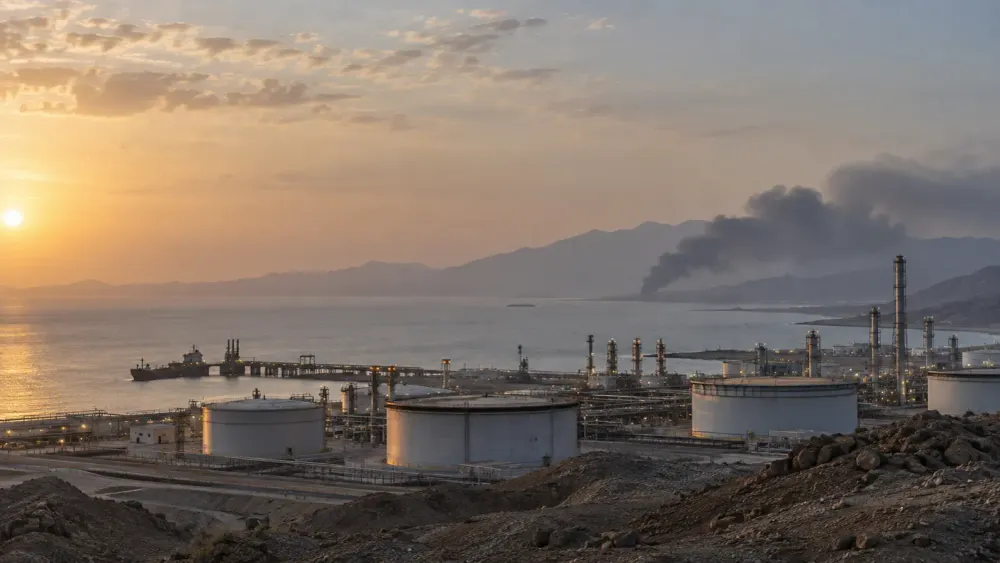
Houthi missiles and drones struck four cities in southern Saudi Arabia early Tuesday, injuring 73 people and setting energy facilities and utilities on fire in the most consequential expansion yet of Yemen’s renewed cross-border war. Saudi authorities said operations at affected sites were temporarily suspended, while the kingdom promised a response and oil prices moved closer to $100 a barrel.
The attacks hit Abha, Jazan, Najran and Khamis Mushait, according to Maj. Gen. Turki al-Malki, spokesperson for the Saudi-led coalition fighting in Yemen. Women and children were among the wounded, he said. The casualty total and the description of the targets come from Saudi officials and had not been independently verified at the time of publication, but both Reuters and the Associated Press reported the figures from named authorities.
The scale is the decisive new fact. The Houthis have attacked Saudi territory before, and the Saudi-led coalition has fought the movement for more than a decade. Tuesday’s barrage, however, combined reported strikes on civilian areas, a military base and multiple energy sites across four cities as the separate U.S.-Iran confrontation was already restricting Gulf oil flows. It opened a second pressure point along Saudi Arabia’s Red Sea energy corridor at the moment that route has become more important as an alternative to the Strait of Hormuz.
What each side says happened
Al-Malki said the strikes hit “civilian and economic facilities,” characterized the operation as a serious escalation and said Saudi Arabia would take measures to defend its territory. The Saudi Energy Ministry said fires broke out at oil installations and utilities in the south and that operations at some locations were temporarily halted while emergency crews responded.
Houthi military spokesperson Brig. Gen. Yahya Saree claimed responsibility in a prerecorded statement. He said the group launched dozens of ballistic missiles and drones against the Jazan City for Primary and Downstream Industries, Saudi Aramco facilities in Najran and Abha, and King Khalid Air Base at Khamis Mushait. Those are the Houthis’ claims about the weapons and intended targets; Saudi authorities confirmed attacks and damage but did not publicly validate every element of Saree’s account.
The Houthis described the operation as retaliation after an airstrike hit a prison in Yemen’s northern Jawf province, killing at least seven people, including a child, according to the AP. The movement blamed Saudi Arabia. Riyadh had not confirmed responsibility for that prison strike by the source cutoff. Reports that Saudi aircraft subsequently struck Marib also rested on Houthi-run media and had not been confirmed by the Saudi government. Those unresolved attributions matter because retaliation claims can quickly become the public rationale for another round of attacks.
Saudi Arabia’s foreign ministry said the kingdom would take necessary measures to defend its sovereignty. Pro-government Yemeni forces, meanwhile, were pressing an offensive against the Houthis, who control the capital, Sanaa, and much of the country’s populated north. The collision of the Yemeni civil war with the larger confrontation involving Iran, the United States and their regional partners makes it harder to isolate any single exchange.
Why the energy targets matter
Jazan contains a refinery capable of processing about 400,000 barrels a day, one of the kingdom’s largest. Saudi officials had not quantified lost production, identified every damaged unit or given a timetable for restoring suspended operations. A fire and a temporary shutdown do not by themselves establish a prolonged supply loss. The immediate economic signal was nevertheless clear: Brent crude rose to about $98 a barrel as markets absorbed the prospect of simultaneous threats to Saudi facilities and regional shipping.
Saudi Arabia is not simply another producer in that calculation. The U.S. Energy Information Administration’s most detailed country analysis describes the kingdom as a leading global crude exporter and says its East-West pipeline can carry 5 million barrels a day to the Red Sea, temporarily expandable to 7 million. That system gives Riyadh a way to bypass both Hormuz and the Bab el-Mandeb chokepoint. Attacks on the southern Red Sea side therefore threaten infrastructure that helps make the global oil system more resilient when Gulf shipping is disrupted.
The same EIA assessment says Saudi Arabia’s crude and petroleum-product exports represented 34% and 26%, respectively, of OPEC exports in 2023. It also found that Saudi Arabia supplied 42% of the crude moving through Hormuz that year. Those historical figures are not a measure of Tuesday’s damage, but they explain why even a temporary interruption can move prices before engineers establish what was hit and how long repairs may take.
The escalation also reaches American interests directly. The White House’s current security strategy identifies open Gulf and Red Sea routes, reliable energy flows and protection from attacks on U.S. interests as core priorities. The State Department’s standing travel advisory warns Americans near Saudi energy infrastructure and military bases that Houthi missiles, drones and falling interception debris create elevated risks, especially near the Yemeni border.
A war spreading across connected fronts
Tuesday’s strikes followed a renewed U.S.-Iran exchange in and around the Gulf. On Saturday, U.S. Central Command said it destroyed three Iranian oil tankers after Iran targeted two U.S. Navy warships, a confrontation TAQ reported as a merger of naval force protection, energy exports and control of Hormuz. CENTCOM’s public release log confirms that operation as the latest announced American strike in the theater.
The Houthis are aligned with Iran and receive Iranian support, but alignment does not prove that Tehran ordered Tuesday’s attack. U.S. officials have documented networks supplying the movement with money, oil revenue and weapons. In January, the Treasury Department imposed sanctions on nearly two dozen people and entities it said were involved in Houthi financing and procurement; Treasury Secretary Scott Bessent said the network threatened U.S. forces and commercial shipping. That sanctions action supports the broader relationship, not a conclusion about operational command in this particular barrage.
The United Nations had warned that this fusion of conflicts was becoming more likely. In an August Security Council briefing, U.N. Special Envoy Hans Grundberg said Yemen risked being drawn into a wider Middle East confrontation and urged the parties to protect a still-fragile path toward a national ceasefire. The council’s record documented both cross-border Houthi attacks and the danger that regional military exchanges would erase recent diplomatic gains.
That risk is now concrete. A conflict that had eased after a 2022 truce is again producing cross-border strikes, Saudi-backed ground operations and displacement inside Yemen. The humanitarian consequences are not collateral context: each additional front complicates access to food, fuel and medical care in a country whose institutions have already been weakened by years of war. The casualty and displacement estimates will require continued verification as access changes.
What happens next
Three questions will determine whether Tuesday’s attack becomes a sharp episode or the start of a more dangerous phase. First, Saudi Aramco and the Energy Ministry must establish which units were damaged, whether exports or domestic fuel supplies were interrupted and when suspended operations can safely resume. Second, Riyadh must decide whether its promised response will remain limited or expand the air campaign in Yemen. Third, U.S. and regional officials must determine whether the operation was coordinated with Tehran or independently timed by Houthi commanders.
None of those answers was available by the source cutoff. There was also no confirmed evidence of fatalities in Saudi Arabia, no independently verified count of missiles and drones, and no official estimate of lasting production losses. Reports of subsequent Saudi strikes in Yemen remained unconfirmed by Riyadh. Those gaps make caution essential even as the confirmed facts justify alarm.
The immediate picture is still consequential: 73 people wounded across four cities, fires at energy and utility sites, temporary operational suspensions and a Saudi promise to respond. The strategic meaning is larger than the damage visible Tuesday morning. The Houthis demonstrated that the Red Sea side of the Arabian Peninsula can be pressured at the same time as the Strait of Hormuz, reducing the separation between Yemen’s war, the U.S.-Iran conflict and the energy routes that connect them to the American economy.