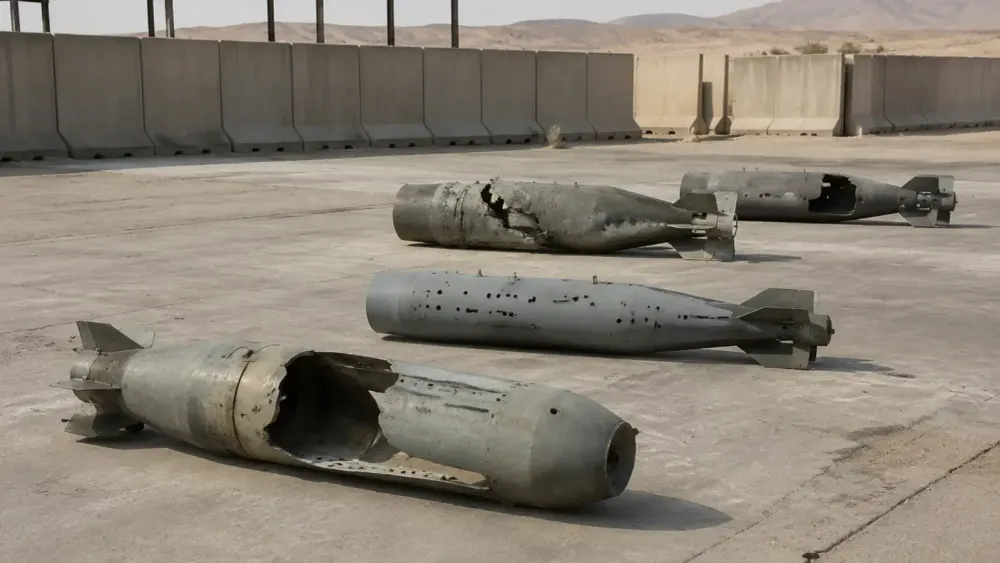
The Organisation for the Prohibition of Chemical Weapons has verified the irreversible destruction of 42 unfilled aerial bombs in Syria, the first internationally confirmed destruction of Syrian chemical munitions on the country’s territory since 2014. United Nations disarmament chief Izumi Nakamitsu disclosed the result Thursday at the Security Council after an OPCW team observed the operation in August, according to the official UN briefing.
The bombs were Category 3 chemical weapons: unfilled munitions or devices designed to deliver toxic agents. Their destruction therefore did not neutralize 42 bombs loaded with sarin or another chemical, and it does not establish that Syria’s remaining clandestine stockpile has been found. It does eliminate delivery hardware from a program the former government concealed and marks a shift from locating dangerous remnants to physically removing them under verification.
Syria’s new authorities also declared an additional chemical-weapons production facility, a newly discovered chemical used to make nerve agents, empty munitions and two storage facilities connected to the finds. The disclosures build on material recovered in May and make Thursday’s announcement an operational milestone rather than a declaration that the dossier is closed. The size, location and condition of other Assad-era holdings remain uncertain.
What the August Operation Established
Verification is the central fact. Syrian personnel carried out the physical destruction, while OPCW inspectors confirmed that the 42 bombs were rendered unusable. The agency’s procedure separates a government’s assertion from an internationally observed result, creating records of the declared items, the agreed destruction method and the outcome. Reuters reported that the August mission was the first such verified operation in a decade.
The category matters because an empty casing poses a different immediate hazard from a munition filled with nerve agent, but it is still controlled under the Chemical Weapons Convention when designed for chemical warfare. Destroying the delivery body prevents later filling and use. It also reduces the risk that military hardware could be diverted while inspectors and Syrian teams search dispersed sites whose records may be incomplete or intentionally falsified.
The operation followed an OPCW decision adopted in October 2025 that created an expedited route for on-site destruction when an item cannot be safely stored or moved. That decision requires Syrian consultation with inspectors, a declaration, a destruction plan, verification, protection of people and the environment, and preservation of evidence. It permits speed in hazardous settings without making destruction an unrecorded battlefield disposal.
A Declaration That Never Closed
Syria joined the Chemical Weapons Convention in October 2013 after a sarin attack in the Damascus suburb of Eastern Ghouta and the threat of U.S. military action. The former government declared roughly 1,300 metric tons of chemical agents and precursors. Those declared materials were removed and verifiably destroyed outside Syria, but the OPCW says questions about the completeness of the declaration persisted, as its Syria record explains.
The gap between destroying a declared stockpile and eliminating an actual program became the defining problem. Inspectors repeatedly found inconsistencies, while investigations attributed later attacks to Syrian government forces. An OPCW report released in January found reasonable grounds to believe that the Syrian Arab Air Force used chlorine in Kafr Zeita in 2016, injuring 35 named people and affecting dozens more. The investigation considered samples, interviews, modeling, satellite imagery and authenticated images.
The current searches show why the earlier declaration could not be treated as comprehensive. Syrian teams working with inspectors had located more than 70 rockets and aerial bombs by May, along with chemicals and equipment associated with sarin production, a Syrian representative told Reuters. The OPCW said dozens of undeclared munitions had been found at high-priority locations in coastal and central Syria.
That inventory is still a starting point. OPCW experts have estimated that as many as 100 locations may need examination, from military bases and laboratories to storage or administrative sites. A March elimination plan backed by the United States and several other governments anticipated months or years of work. Some locations have been bombed or looted, and the secret program left gaps in documents, institutional memory and technical expertise.
Cooperation Changes the Mission
The fall of Bashar al-Assad’s government in December 2024 changed inspectors’ access. Under the former authorities, the OPCW described years of obstruction and disputed declarations. The successor government granted site and personnel access, security escorts, faster visas and documentation. Since November 2025, the agency has maintained a continuous presence in Syria through its Office of Special Missions, coordinating inventory, destruction, verification and investigations.
That cooperation has produced political as well as operational consequences. OPCW members suspended Syria’s voting rights in 2021 after findings that government forces had used chemical weapons. In July 2026, the Executive Council restored those rights by consensus after citing concrete steps under the new authorities; the decision was co-sponsored by 67 states. The restored rights reward cooperation but do not certify that every weapon or facility has been declared.
Three separate OPCW missions remain active. The Declaration Assessment Team works through gaps and inconsistencies in Syria’s submissions. The Fact-Finding Mission determines whether toxic chemicals were used as weapons. The Investigation and Identification Team assigns responsibility in specified incidents. Keeping those mandates distinct prevents successful destruction work from erasing unresolved questions about the historical program or accountability for attacks.
Security Conditions Still Limit the Search
Finding and destroying remnants is technically difficult even with government access. Suspect materials must be identified, sampled and secured without exposing workers or nearby communities. Inspectors must distinguish prohibited agents and precursors from chemicals with legitimate industrial uses, while preserving an auditable chain of custody. The Chemical Weapons Convention’s core rule requires states to destroy weapons and production facilities under their jurisdiction, not merely relocate or abandon them.
Physical security presents a second problem. Syria’s envoy Ibrahim Olabi told the Security Council that repeated Israeli attacks had impeded searches and put Syrian teams at risk. Israel did not immediately respond to Reuters’ request for comment. The OPCW’s expedited framework separately recognizes that airstrikes, militant groups, damaged sites and unstable conditions can make storage or transport unsafe, which is why verified destruction may sometimes occur where material is found.
The tradeoff is speed against evidence preservation. A dangerous munition may need prompt destruction to prevent theft or accidental release, yet fragments, residues and site records can help identify the program’s scale and connect material to past attacks. The OPCW decision requires destruction methods to protect people and the environment while retaining evidence when feasible. Each operation must therefore solve a security problem without unnecessarily weakening future investigations.
Destruction and Accountability Now Converge
Syrian authorities have detained 18 people suspected of involvement in the former chemical-weapons program, including senior military, political and technical officials, and Olabi said the first court hearing is being prepared. Detention and a planned hearing are not convictions. The defendants have not been publicly identified, the evidence against each has not been presented in court, and the fairness and independence of the proceedings will determine whether they amount to credible accountability.
The destruction mission and the legal process depend on some of the same evidence but pursue different outcomes. Inspectors seek to identify, secure and eliminate weapons; investigators reconstruct who ordered, produced or used them. The OPCW’s 2025 framework explicitly directs the collection and preservation of evidence so that urgent disposal does not foreclose later cases. That linkage is important because eliminating hardware prevents future use, while adjudicating responsibility addresses past conduct.
The 42 bombs establish that verifiable disarmament has resumed inside Syria, not that the Assad-era program has been eliminated. The next measures are concrete: additional site declarations, verified destruction of recovered chemicals and munitions, resolution of inconsistencies in Syria’s original filing and documented progress across the estimated search locations. Continued access will determine whether Thursday’s milestone becomes the first step in closing the dossier or remains an isolated success within a still-unknown arsenal.