Nigeria’s securities regulator has approved a 4.1 billion-share offering by Dangote Petroleum Refinery at ₦525 a share, giving Africa’s largest refinery permission to seek about ₦2.15 trillion, or roughly $1.6 billion, from public investors. If fully subscribed, the transaction would be the continent’s largest share sale, according to Reuters. It would also turn one of Africa’s most consequential private industrial projects into a test of how much investors will pay for control of regional fuel supply.
The approval does not mean the money has been raised. The company has said the Securities and Exchange Commission cleared its draft offer documents and authorized the formal completion process, while people familiar with the timetable expect the order book to open September 14. The company account confirms the price and share count, but final demand, allocations and the listing date remain unresolved.
The offering’s appeal rests on an unusual combination: a refinery that has already changed Nigeria’s import-dependent fuel market and a proposed valuation that assumes much more growth is ahead. That makes the sale more than a fundraising exercise. It asks investors to value an operating plant, a capacity-doubling construction plan and a set of ambitious earnings targets together, even though detailed public financial statements for the refinery are not yet available.
A Small Public Float at a Very Large Price
Dangote Refinery has about 120.13 billion registered shares before the offer. Adding 4.1 billion new shares would put the base sale at roughly 3.3% of the enlarged total, before any over-allotment option. That is a narrow public slice for a company seeking a record transaction, and it may limit trading liquidity even if the offer attracts the broad African participation that founder Aliko Dangote says he wants.
At ₦525 a share, the existing capital implies an equity value near $47 billion at the exchange rate used in the offering coverage. A private placement in July reportedly valued the business around $40 billion. For perspective, listed refiners with broadly comparable aggregate capacity, including Turkey’s Tupras and the United States’ HF Sinclair, recently carried market values of roughly $12 billion and $16 billion, respectively, though refinery configuration, debt, market access and ownership make simple comparisons imperfect.
Dangote’s premium case is that the refinery is not merely another processor in a mature market. It sits beside one of Africa’s largest fuel-consuming economies, can substitute for imported products and has export access from the Lekki coast. Those advantages may justify a higher multiple. They do not, by themselves, establish the value of an enterprise whose leverage, margins, working-capital needs and related-party arrangements have not yet been presented in a full public prospectus.
The Plant Has Already Rewritten Fuel Trade
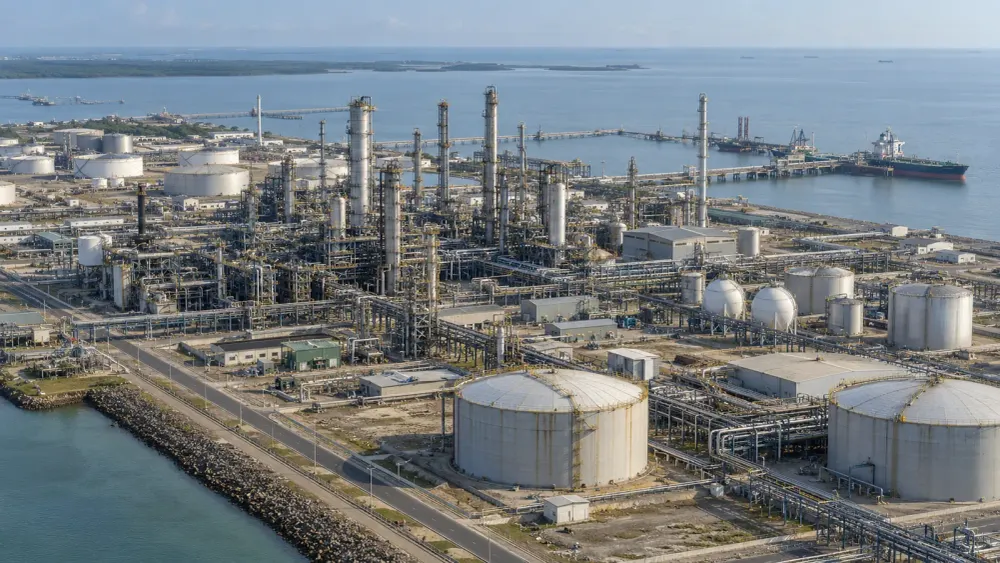
The approximately $20 billion refinery began commercial operations after years of construction with nameplate capacity of 650,000 barrels a day. In June, it processed more than 700,000 barrels a day during a performance test, according to operating data, while product exports reached 353,000 barrels a day in April and 285,000 in May. Those figures demonstrate physical scale, although a short test is not the same as sustaining that throughput across a full financial year.
The market opportunity is equally tangible. Nigeria imported 20.3 billion liters of motor gasoline in 2023, even as a major crude producer, official statistics show. Domestic refining therefore can reduce shipping costs and foreign-exchange demand while improving supply security. The plant’s diesel, jet fuel and gasoline exports have also forced traditional suppliers to compete for markets they once served with limited African refining competition.
Yet measurement disputes show why public disclosure matters. Dangote said in late 2025 that it could supply 1.5 billion liters of gasoline a month, while regulator figures cited at the time put its daily output near 18 million liters, about one-third of national demand. That discrepancy may reflect different periods, definitions or operating conditions, but shareholders will need reconciled production and sales data rather than competing public claims.
Expansion Is Carrying the Valuation
Management plans to expand capacity to 1.4 million barrels a day by 2028, which would make the complex the world’s largest single-site refinery by the company’s measure. A reported $2.5 billion financing package for that work was heavily oversubscribed, the Financial Times reported in August. IPO proceeds would add another pool of capital, but the announced expansion cost, funding mix and obligations to lenders will shape what remains for ordinary shareholders.
Execution risk is not theoretical. The original project took nearly a decade to complete and cost about $19 billion, significantly more than early expectations, according to an Associated Press review of the expansion plan. Doubling a complex that is still stabilizing operations requires equipment, contractors, feedstock agreements and infrastructure. A 2028 target can support a valuation narrative today, but missed milestones would postpone the earnings that are supposed to justify it.
Dangote has said the refinery could eventually generate more than $12 billion in annual earnings before interest, taxes, depreciation and amortization. That is a management ambition, not an audited result. Refining profits move with crude costs, product prices, outages and shipping conditions; they can compress quickly after periods of scarcity. Investors therefore need historical margins, debt service, capital expenditure and sensitivity assumptions before treating that figure as a dependable earnings base.
Public Markets Bring New Demands
The regulator’s approval marks a notable change from June, when the SEC ordered a halt to promotional activity for a purported offering and said no application had been approved. Its cease-and-desist notice warned that unauthorized solicitation could mislead investors. Clearing the documents three months later resolves that procedural obstacle, but it also raises expectations that the final prospectus will replace promotional projections with standardized, reviewable information.
A listing also imposes continuing obligations beyond the initial sale. The Nigerian Exchange’s requirements cover public ownership, shareholder distribution, corporate records and disclosure, with standards varying by board. A small float can meet a capital-raising goal while leaving governance concentrated in the founder’s group. Investors will watch the chosen board, free-float treatment, independent directors and timetable for reporting as closely as the headline subscription total.
Currency is another complication. Dangote has promoted dollar-linked payouts and returns as a way to attract both Nigerian and international capital. The refinery earns foreign currency from exports but also faces dollar-denominated equipment, debt and feedstock costs. A structure that protects investors from naira depreciation could widen demand, yet the prospectus must explain the legal mechanism, available cash flows and circumstances in which those promised links might not translate into actual distributions.
The Offer Is a Test, Not a Verdict
The approved base deal is substantially smaller than the roughly $5 billion fundraising target Dangote discussed only a day before the terms emerged. He had said the offer could open within 10 to 12 days, according to an earlier interview. A smaller first tranche may improve the odds of completion, preserve control and leave room for future sales, but it also means the IPO alone cannot fund every expansion ambition.
About $400 million of underwriting commitments and a possible 15% over-allotment provide support, not a guarantee. Investors must also consider policy risk. Nigeria abandoned a planned 15% fuel-import tariff in 2025 after marketers warned that it could make the country too dependent on one domestic supplier, a policy reversal that showed the government balancing industrial development against competition and consumer prices.
The order book will reveal whether investors accept that balance of demonstrated industrial power and still-unproven financial value. Strong demand would give Dangote capital, credibility and a public-market currency for expansion. Weak demand would not erase the refinery’s strategic importance, but it would challenge the $47 billion price. The decisive evidence will be the final prospectus, audited results, allotment data and construction milestones—not the scale of the plant or the ambition of its owner alone.