An Ohio manufacturer that supplies power and structural equipment for data centers is asking public investors to value it at as much as $5.37 billion, making its initial public offering a closely watched test of how far the artificial-intelligence infrastructure boom can extend beyond chipmakers and cloud operators.
Accelevation Holdings and some existing shareholders plan to sell 30 million shares for $20 to $24 each, according to an amended filing submitted to the Securities and Exchange Commission on Tuesday. The offering would raise $600 million at the low end and $720 million at the high end before underwriting discounts and other expenses. At the midpoint, gross proceeds would be about $660 million.
The Miamisburg-based company expects to trade on the Nasdaq Global Select Market under the symbol ACCV. Morgan Stanley, JPMorgan, Goldman Sachs, Barclays and Bank of America are among the banks leading the offering, according to the prospectus and an independent IPO profile. Trading is expected to begin Sept. 30, although timing and pricing can change while the roadshow is underway.
A factory-floor route into the AI buildout
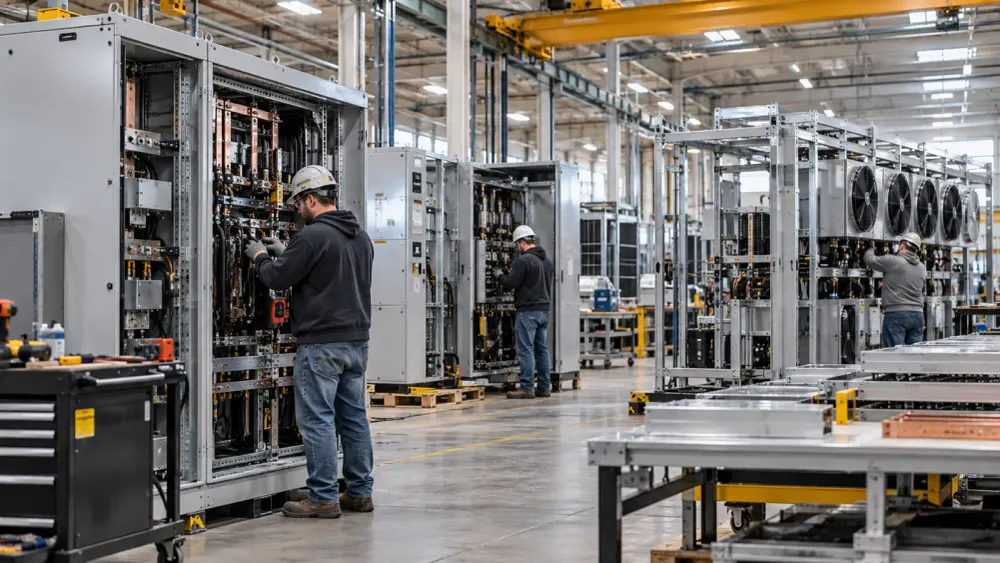
Accelevation does not make semiconductors or train AI models. It designs, manufactures and installs the physical systems needed inside data centers: power-distribution units, remote power panels, cable-routing structures, racks, containment products and cooling-ready modular infrastructure. The company says its integrated approach is meant to reduce the number of suppliers and handoffs required to bring new computing capacity online.
That position gives investors a different way to gain exposure to AI spending. Large computing campuses require far more than processors. They also need electrical distribution, steel structures, airflow management and increasingly complex cooling systems. Accelevation says it operates 1.5 million square feet of U.S. manufacturing capacity, with Ohio at the center of its corporate footprint. Its website describes the business as combining engineering, factory production and field installation in one operating system.
The growth numbers explain the market interest. Revenue rose 147% from 2024 to 2025, reaching about $447.8 million, while net income reached about $21.8 million, according to the company’s initial filing and data compiled by IPO Scoop. The company reported a backlog of roughly $1.1 billion as of June 30, more than twice its 2025 revenue. Backlog is not the same as recognized sales, but it indicates the volume of work customers have committed to under existing orders and contracts.
Accelevation was founded in 2017 by Chief Executive Michael Rubiera and was acquired by private-equity firm Olympus Partners in January 2025, according to a Reuters report on the original registration. The company employed 1,716 people when the prospectus data were compiled.
Valuation leaves little room for a slowdown
At the top of the proposed range, the $5.37 billion valuation would equal roughly 12 times Accelevation’s 2025 revenue and about 247 times its 2025 net income. Those comparisons are backward-looking and do not account for the company’s rapid expansion, but they show how much future growth is already embedded in the asking price. The 2025 net margin was just under 5%, a reminder that fast sales growth has not yet translated into software-like profitability.
The central investment question is whether data-center construction remains strong enough for Accelevation to convert backlog into revenue while expanding factories and preserving margins. Its own market estimate, prepared with outside consulting support and summarized in the prospectus, puts the addressable market at $22 billion in 2025 and projects it could approach $80 billion by 2030. That forecast is not a guarantee; it depends on continued cloud and AI capital spending, faster data-center deployment and demand for more power-dense systems.
Execution matters because manufacturing is capital-intensive. Orders can shift, large construction projects can be delayed and changes in chip architecture or cooling design can force suppliers to retool. Backlog also carries less certainty than completed revenue. The prospectus warns that the business depends on maintaining customer relationships, meeting demanding delivery schedules and managing supply chains as it scales. Investors will also have to assess the influence of Olympus and other existing owners after the transaction.
The offering arrives amid renewed appetite for AI-linked listings. A Tuesday report noted that investors are becoming more selective about where companies sit in the AI value chain and whether their finances can support fast expansion. Accelevation is profitable, unlike many growth-stage technology issuers, but its proposed valuation assumes that demand for data-center infrastructure will remain unusually strong.
A broader test for industrial AI suppliers
If the deal prices near the top of the range, it would show that public markets are willing to award premium valuations to the industrial layer beneath AI computing. A weaker price or reduced share count would suggest investors want a larger margin of safety after years of aggressive spending forecasts.
For Ohio, the transaction would bring a fast-growing local manufacturer into the public markets at a scale rarely seen among recent industrial issuers. For investors, the roadshow will test a simpler proposition: whether the physical bottlenecks of the AI expansion can produce durable profits, not merely rapid orders. The answer will depend less on headlines about artificial intelligence than on factories, delivery schedules and Accelevation’s ability to turn a $1.1 billion backlog into cash.