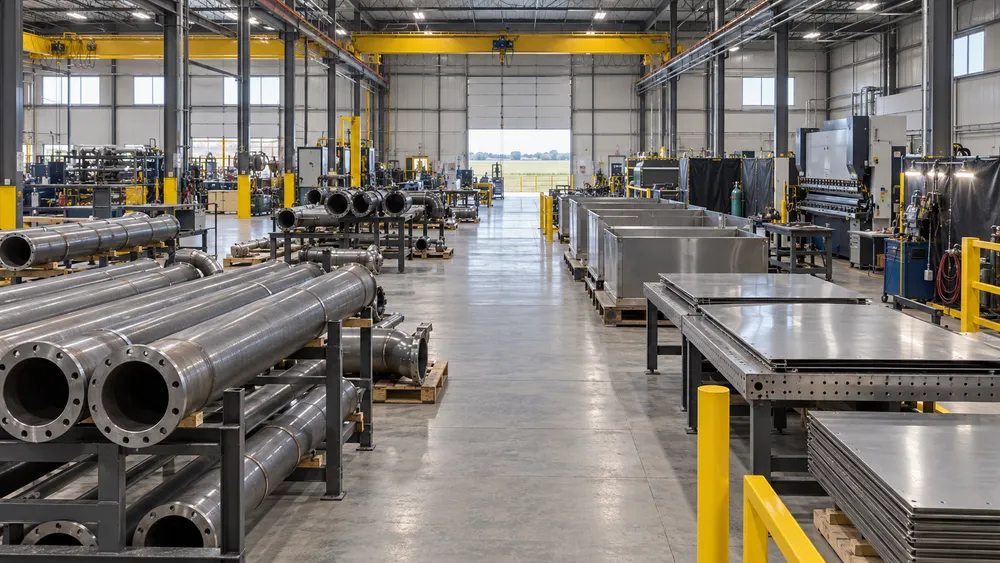
U.S. Engineering Metalworks has opened a second production facility in Lawrence, adding 110,000 square feet of fabrication capacity and committing $25 million to an expansion expected to create 50 jobs over three years. The Kansas announcement places the project at Lawrence VenturePark, where the company began operating in 2022.
The company expects to add about 30 positions during the first year and 20 more within three years. It already employs roughly 160 people in Lawrence, including about 140 production workers and 20 support employees. According to the company’s project release, production employees at the site earn an average of more than $90,000 annually. That wage figure is a company-reported average, not a guarantee for each new position.
The Lawrence operation fabricates piping, plumbing, sheet metal and other mechanical systems used in hospitals, research facilities, data centers and large commercial projects. The additional floor space is intended to increase off-site fabrication, allowing assemblies to be built under controlled factory conditions before they are delivered to construction sites. The company said its Lawrence work also supports the Panasonic Energy development in De Soto.
The expansion carries a public-incentive component. Lawrence city commissioners approved industrial revenue bonds of up to $25 million, a sales-tax exemption on construction costs and a 10-year, 70% property-tax abatement. The October 2025 city minutes show the measure passed 4-0 after a public hearing. Industrial revenue bonds in this context are a financing and tax-incentive mechanism; the authorization does not mean the city is paying the company’s full investment.
A city study cited by the state and company projects more than $52 million in net benefits over 25 years for Lawrence, Douglas County, the Lawrence school district and Kansas. That forecast is materially larger than the stated investment, but it remains a projection tied to assumptions about payroll, hiring, taxable activity and the durability of the operation. Actual public returns will depend on whether the promised jobs arrive, wages hold and the facility remains productive after the abatement period.
The project is also a test of Lawrence’s Catalyst Program, which is designed to speed approvals for qualifying industrial investment and job creation. A trade report confirms the facility’s size, hiring schedule and role in supplying complex building projects nationwide. Those details make the expansion consequential beyond a ceremonial opening: it enlarges Kansas’s advanced-manufacturing base while linking state incentives to measurable employment targets.
For state and local officials, the useful benchmarks are now straightforward. They can track the 30 first-year hires, the additional 20 positions by year three, actual average wages and the tax value forgone under the abatement. Publishing those results against the original forecast would let Kansans judge whether the $25 million expansion is producing the promised public benefit as well as private manufacturing capacity.