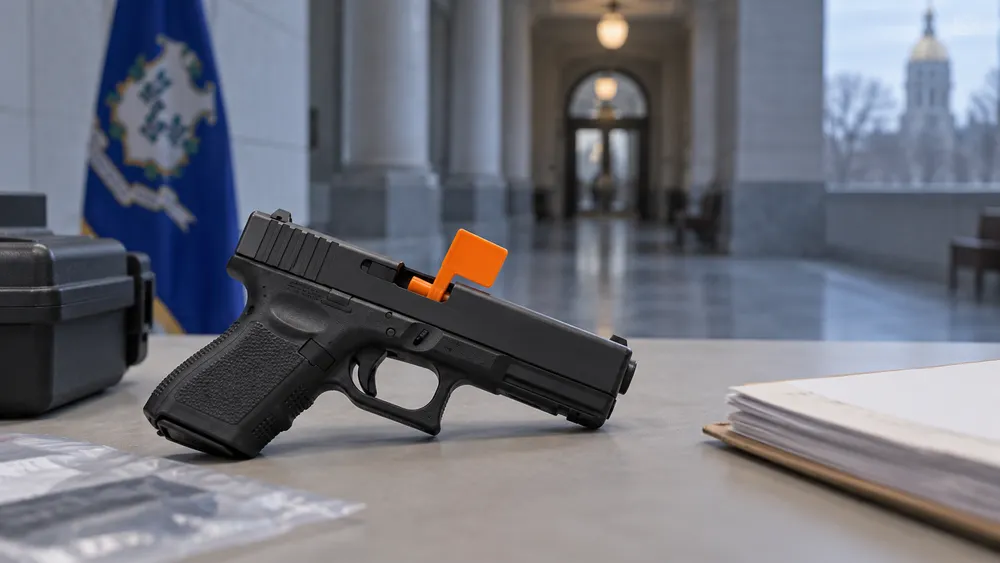
Glock and firearms-rights groups have opened a federal court challenge to Connecticut’s new ban on the sale or import of certain semiautomatic pistols that can be converted to automatic fire, asking a judge to intervene before the law takes effect Oct. 1.
Glock’s lawsuit, filed Monday in U.S. District Court in Connecticut, argues that the statute is unconstitutionally vague and violates the Second Amendment. The company is seeking an order that would prevent the state from enforcing the ban against its pistols while the case proceeds.
The law applies to newly sold or imported semiautomatic handguns with a “cruciform trigger bar” that can be converted into a machine gun by hand or with a common household tool. A violation can bring up to five years in prison, a fine of as much as $5,000, or both, according to a detailed account of the measure signed by Gov. Ned Lamont in May.
The litigation does not involve a state effort to confiscate pistols already legally owned. The prohibition is directed at future sales and imports, a distinction documented in a national review of laws aimed at conversion devices. Those small components, often called “Glock switches,” can allow a semiautomatic pistol to fire continuously while the trigger remains depressed.
A second federal suit was filed by the National Shooting Sports Foundation, the Second Amendment Foundation and individual plaintiffs. That complaint likewise contends that the statute improperly restricts commonly owned handguns. Together, the cases put both the wording of Connecticut’s definition and the broader constitutional treatment of the covered firearms before the federal court.
The industry plaintiffs say the law reaches pistols because of their design rather than because a conversion device has actually been installed. The state’s position is that regulating firearms that can be readily converted addresses the supply of weapons most susceptible to illegal modification. Those competing descriptions will shape how the court evaluates both the law’s fit and its practical reach.
Attorney General William Tong said the state would defend the law. In an official statement, Tong called the claims meritless and said Connecticut adopted the restriction to reduce the risk that pistols could be readily converted into illegal machine guns.
The practical question for dealers is immediate: unless a court issues relief, the sales and import restriction begins Oct. 1. The cases could also clarify how precisely lawmakers must describe firearm features when a criminal penalty turns on whether a weapon is readily convertible.
For Connecticut residents, the dispute is narrower than a general handgun ban. It concerns a specified design feature and future commercial activity, while the plaintiffs argue that the covered models are ordinary semiautomatic pistols protected by the Constitution. The court’s first decisions are therefore likely to focus on whether enforcement should be paused and whether the statutory language gives manufacturers, dealers and buyers adequate notice of what is prohibited.