The Lucas Museum of Narrative Art opened to the public in Los Angeles on Tuesday, ending a 17-year effort to build a permanent home for more than 40,000 works collected by filmmaker George Lucas and business leader Mellody Hobson.
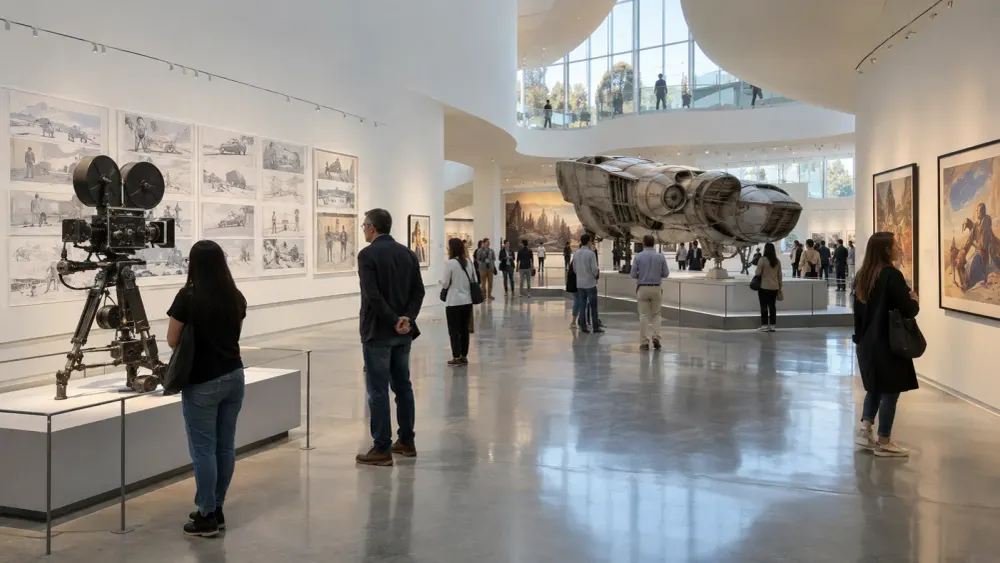
The roughly $1 billion institution arrives with an unusually broad definition of museum-worthy storytelling. Its holdings span paintings, illustration, comics, photography, murals, film production materials and popular art, placing Frida Kahlo and Norman Rockwell in conversation with comic strips, cinematic concept designs and objects from the Star Wars and Indiana Jones archives.
The public debut is a significant cultural event for the entertainment industry and Los Angeles. Lucas built his career around film franchises, but the museum's central argument is larger: images made for broad audiences can carry artistic, historical and social meaning alongside works traditionally displayed in fine-art institutions.
A collection built around stories
The museum's official account says Lucas began collecting original comic art in college and expanded the collection over more than five decades. It now includes more than 40,000 works, assembled by Lucas and Hobson around the idea that illustrated stories connect people across cultures and generations.
Among the opening highlights are a rare 1940 Kahlo self-portrait, works by Diego Rivera, Judith Baca and Banksy, and familiar American illustration. The Associated Press reported that the galleries move deliberately between canonical fine art and mass culture, including Cassius Marcellus Coolidge's dogs-playing-poker imagery and models, costumes and production art associated with Lucas's films.
That mix is the institution's defining proposition. Narrative art is presented not as one period or medium but as any visual work that communicates a story. The approach gives comics, posters, children's illustration and movie design the same curatorial seriousness often reserved for painting and sculpture.
The Lucas Archives add a direct entertainment-industry dimension. According to the museum's archive record, the collection began at Skywalker Ranch in 1983 and includes props, artwork and artifacts from the first six Star Wars films, the first four Indiana Jones movies and other Lucasfilm productions. Lucas donated the archive in 2013 as a foundation for the museum.
A major new Los Angeles landmark
The five-story building occupies a 13-acre campus in Exposition Park, across from the University of Southern California and near the California Science Center, the Natural History Museum and the Los Angeles Memorial Coliseum. Its flowing exterior was designed by Ma Yansong of MAD, with landscaping by Mia Lehrer and Studio-MLA.
The museum's campus details list 300,000 square feet of interior space, including 100,000 square feet of galleries, two theaters, a research library, classrooms, dining and event areas. More than 200 new trees, drought-tolerant plantings and public gardens replace what had largely been asphalt parking lots.
The structure's scale and design are part of its cultural statement. Rather than presenting popular imagery inside a conventional box, the building uses curved forms, elevated volumes and natural light to frame the museum as an attraction in its own right. Its programming is intended to reach beyond franchise fans and establish a broader platform for visual storytelling.
Seventeen years and three cities
The opening follows a long and politically complicated development process. Lucas first pursued a museum in San Francisco, then selected a lakefront site in Chicago before legal challenges and local opposition stalled that plan. Los Angeles was chosen in 2017, and construction began the following year.
The Guardian reported that the project took nearly two decades to realize and that its mission was shaped in part by skepticism toward illustration and commercial art. The result is neither a conventional film museum nor a monument solely to Lucas. Its galleries are organized around themes such as childhood, family, work, fantasy and civic life.
That breadth also creates a curatorial challenge. Visitors attracted by Star Wars may encounter centuries of visual culture, while traditional art audiences are asked to consider storyboards, comic panels and production models as serious creative works. The museum will have to demonstrate that those juxtapositions illuminate the objects rather than simply placing famous material side by side.
Public access begins
General admission is $25 for adults, while children 17 and younger and active-duty military members enter free. Timed tickets are required. The gardens, store, cafe and Skywalker Grill can be accessed without a museum ticket, subject to capacity, according to the institution's visitor guidance.
A visitor guide noted that the museum includes more than 30 galleries, film screenings and a research library, making the opening more than a display of memorabilia. Its success will depend on whether the institution can turn Lucas and Hobson's private collection into a durable public conversation about who defines art and which stories enter the cultural record.
For Los Angeles, the immediate result is a major new institution in a city identified globally with image-making but long divided between the film industry and the fine-art establishment. The Lucas Museum opens by arguing that the boundary was always less stable than it appeared.