More than 6.3 million acres have burned across the United States so far in 2026, according to the NIFC, a total already exceeding the full-year toll of 2025 with four months of fire season still ahead. As of Monday's federal situation report, 94 large fires remained uncontained nationwide, and the National Multi-Agency Coordinating Group has kept the country at Preparedness Level 5, the highest of five tiers, meaning nearly all available wildland firefighting resources are already committed or on standby, according to the BLM.
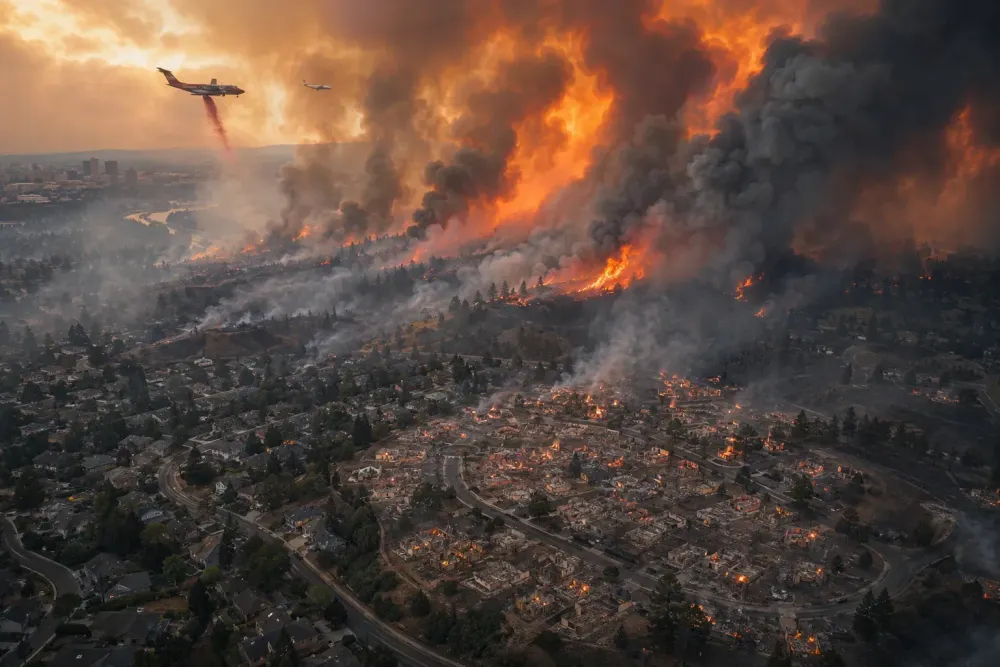
The crisis is most visible in Spokane, Washington, where a cluster of blazes that ignited on August 1 has become one of the costliest urban wildfire disasters in state history. More than 920 structures have been destroyed, according to the Red Cross, and while some evacuated neighborhoods began reopening this week, officials are still warning residents to stay out of restricted zones because hazards can linger even after flames are contained. The three fires — Old Trails, Fairview and Autumn Lane, collectively called the Spokane Complex — forced roughly 60,000 to 67,000 residents from their homes at the height of the emergency and knocked out power to tens of thousands more, according to Reuters. Spokane Mayor Lisa Brown called it the worst natural disaster her region has faced, a striking assessment for a metro area of roughly 230,000 people that had not previously seen wildfire breach its urban core at this scale.
Governor Bob Ferguson declared a statewide state of emergency on August 1 and a burn ban running through the end of September, after the National Weather Service issued Washington's first-ever "particularly dangerous situation" red flag warning, its most severe fire-weather alert category, according to Ferguson's office. The federal government subsequently approved an emergency declaration covering six counties and three tribal nations — the Yakama Nation, the Colville Reservation and the Spokane Tribe of Indians — unlocking Federal Emergency Management Agency support for sheltering, emergency food and water, and search-and-rescue operations, according to the governor's office. A separate federal public health emergency, approved August 7, is intended to speed medication refills and ease paperwork burdens for displaced residents relying on Medicare and Medicaid, the governor's office said.
The scale of loss has already drawn attention from the insurance industry. Reinsurance broker Gallagher Re has estimated that insured losses from the Spokane fires could reach into the hundreds of millions of dollars, with a plausible path to becoming a billion-dollar industry loss event and a chance of ranking among the costliest wildfires in Washington's history, according to Reinsurance News. Ratings agency AM Best separately concluded that insurers with concentrated exposure in the Spokane area will likely face considerable losses, though the damage does not yet appear to approach the scale of the 2025 California wildfires, according to AM Best. For context on how quickly costs can escalate, Washington's 2023 wildfire season, which included fires near Medical Lake and Elk not far from Spokane, produced roughly $240 million in insurance claims, an analyst told Stateline; this year's damage in the same region already appears larger.
Washington's crisis is only part of a national pattern. Governor Ferguson's own office noted the state is in the midst of a record fourth consecutive year of statewide drought, with more than 1,000 fires having burned roughly 450,000 acres by early August — the most acreage lost in the state since 2021, according to the governor's office. Nationally, the Northwest region — Washington and Oregon together — currently accounts for 44 of the 94 uncontained large fires tracked by federal coordinators, more than any other region, according to NIFC data. Oregon alone has recorded more than 1,400 wildfires this summer, burning over 2.2 million acres, the Red Cross said.
Elsewhere, a wildfire burning through Utah's Fishlake National Forest since late July turned fatal on August 8, when a Sikorsky S-64 helicopter contracted by the U.S. Forest Service crashed while fighting the blaze, killing both pilots aboard, according to The Times. Rescue crews could not immediately reach the wreckage because of the fire itself, which by that point had grown to nearly 174 square miles, and the crash reportedly ignited additional vegetation that merged with the existing perimeter. The National Transportation Safety Board is investigating, a process officials say could take a year or more given the complexity of aviation crash inquiries.
Federal officials describe the current alert level as a function of both fire intensity and resource scarcity rather than a single storm or region. At Preparedness Level 5, roughly 80 percent of the nation's wildland firefighting capacity is already tied up, meaning crews and aircraft can be harder to secure for any new fire that breaks out, regardless of where it starts, according to reporting that cited NIFC guidance via Healthcare Ready. The country has now been at that top tier since July 18 — the fifth time in roughly the past decade the designation has been reached, and notably longer and earlier than several recent comparable years, according to NIFC. An international incident management team and firefighting personnel from Australia and New Zealand have been deployed to support operations in the Northwest, alongside U.S. Air Force Reserve and California Air National Guard airtankers, according to the federal situation report.
The causes behind this year's fire activity are structural rather than attributable to any single decision or policy. Federal predictive services attribute the surge to a combination of persistent drought, above-normal temperatures, high wind events and the accumulation of dry vegetation built up over prior seasons — a set of conditions fire scientists describe as increasingly common across the Western United States, according to the seasonal outlook posted by NIFC. Investigators have also determined that human activity, not just weather, played a role in some individual fires: authorities in Spokane and Washington state have opened arson investigations into at least one of the Spokane Complex fires, and a man in the Spokane area was separately arrested and charged with intentionally starting one of three blazes that burned for over a week near the city, according to the Associated Press. No single cause explains a fire season of this magnitude; officials and researchers point instead to the interaction of climate-driven aridity with an expanding population living near fire-prone wildland areas.
For residents in and around Spokane, the immediate concern remains practical rather than statistical. Nearly 1,000 Red Cross disaster workers are staffing shelters, distributing wildfire recovery kits with N95 masks, protective suits and self-heating meals, and running a joint disaster assistance center where displaced families can access services from dozens of organizations at once, according to the Red Cross. Even as containment lines hold in some neighborhoods, officials continue to caution that returning too early carries its own risks — a reminder that a fire's retreat from the map does not mean a full return to normal life for the households it touched.