🎧 Listen to this article
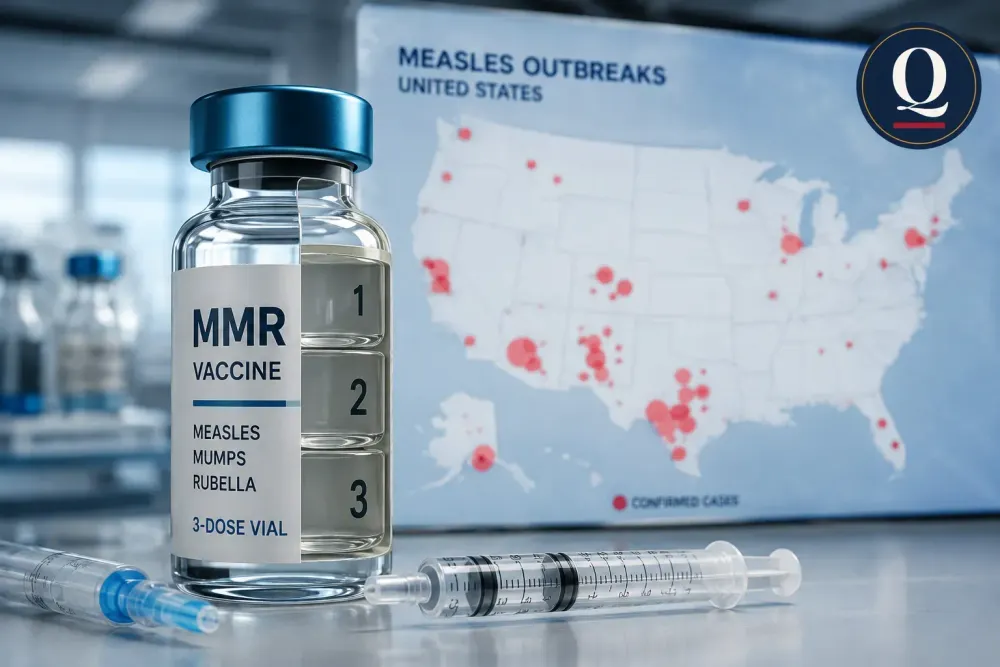
More than 2,400 measles cases have been confirmed nationwide so far this year, according to CDC data, the highest annual tally since the disease was declared eliminated in the United States in 2000 — a backdrop that framed President Donald Trump's decision to sign an executive order on Monday directing federal health agencies to recommend spacing out childhood immunizations and splitting the combined measles-mumps-rubella vaccine into three separate shots. The order, described in a White House announcement carried by Reuters, calls for "more vaccine flexibility and research" and states that "to the maximum extent feasible, all childhood immunizations should be administered at separate medical visits."
What the order changes
At a signing ceremony in the Oval Office, Trump framed the move as bringing the United States in line with international norms, saying the update "finally aligns the United States with other advanced and developed nations around the world," and adding, "nothing bad can happen from what we're doing," according to remarks reported by Notus. The order directs agencies to reorganize the childhood vaccine schedule into three tiers with differing recommendations depending on the vaccine, and instructs that combination shots — used for decades to reduce the number of injections a child receives — be broken into single-disease doses where possible. Health Secretary Robert F. Kennedy Jr. pledged that HHS would deliver an implementation plan within 90 days, saying, according to Notus, "we will keep working with urgency until American parents can have confidence that the medical advice that their government gives them is worthy of their trust." NIH Director Jay Bhattacharya said the order restores the "autonomy of families and parents to make good decisions for their kids," according to the same account.
One practical complication: standalone rubella and mumps vaccines are not currently sold in the United States, so the three-shot MMR breakdown cannot take effect immediately, according to the Associated Press. The order's own text, obtained by Axios and cited by Reuters, acknowledges this, specifying that the split-dose approach should proceed "once such products are domestically available."
Second attempt after a court setback
Monday's order follows an earlier push by Kennedy to cut the number of vaccines recommended for all children from 17 to 11, a change the CDC announced in January, according to STAT News. That revision moved shots for rotavirus, hepatitis A, hepatitis B, meningitis and seasonal flu into a "shared clinical decision-making" tier requiring individual provider consultation. A federal judge blocked elements of that effort in March, and the administration's appeal remains pending, according to AP reporting. Monday's order represents a fresh route toward similar goals while that litigation continues.
The American Academy of Pediatrics, representing more than 70,000 pediatricians, publishes a competing schedule that keeps the broader vaccine list intact. AAP President Andrew Racine called the earlier CDC revision "dangerous and unnecessary," warning it would "sow further chaos and confusion and erode confidence in immunizations," according to The Hill. Several major pediatric hospital systems, including Children's National in Washington and Texas Children's, have said they will keep following AAP guidance rather than the revised federal schedule, according to STAT News.
The measles context
The immediate backdrop is the worst measles year in the US since 1991. The CDC's measles tracker shows 2,465 confirmed cases as of August 6, spread across 47 jurisdictions, with 38 new outbreaks and 94% of cases tied to an outbreak, according to CDC data. That exceeds the 2,289 cases recorded in all of 2025, itself a 33-year high, putting 2026 on pace for the worst measles year since the 1989–1991 resurgence, according to Reuters. About 93% of this year's cases involve people who were unvaccinated or had unknown vaccination status, and children and young adults up to age 19 account for roughly 69% of infections, according to the same figures. AAP President Andrew Racine said in a statement reported by CIDRAP that "halfway into 2026, the U.S. is experiencing the worst year for measles since 1991," adding, "we are witnessing an avoidable crisis that disproportionately hurts children." The nation is on track to lose its official measles elimination status this fall, a designation held since 2000, according to the same CIDRAP report.
Infectious-disease specialists cited by the AP have raised concerns that spacing out shots into separate visits, as the new order recommends, could leave children unprotected for longer stretches between appointments, increasing the window for infection before a series is complete, according to AP reporting. The same report notes that the premise sometimes cited for spacing out shots — that combination vaccines overwhelm a child's immune system — runs counter to existing vaccine-safety research.
The signing ceremony also touched on a separate, ongoing NIH research initiative examining potential causes of autism, first announced in September 2025 and including 13 grants to outside researchers, according to Notus. Bhattacharya said the effort, expected to run roughly two more years, would produce early results within "a couple weeks," while cautioning that "it's not going to be a simple answer."
A structural, not partisan, fault line
The dispute sits at the intersection of executive authority, agency rulemaking and clinical guidance rather than a simple partisan divide: it pits the White House and HHS leadership against career public-health scientists, professional medical associations and, in several instances, federal courts, with litigation still unresolved. Both Kennedy and Bhattacharya said in television interviews last week, amid the measles surge, that children should generally be vaccinated, according to Notus, even as the administration pushes changes to how and when those vaccinations occur. HHS's 90-day timeline means implementation details — and any further court challenges — will likely take shape before year's end.