
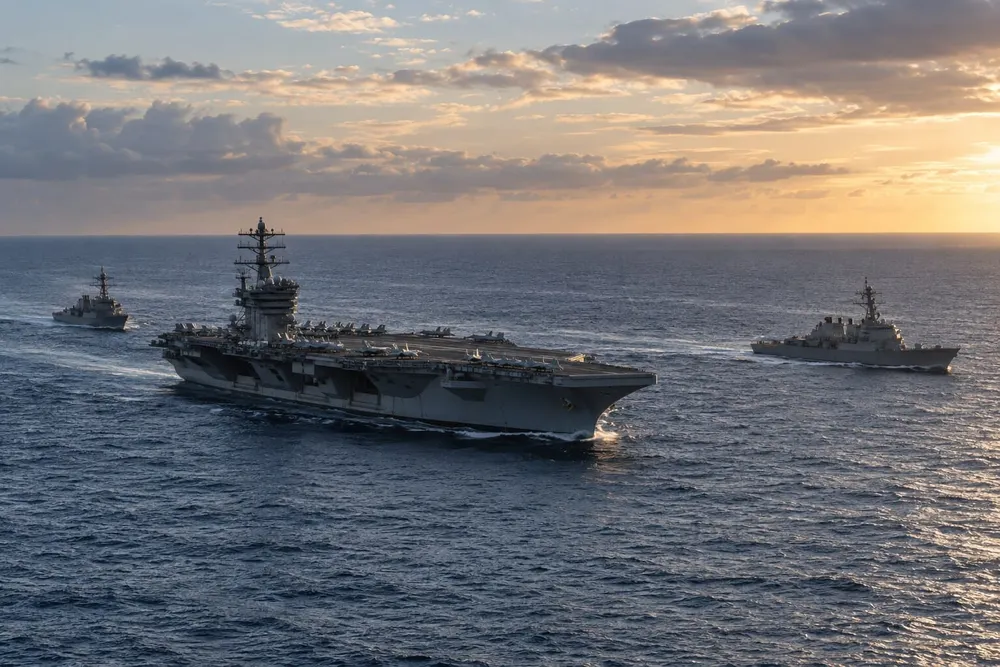
Roughly 9,000 U.S. sailors and Marines aboard a carrier strike group and an amphibious force are moving toward the Middle East, a buildup that could put three American aircraft carriers in the region while President Donald Trump considers renewed strikes against Iran.
The force includes the USS Theodore Roosevelt carrier strike group, with more than 7,000 personnel, and the USS Makin Island amphibious readiness group, carrying about 2,000 Marines, a U.S. official told the Associated Press. The ships have left California, but their arrival timetable and final disposition remain less certain than the size and composition of the force. U.S. officials told the Journal that the groups would reach the region by the end of November, while AP reported that three carriers could overlap as early as the end of October.
The deployment does not establish that Trump has decided to expand the war. It does give U.S. Central Command substantially more air, missile-defense, surveillance and amphibious options at a moment when ceasefire diplomacy is stalled, Iran is preparing for the possibility of renewed attacks and global fuel markets are already reacting to the risk of escalation.
Two naval groups add different capabilities
Theodore Roosevelt left San Diego on Sunday with Carrier Air Wing 11. A defense official confirmed the start of its planned deployment to USNI News, which had initially expected the carrier to relieve the Japan-based USS George Washington in the Middle East. The USS George H.W. Bush is also operating there. If Washington remains when Roosevelt arrives, the Navy would have three carrier strike groups in the theater for the first time since April and, before that, since the 2003 invasion of Iraq.
A carrier strike group provides sustained tactical aviation, air defense, electronic warfare and long-range strike capacity from international waters. The Navy describes Theodore Roosevelt as a nuclear carrier capable of supporting an embarked air wing. Its presence would not by itself signal that strikes are imminent, because carriers routinely deploy and can be redirected. But keeping three groups in one theater would concentrate ships and aircraft that otherwise support U.S. commitments in Europe and the Indo-Pacific.
The Makin Island group adds a different set of tools. It includes the USS John P. Murtha and USS Anchorage and carries the 13th Marine Expeditionary Unit. The Marine Corps describes that unit as a flexible, sea-based force for crisis response, amphibious operations and other missions. Its roughly 2,000 Marines can deploy aircraft and ground forces without requiring a permanent land base, giving commanders options ranging from evacuation and recovery missions to raids and reinforcement.
The destination is reported, but some details remain unsettled
Multiple news organizations independently reported the buildup through U.S. officials, but the public record contains a meaningful qualification. Bloomberg reported that Theodore Roosevelt had left San Diego while no final decision on its destination had been announced; Central Command said it does not discuss unit schedules for operational-security reasons. AP and The Wall Street Journal reported more definitively that the carrier and amphibious groups were heading to the Middle East.
That distinction matters because a scheduled deployment can become either a reinforcement or a rotation. George Washington could leave before Roosevelt arrives, preserving a two-carrier posture rather than creating a sustained three-carrier presence. The known movement still sends roughly 9,000 additional sailors and Marines toward a command that can redirect them, but the eventual peak force level depends on how long the two carriers already in the region remain.
AP estimated that an overlap would place more than 20,000 U.S. naval personnel and hundreds of aircraft in the region. That figure describes sailors and Marines assigned to the naval formations, not the entire American military presence across Middle Eastern bases. It also should not be read as a ground-force deployment of 9,000 soldiers: most of the personnel operate ships, aviation units and the embarked Marine force.
Military pressure rises as diplomacy stalls
The buildup follows Trump's rejection of Iran's latest truce proposal. He said Thursday that he was still weighing his options and had not disclosed a target or timetable. Iran, meanwhile, is planning a broader response if the United States resumes large-scale attacks, according to Reuters reporting based on Iranian officials and an insider familiar with the discussions. Neither side has announced a new ceasefire framework.
The additional forces arrive after repeated risks to American personnel and shipping. Eight Marines were wounded in a previously undisclosed Iranian strike on a vessel in the Strait of Hormuz, according to earlier TAQ reporting. The Navy's current posture therefore serves both offensive and defensive purposes: it expands strike capacity, but it also increases air defense, escort and personnel-recovery resources in a theater where U.S. ships have already faced missile attacks.
Oil markets price in a wider conflict
Energy markets responded before the deployment's final shape was clear. December Brent crude settled Thursday at $102.31 a barrel, up 4.4%, while U.S. benchmark crude rose 2.7% to $92.87, according to market data. The move also reflected China's suspension of most fuel-product exports and tight diesel inventories, so the day's price increase cannot be attributed to the U.S. deployment alone.
The reaction nevertheless shows why the naval buildup matters beyond military planning. The Iran conflict has disrupted refinery operations, shipping routes and expectations for fuel availability. A third carrier would not necessarily mean more fighting, but it reduces the time and logistical preparation needed for a larger U.S. operation. That option value is itself consequential when traders, allied governments and Iran are assessing whether the current lull will hold.
The next verifiable markers are operational rather than rhetorical: whether Central Command confirms Theodore Roosevelt's destination, whether George Washington rotates out before its arrival, and whether the Makin Island group enters the theater as planned. Until then, the confirmed movement is a major reinforcement in capability, while the duration of a three-carrier posture and the president's decision on renewed strikes remain unresolved.