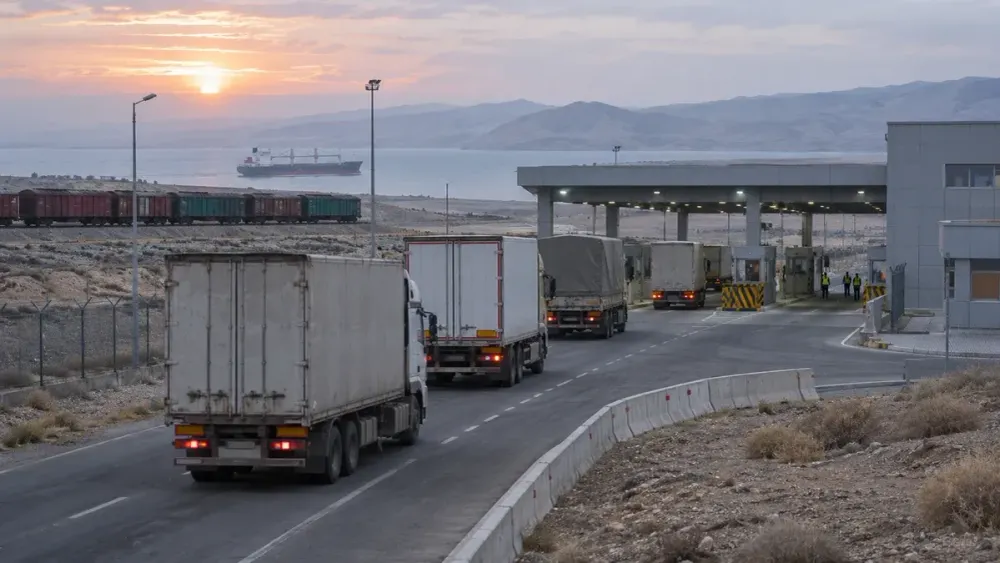
U.S. Central Command created a roughly 20-person task force Saturday to disrupt the movement of advanced weapons, dual-use technology, sanctioned goods and illicit revenue across Iran’s land borders and the Caspian Sea, extending the American pressure campaign beyond its naval blockade.
Adm. Brad Cooper directed the formation of Task Force Iron Gate at CENTCOM’s headquarters in Tampa, Florida. In its public statement, the command said the team would coordinate with other U.S. agencies to prevent restricted material and money from reaching or leaving Iran. Reuters and The Post independently confirmed the task force’s staffing, location and mission.
The announcement is a material expansion of the administration’s Iran strategy, but it is not an announced land blockade or a new deployment of combat troops. CENTCOM described Iron Gate as an internal staff that will combine military information with the sanctions, law-enforcement, diplomatic and intelligence tools of other agencies. It did not specify new legal authorities, name partner countries or explain how it would stop cargo outside U.S. jurisdiction.
A land and Caspian gap
The new task force targets a vulnerability left by the maritime campaign. A naval blockade can restrict tankers and cargo ships using Iranian ports on the Persian Gulf and Gulf of Oman, but it cannot by itself stop trucks crossing Iran’s long frontiers, cargo moving through neighboring states or ships arriving from Russia across the Caspian Sea. The Associated Press reported that CENTCOM said strict maritime enforcement would continue while Iron Gate focused on land routes and the Caspian.
Those corridors matter because Iran has continued obtaining military-related supplies despite Western sanctions and the blockade. A recent Reuters investigation traced at least $2 billion in hardware, explosives and heavy-duty trucks imported since January 2025 through a network that used Russian cargo ships, Central Asian trucks and Chinese freight aircraft. The investigation did not establish that all of the shipments violated U.S. law, but it documented the scale and geographic diversity of the network Iron Gate is intended to constrain.
CENTCOM said its naval blockade has already prevented more than $25 billion in Iranian crude exports. That figure is the command’s estimate, not an independently audited accounting, and neither CENTCOM nor the White House released a methodology with Saturday’s announcement. UPI also reported the estimate while attributing it to the military.
Coordination, not a closed border
Iron Gate’s small size indicates that it is designed as a coordinating cell, not a force capable of physically sealing Iran’s borders. Reuters reported that the expected participants include the Treasury, State and Justice departments as well as the intelligence community. Treasury can identify and sanction companies, banks and intermediaries; Justice can pursue cases within U.S. jurisdiction; and diplomatic and intelligence agencies can work with governments that control the actual crossings and transport networks.
That structure could make enforcement faster if the agencies share cargo, financial and ownership data in real time. It could also expose points in the supply chain where private carriers, insurers or banks face U.S. sanctions risk. But the effectiveness of the task force will depend heavily on cooperation from transit countries and on the quality of information about opaque companies and changing shipment routes. Saturday’s release did not identify measurable targets, a budget or a deadline for assessing results.
Cooper said stronger interagency work would further restrict Iran’s ability to finance militant groups, rebuild weapons factories and replenish its military. Those are the command’s stated objectives, not demonstrated outcomes. The new unit’s creation proves that Washington is broadening enforcement; it does not yet show how much cargo or money Iron Gate can intercept.
A separate escalation from the Qeshm strikes
The task force was announced on the same day that U.S. forces carried out another round of strikes on Iran’s Qeshm Island, a development TAQ reported earlier Saturday. The two actions apply pressure in different ways. The Qeshm operation was a kinetic military strike; Iron Gate is an attempt to impose longer-term logistical and financial constraints across multiple transport corridors.
The timing also complicates diplomacy. Mediators have intensified efforts to contain an eight-month conflict, while Washington has continued military action and Tehran has threatened wider retaliation. Reuters reported that recent U.S. intelligence assessments have questioned whether renewed strikes would fundamentally change Iran’s negotiating position or bring down its government. The task force offers the administration a tool short of another attack, but it may also deepen the economic pressure Tehran cites as an obstacle to talks.
What remains unknown
The next test is operational: whether Iron Gate produces public sanctions, seizures, prosecutions or agreements with countries bordering Iran. The announcement did not say whether the task force will request additional authority from Congress, whether allied governments have joined it or how humanitarian commerce will be protected from disruption. Those omissions matter because dual-use goods can serve both civilian and military purposes, and aggressive enforcement can create compliance costs for lawful trade.
For now, the confirmed change is institutional. CENTCOM has built a permanent interagency mechanism to pursue Iranian supply networks beyond the sea at the same time that the United States is maintaining military strikes and negotiations. Its significance will depend less on the size of the Tampa staff than on whether other governments and U.S. agencies can turn intelligence about cargo and money into enforceable action without widening the war.