
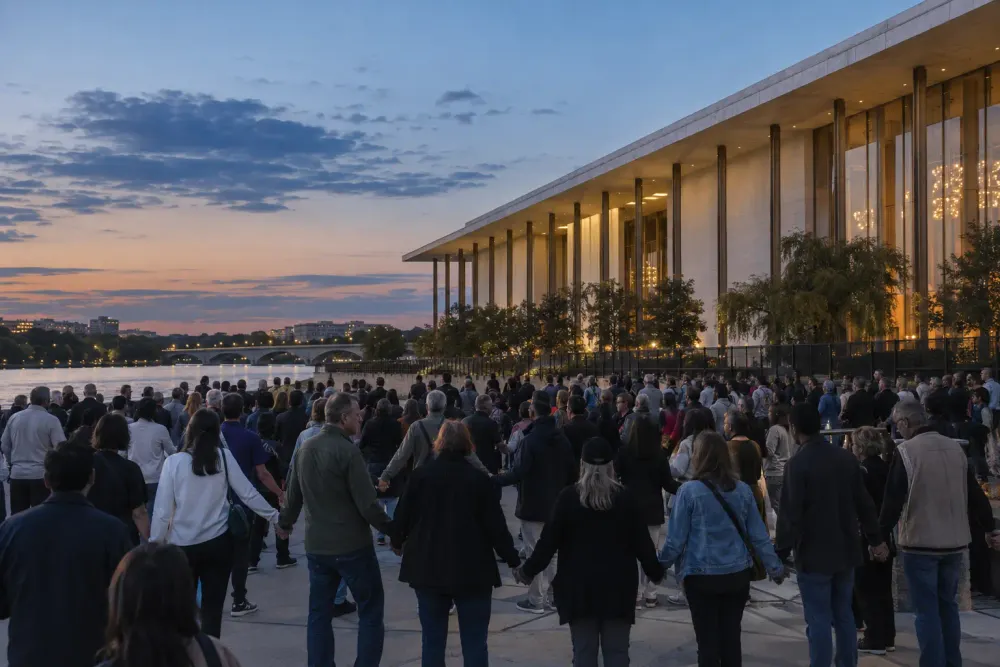
Thousands of people gathered outside the John F. Kennedy Center for the Performing Arts on Friday evening, forming a human chain around the darkened complex as uncertainty grew over how long the national cultural landmark will remain closed and whether its main building could eventually be demolished.
The “Hands Around the Kennedy Center” demonstration drew artists, volunteers, students and other residents to the Potomac River waterfront. The crowd spilled into nearby streets and temporarily disrupted traffic, according to The Associated Press. Organizers framed the gathering as an effort to protect both the building and its public mission after a week of abrupt operational and legal changes.
The immediate facts are narrower than some of the protesters’ fears. The Kennedy Center is closed, its board has approved a longer shutdown for repairs, and President Donald Trump has repeatedly raised the possibility that the deteriorating structure could be torn down. But no demolition plan has been publicly approved. A federal court has ordered advance notice before any such move, preserving time for further litigation and public review.
A protest after an indefinite closure
The Kennedy Center’s board, chaired by Trump and dominated by his appointees, voted Tuesday to close the institution indefinitely for renovations. That action followed months of conflict over the center’s name, programming and governance. It also came hours after U.S. District Judge Christopher Cooper again blocked efforts to put Trump’s name on the building.
A separate emergency closure began Wednesday. Kennedy Center executive director Matt Floca said in a court filing that the building would remain closed for at least seven days while engineers assessed “acute risks to public safety” in areas showing severe structural deterioration. The cited concerns included the roof-terrace canopy and a partial ceiling collapse earlier in September, according to an AP account of the filing.
Those explanations establish a legitimate safety issue, but they do not settle the dispute over the broader shutdown. The board has discussed a renovation lasting as long as two years and costing $257 million. Rep. Joyce Beatty, D-Ohio, an ex officio trustee, argues that the indefinite closure could evade an earlier court order requiring the board to make a considered and independent decision before suspending operations.
The court created a 30-day guardrail
On Thursday, Cooper declined Beatty’s request for an emergency hearing but directed the Kennedy Center to provide more than 30 days’ written notice before making major physical changes outside the renovation scope previously presented to the court, including demolition of the main building. The order does not permanently forbid demolition. It creates a window in which plaintiffs could challenge a changed plan before irreversible work begins.
The legal case began over the board’s effort to add Trump’s name to the center. Cooper ordered the name removed in May and ruled that only Congress could rename the institution. A later court dispute focused on whether the board’s closure vote complied with his earlier limits. The administration has appealed the naming decision.
Federal law gives that dispute unusual weight. The governing statute directs the board to maintain and administer the center as the National Center for the Performing Arts and “a living memorial” to President John F. Kennedy. It also places congressional leaders and committee members on the board alongside presidential appointees, reflecting the institution’s hybrid public structure.
Trump leaves demolition question open
Trump on Friday defended his campaign for recognition on the building, saying his administration deserved credit for securing renovation money and trying to preserve the center. Asked directly whether he intended to demolish it, he did not give a yes-or-no answer. He called the center a “dump” and said he could build a replacement better than others, according to Reuters.
Trump has said the center is in dangerous condition and would eventually be “ripped down” without intervention. His critics interpret those comments, combined with the abrupt closure and unresolved naming fight, as leverage in the litigation. The White House and Kennedy Center have presented the renovation as necessary preservation work.
The financial picture is contested as well. Trump has described the venue as facing long-term distress. Reuters reported that federal tax filings showed profits in seven of the past nine years, while an analysis of the latest return found that the $257 million federal renovation allocation substantially complicated year-to-year comparisons. That filing alone does not resolve whether ordinary operations are sustainable or how much future fundraising will be required.
The shutdown reaches beyond performances
The Kennedy Center is more than a collection of theaters. It hosts the National Symphony Orchestra, education programs and partnerships with Washington-area schools. At Friday’s protest, participants described lost performances, volunteer opportunities and student access, including ties to the Duke Ellington School of the Arts.
Those impacts will depend on the length and scope of the closure and whether programs can be relocated. Officials have not published a complete schedule for repairs, reopening milestones or substitute venues. The center’s temporary safety review and the board’s longer renovation decision remain related but legally distinct actions.
What happens next
The next meaningful tests are procedural. The Kennedy Center must complete its immediate safety assessment, explain the basis and timetable for the larger closure, and comply with the court’s notice requirement if its plans expand toward demolition. Congress could also act through oversight, funding conditions or legislation governing the memorial.
Friday’s protest did not change those legal authorities, but it demonstrated that the dispute has moved beyond board meetings and court filings. The central question is no longer only whose name appears on the facade. It is whether a federally chartered performing-arts institution can be repaired, governed and reopened without its public mission becoming collateral in a fight over recognition and control.