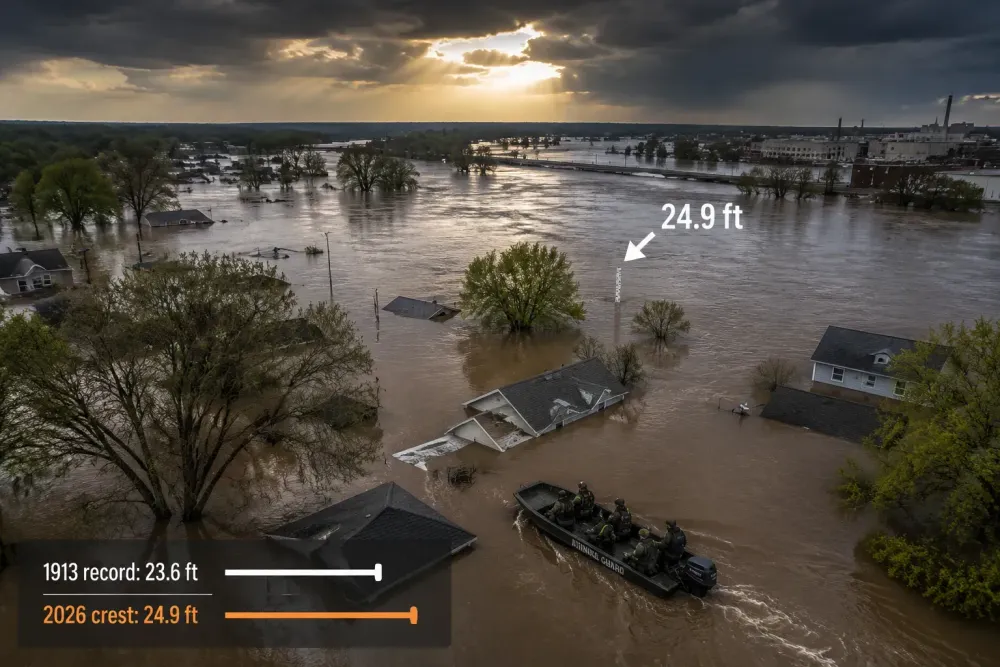
The White River at Anderson, Indiana, rose to 24.9 feet early Saturday, breaking a flood record that had stood since 1913, according to NOAA data and confirmed by AccuWeather. By Sunday evening, August 16, 2026, state officials had confirmed at least seven storm-related deaths since the rain began five days earlier, according to AP. The disaster illustrates how a single slow-moving storm system, dropping more than 11 inches of rain in places, can overwhelm river infrastructure engineered around century-old benchmarks that a warming, wetter climate is now routinely exceeding.
A river that outran its own history
The flooding traces back to August 11, when a derecho and a series of thunderstorms stalled over central and eastern Indiana, according to NWS data. Some counties recorded six to twelve inches of rain within days, saturating ground already soft from a wet summer. The White River, which threads through Anderson, Noblesville and Indianapolis before draining into the Wabash, responded by climbing past every mark on its gauge history. At Noblesville, the river hit 24.6 feet, well above the 23.8-foot record set in March 1913, according to Mayor Jensen, who called the previous two days "unprecedented in this community." At Anderson, the crest reached 24.93 feet, topping the old 23.6-foot mark by more than a foot, according to AccuWeather. Indianapolis Mayor Joe Hogsett described the flooding downstream as the worst the city had experienced in more than three decades, according to AP.
The 1913 comparison is not incidental. That spring's flood killed an estimated 200 people across Indiana and displaced roughly 200,000 residents statewide, making it one of the deadliest natural disasters in the state's history, according to USA Today. Engineers built levees, floodwalls and the Broad Ripple-area protective berms partly in response to that event, and those systems were tested directly this week: floodwaters reportedly reached the top of the Warfleigh levee project protecting nearly 1,400 homes and 200 businesses in Indianapolis' Broad Ripple neighborhood, according to NOAA.
Seven lives lost across scattered counties
The seven confirmed deaths were spread across the state rather than concentrated in one place, reflecting how the storm's hazards varied from location to location. In Henry County, 31-year-old cyclist James Briar died after apparently riding around a barricade and falling into a sinkhole that had opened on a washed-out road, according to Henry County Coroner Brian Clark, cited by IndyStar. In Jennings County, a 4-year-old boy was killed Tuesday when a tree crashed through his bedroom during high winds, according to Jennings County Chief Deputy Cody Low, who told reporters, "This is obviously unexpected. There's nothing we can say that is going to make it any better. We're going to push through this as a community," according to AP.
In Delaware County, two residents died in separate incidents tied to the rising water. Nineteen-year-old Matthew Morey, a recent high school graduate headed to Purdue University, drowned after jumping from a bridge into the swollen Mississinewa River with friends; his body was recovered three days later, according to IndyStar. Delaware County Sheriff Tony Skinner said, "There are no words that can ease the pain of losing a child. Our hearts are with Matthew's family, friends, classmates, and everyone who knew and loved him." The same county lost 58-year-old Stephanie Sallee, found dead in a cornfield with her dog after her car was apparently swept off a flooded road. Additional fatalities were confirmed in Lake, Porter and LaPorte counties in the state's northwest, an area hit primarily by straight-line winds reaching 99 miles per hour in Gary rather than river flooding, according to Gov. Braun.
Rescues, evacuations and a strained power grid
Indianapolis Fire Department crews conducted roughly 95 water rescues and recovered 45 stranded pets as of Saturday, according to department spokesperson Rita Reith, cited by local officials. More than 400 residents were evacuated from the Ravenswood neighborhood alone, with additional evacuations in Broad Ripple and an assisted-living facility in Carmel, according to city officials. Statewide, more than 350 additional evacuations occurred outside Indianapolis, largely in Delaware County, according to WFYI.
Power losses compounded the danger. Outages peaked above 300,000 customers statewide as the derecho's winds toppled lines in the northwest even as floodwaters rose in the east and center of the state, according to state records. By Sunday night, roughly 130,000 customers remained without power as utility crews worked through debris-clogged roads, according to AP. A furniture maker on Indianapolis' north side, Frank Gounder, told AP he found about two feet of water in his house and workshop, damaging handmade pieces in various stages of completion, a small-scale illustration of losses now being tallied door to door across the state.
Structural response, not a single point of failure
Governor Mike Braun declared a statewide disaster emergency on August 13, mobilized the Indiana National Guard, and directed the state's $1.14 billion rainy-day fund toward the response, according to his order. He requested a federal emergency declaration the following day, and President Trump approved it Saturday evening after a phone call between the two, unlocking up to $5 million in immediate Federal Emergency Management Agency support across 53 counties, according to FEMA. Indiana Department of Homeland Security Director Jonathan Whitham said the eventual federal cost estimate would run into "tens of millions of dollars" at minimum, a figure state officials expect to grow once a Major Disaster Declaration, which would unlock individual assistance for displaced homeowners, is pursued, according to state briefings.
The scale of this week's flooding reflects a confluence of ordinary meteorological ingredients rather than any single institutional failure: a slow-moving storm system, already-saturated soil from a wet season, and a derecho that struck the same window as the heaviest rain. Hydrologists have also noted that flood-frequency statistics calculated from a century of gauge records are increasingly being tested by storms that concentrate more rainfall into shorter windows, a pattern documented broadly by federal researchers examining Midwest precipitation trends, independent of any specific policy decision in either party. Indiana's response drew bipartisan support at the federal level, with the state's Republican governor and Republican members of Congress praising a Republican administration's rapid disaster approval, a sequence that, in this case, unfolded without partisan friction, according to Rep. Spartz and Sen. Young's offices.
For now, the immediate crisis is easing. Hamilton County Board of Commissioners President Christine Altman told reporters Sunday morning, "I must admit it is a good morning. It's not raining, and the water is receding." But officials cautioned that receding water reveals its own hazards, washed-out roads, undermined bridges and buried debris, the very conditions that killed James Briar hours after the crest had already passed. Hamilton County is still assessing whether a major bridge damaged in the flooding can be repaired or must be rebuilt entirely, a decision that will shape commuting patterns in the fast-growing Indianapolis suburb for years regardless of how quickly the water itself recedes.