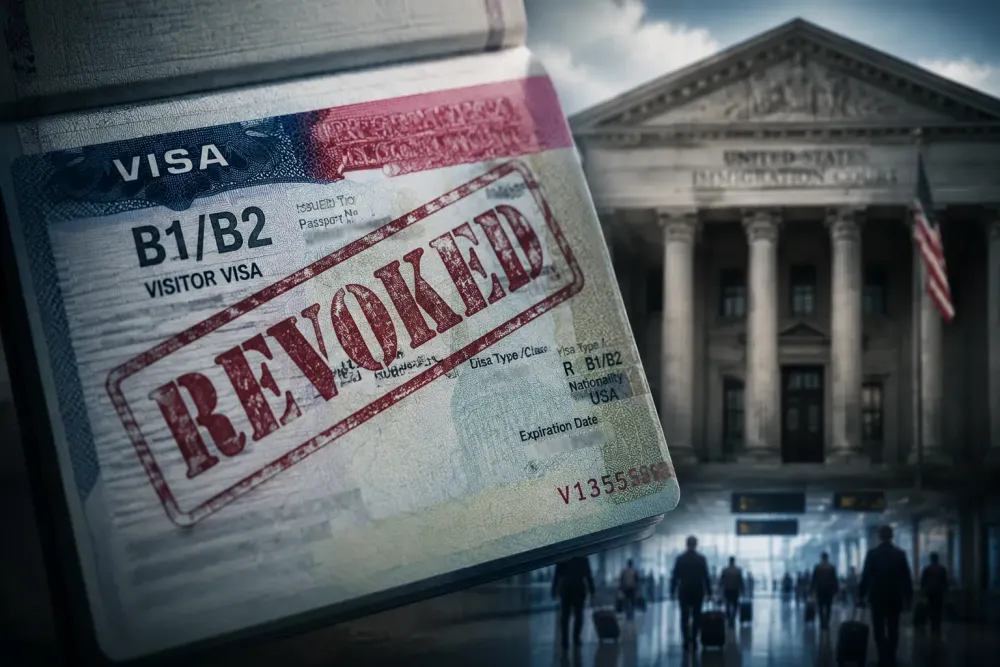
Up to 200,000 B-1 and B-2 business and tourist visas issued from 2016 through 2026 could be revoked under a Trump administration plan aimed at foreign nationals who entered the United States on temporary visas and later sought asylum, according to reporting by AP and Reuters. The contemplated action would be unusually large in scale, but the number remains an upper-bound estimate rather than a final tally: the administration has not publicly specified how many visas it ultimately intends to cancel.
The initiative joins two immigration systems that are legally distinct. B-1 and B-2 visas are temporary nonimmigrant documents generally issued to travelers who establish that they qualify for a temporary business or tourism stay. Asylum, by contrast, is a statutory protection available to people who allege persecution or a well-founded fear of persecution on specified grounds. Revoking an unexpired visa can affect future travel and the government's view of a person's nonimmigrant status, but it does not itself adjudicate an asylum claim or automatically remove someone from the country.
That distinction is central to what the policy would actually do. The administration is signaling that later pursuit of asylum may be treated as inconsistent with the temporary purpose on which a B visa was granted. Yet the asylum process allows eligible people physically present in the United States to seek protection, including some who entered lawfully on temporary visas. The policy tension is therefore how aggressively the government may revisit an earlier visa after a protection claim changes the traveler's expected immigration trajectory.
Temporary visas and asylum operate under different rules
U.S. law generally presumes many applicants for nonimmigrant visas to be intending immigrants until they establish otherwise. The State Department's explanation of INA 214(b) describes that presumption and the applicant's burden to demonstrate eligibility for the requested nonimmigrant category. B-visa applicants commonly establish a temporary purpose, sufficient means and circumstances consistent with departing after the authorized stay.
An asylum claim operates under a separate framework. Applicants seek protection based on a claimed fear of persecution tied to race, religion, nationality, membership in a particular social group or political opinion. When a case moves into immigration-court proceedings, asylum and related protections can remain forms of relief from removal; USCIS explains that some immigration benefits are adjudicated in or alongside proceedings before the Executive Office for Immigration Review.
The planned revocations therefore appear designed less as direct decisions on asylum eligibility than as reassessments of the visas that originally facilitated travel. That can still be consequential: a revoked visa cannot simply be used for future entry, and travel while an asylum case is pending already carries separate legal requirements. But describing the plan as cancellation of 200,000 asylum cases would be inaccurate. The reported action concerns visas, not an across-the-board denial of protection applications.
The scale would extend a broader revocation campaign
The possible 200,000-visa action comes after a substantial increase in cancellations. AP reported that the State Department has revoked about 175,000 visas during the previous 18 months, citing reasons that have included criminal charges and conduct the government has characterized as contrary to U.S. interests. If implemented near its maximum reported size, the new asylum-linked initiative could exceed that recent total in a single policy category.
The administration has also tightened temporary-visa processing. Effective July 15, 2026, the State Department said most nonimmigrant applicants should schedule interviews in their country of nationality or residence. Separately, visa issuance has been suspended or restricted for nationals of a number of countries under national-security proclamations, subject to exceptions described in current State Department guidance.
Those measures illustrate a broader shift toward continued scrutiny after a traveler has already entered the immigration system. A visa has never guaranteed admission at a port of entry, and the executive branch has long possessed substantial authority over issuance and revocation. What makes the reported asylum initiative notable is the categorical trigger: a later application for humanitarian protection could become a reason to revisit a temporary visa previously granted.
The White House has used post-issuance tools in other contexts. An August order addressing so-called birth tourism authorized immigration agencies to take actions that can include visa or travel-authorization revocation. Together, the measures point toward a model in which visa eligibility is treated as subject to continuing reassessment when later conduct or information is viewed as inconsistent with the original basis of issuance.
Revocation does not create an automatic deportation order
For affected travelers, the most important operational distinction is between losing a visa and losing an asylum case. AP and Reuters both reported that revocation would not itself mean immediate deportation. Removal ordinarily requires a separate legal basis and, in many cases, proceedings in which the person can seek relief or contest the government's case.
The immigration-court system is already processing a historically large workload. The Justice Department said in May that the Executive Office for Immigration Review had completed more than 1.08 million cases since January 20, 2025, while reducing the pending caseload to below 3.53 million from roughly 4 million. Those figures show why a policy that changes the legal posture of a large group can have administrative effects even without automatic removal.
Asylum applicants also face separate filing and work-authorization rules. USCIS maintains an annual fee regime for certain I-589 applications pending for at least 365 days, although litigation has affected enforcement consequences for nonpayment; the agency's fee page describes the current framework. These parallel processes reinforce that a protection claim has legal consequences independent of the visa used for original entry.
Individual facts could become important in disputes over revocation. A person may argue that applying for asylum after conditions changed does not establish that the original B-visa application was fraudulent or that temporary intent was misrepresented. The government may argue that later conduct is relevant to whether the person remains eligible to possess or use a temporary visa. Those are different propositions, and their resolution will depend on the authority invoked and the record in each case.
The policy could alter behavior before courts reach the merits
Even without immediate removal, a large-scale revocation program can change incentives. Visa holders considering asylum may weigh whether applying could foreclose future use of an existing visitor visa. People with family or business connections abroad may become more reluctant to travel, while attorneys and employers may face more questions about how revocation interacts with later immigration benefits.
The policy could also affect future consular adjudication. If the State Department treats a later asylum application as evidence that temporary intent was absent from the outset, officers could scrutinize B-visa applicants more closely where circumstances suggest a possible protection claim. That would not make asylum seeking unlawful; it would increase the practical linkage between humanitarian protection and discretionary screening of temporary travelers.
Critics are likely to argue that a categorical policy could deter legitimate asylum claims or use later events to infer intent that did not exist when a visa was issued. The administration has framed its broader immigration program as an effort to tighten enforcement and reduce misuse. The evidence question is therefore central: an asylum claim can reflect circumstances known before travel, events after arrival or deterioration in the applicant's home country, and those scenarios are not equivalent.
A December 2025 presidential proclamation illustrates the separation among these policy levers. It stated that visas issued before its effective date would not be revoked solely under that proclamation and preserved the ability to seek asylum consistent with law. The proclamation shows that entry restrictions, visa revocation and asylum eligibility can be legally distinct even when pursued within the same enforcement agenda.
Scope and implementation will determine the real effect
The figure of 200,000 is the clearest measure of the policy's possible scale, but it is not evidence that 200,000 people will lose visas. The administration has not publicly issued a final affected-person count, detailed criteria or an implementation schedule matching the specificity of the internal planning described by news organizations. Until those details are published, estimates of the policy's reach remain provisional.
What is established is narrower but still consequential: the administration is preparing to use visa-revocation authority against a potentially large population defined by a later asylum application. What remains unresolved is how individualized the review will be, how courts will treat changed circumstances versus alleged misrepresentation at issuance, and how often a revoked visa will lead to a separate enforcement action.
If revocations approach 200,000, the policy would represent a major expansion in the use of visa authority as an immigration-enforcement tool. Its legal and human consequences, however, will be measured by another set of numbers: how many revocations become final, how many asylum claims remain pending or are granted, how many cases enter removal proceedings, and whether adjudicators require the government to distinguish a person's original temporary intent from the later decision to seek protection.