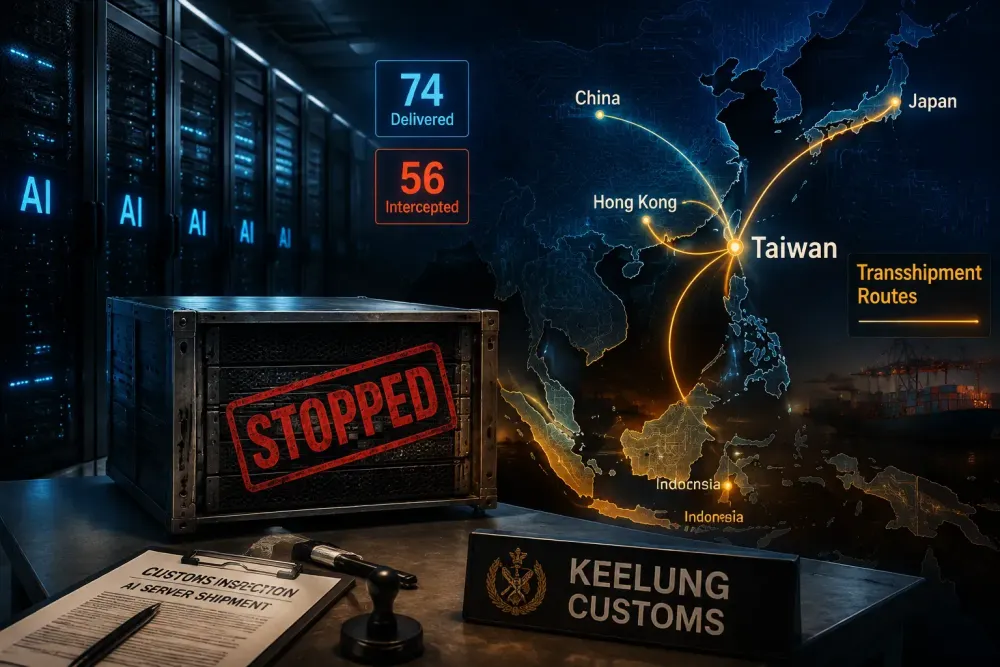
Seventy-four high-end artificial-intelligence servers allegedly reached China while another 56 were stopped by Taiwanese customs in a diversion scheme involving 130 systems and more than US$21.2 million in alleged illicit proceeds, according to prosecutors in Keelung. Taiwan authorities on August 24 indicted nine people, including an Nvidia Taiwan employee and two Super Micro Computer Taiwan employees, over what prosecutors say was a coordinated effort to disguise the servers' true destinations and bypass strategic-technology export controls.
The case reaches beyond the familiar question of whether advanced chips can be sold directly to China. The systems at issue were Nvidia B300-based servers, according to AP, meaning the alleged scheme operated at the level of assembled computing infrastructure, distributors, end-user documentation and transshipment. Reuters reported that 74 servers had already been delivered before authorities stopped 56 more.
The indictments are allegations, not findings of guilt. The defendants have not been convicted, and Nvidia and Super Micro themselves were not indicted in the case. Both companies have said they are cooperating with authorities. That legal distinction is important because the enforcement question is not whether employment at a technology company establishes corporate wrongdoing, but whether individuals used access, documentation or distribution channels to defeat export restrictions.
Prosecutors allege a supply-chain diversion rather than a direct sale
Taiwan's Central News Agency, through Focus Taiwan, reported that the defendants include an Nvidia distribution manager, two Super Micro sales managers, the head of computer maker Albatron and employees or executives connected to telecommunications, importing and customs-clearance businesses. Prosecutors allege the group used false documentation and fabricated end-user arrangements to make controlled servers appear destined for permitted customers outside China.
The alleged routing was deliberately indirect. Prosecutors said 50 of the 74 servers that reached China were sent through Indonesia, eight moved through Japan or Hong Kong, and the remainder were delivered by other routes. Such transshipment is a longstanding vulnerability in export-control regimes because an item can leave the original jurisdiction under a seemingly lawful destination before being redirected.
The alleged scheme also exploited a compliance threshold. Focus Taiwan reported prosecutors' assertion that orders for more than eight servers require site inspections, creating an incentive to manipulate documents, customers or shipment structure. Authorities say false sites and paperwork were used to satisfy or evade those checks. If proven, the conduct would demonstrate that control systems are only as strong as the verification of the end user behind the paperwork.
That mechanism matters because advanced AI hardware is increasingly sold as complete racks, servers and clusters rather than as isolated processors. Restricting a particular GPU model can be undermined if downstream distributors, integrators or customers can move finished systems through jurisdictions with weaker enforcement. The compliance perimeter therefore extends from semiconductor fabrication through server assembly, sales, logistics, payment and final installation.
Taiwan's role makes enforcement unusually consequential
Taiwan sits near the center of the global semiconductor and server supply chain. Its companies manufacture or assemble a large share of the hardware used in advanced computing, which gives Taiwanese regulators leverage but also creates a large compliance burden. Export controls must distinguish ordinary commercial shipments from transactions that could deliver controlled computing capacity to restricted end users.
Taiwan's trade rules require permits for exports of strategic high-tech commodities when specified conditions apply. The government has also expanded its entity-control lists. In June, Taiwan's International Trade Administration said it added 265 entities, including China-based organizations, bringing the control list above 11,480 entities and individuals. The announcement reflects an enforcement model increasingly aligned with controls used by the United States and other technology-producing economies.
The advantage of such lists is precision: regulators can focus on buyers and intermediaries associated with military, weapons or restricted technology programs. The limitation is that controlled buyers can form new companies, use third-country affiliates or purchase through intermediaries not yet listed. That creates a recurring cycle in which authorities identify a network only after transactions, update lists and then search for the next replacement.
The Keelung case illustrates that export controls are therefore not only a licensing problem. They are also a know-your-customer problem. Manufacturers and distributors must verify whether a buyer exists where it claims, whether the volume makes commercial sense, who controls the purchaser and whether the equipment will remain at the declared destination.
U.S. controls increasingly follow computing systems and end use
The United States has built a parallel framework around advanced computing items, including restrictions tied to China and Macau. The Commerce Department's Export Administration Regulations contain licensing rules and exceptions for advanced computing, while Part 744 includes end-use and end-user controls. The Bureau of Industry and Security also limits the use of certain license exceptions for destinations in higher-risk country groups, including restrictions described in Part 740.
Those rules help explain why finished server diversion has become a major enforcement focus. A server containing controlled accelerators can deliver substantially the same AI-training capability that chip-level restrictions are designed to limit. If the system can be bought in one country and re-exported to another, the policy objective depends on downstream controls and partner-country enforcement.
A separate U.S. criminal case shows the scale such diversion networks can reach. In March, the Justice Department charged three people with conspiring to divert advanced U.S. AI technology to China. Prosecutors alleged that companies involved purchased more than $2.5 billion in servers and that at least roughly $510 million in equipment was diverted during a period in 2025. The Justice Department emphasized that the charges were allegations, but the case demonstrates why authorities are scrutinizing transactions that appear commercially legitimate at the first point of sale.
The Taiwan case is much smaller in dollar terms, yet it may be more revealing about ordinary distribution channels. The accused include people positioned inside or alongside legitimate technology businesses rather than an exclusively clandestine smuggling organization. If the allegations are proven, the enforcement failure would have occurred through normal commercial processes that were allegedly manipulated from within.
Compliance systems face a difficult information problem
Technology vendors can screen sanctioned-party lists, review shipping addresses and require end-use certifications, but each control has limitations. A new shell company may have no negative history. A warehouse in Indonesia may be a real address even if the ultimate customer is elsewhere. A reseller may have legitimate business alongside prohibited transactions. High-value computing equipment can also be broken into smaller orders or routed through multiple distributors.
The most effective controls therefore combine transaction data with behavioral signals. Unusually large orders, buyers with little history in data-center operations, payments from unrelated entities, last-minute shipping changes and requests for delivery to freight forwarders can all justify additional review. None proves diversion by itself. The objective is to identify combinations of anomalies that warrant a physical site check, customer interview or escalation to government authorities.
The current case also raises questions about internal access. Employees in sales or distribution can understand exactly which documents trigger scrutiny and which thresholds require additional review. That makes segregation of duties, audit trails and independent compliance approval important. A system designed solely around employee declarations may be vulnerable if the person entering the data is part of the alleged scheme.
Super Micro disclosed in July that two Taiwan employees had been detained in an investigation involving its AI servers, according to Reuters. The August indictments therefore represent a progression from investigation to formal charges, not a newly discovered event occurring in a single day.
The 56 stopped servers show both success and leakage
The most informative numbers in the case point in opposite directions. Customs authorities stopped 56 servers before they reached the alleged destination, evidence that screening and enforcement can intercept controlled hardware. But prosecutors say 74 systems had already reached China, meaning more than half of the 130 servers in the alleged scheme were delivered before the network was disrupted.
Neither number alone is enough to evaluate the wider export-control regime. Seizing 56 servers does not prove that controls generally prevent diversion, while 74 alleged deliveries do not show that most restricted AI hardware reaches China. The case is a detected network, not a representative sample of all shipments.
Its broader significance lies in where enforcement failed and recovered. Modern AI controls are increasingly designed around compute capacity, end users and final destinations rather than the nationality of the first buyer. The alleged use of Indonesia, Japan and Hong Kong as intermediate routes shows why partner-country coordination and end-use verification are now as important as factory-gate restrictions.
If prosecutors prove the allegations, the case will demonstrate that advanced-computing controls can be defeated without smuggling loose chips across a border: legitimate servers, sales channels and paperwork can be repurposed into a diversion system. The policy test is whether regulators and companies can make that manipulation expensive and detectable enough that the 56 intercepted systems become more typical than the 74 that allegedly got through.