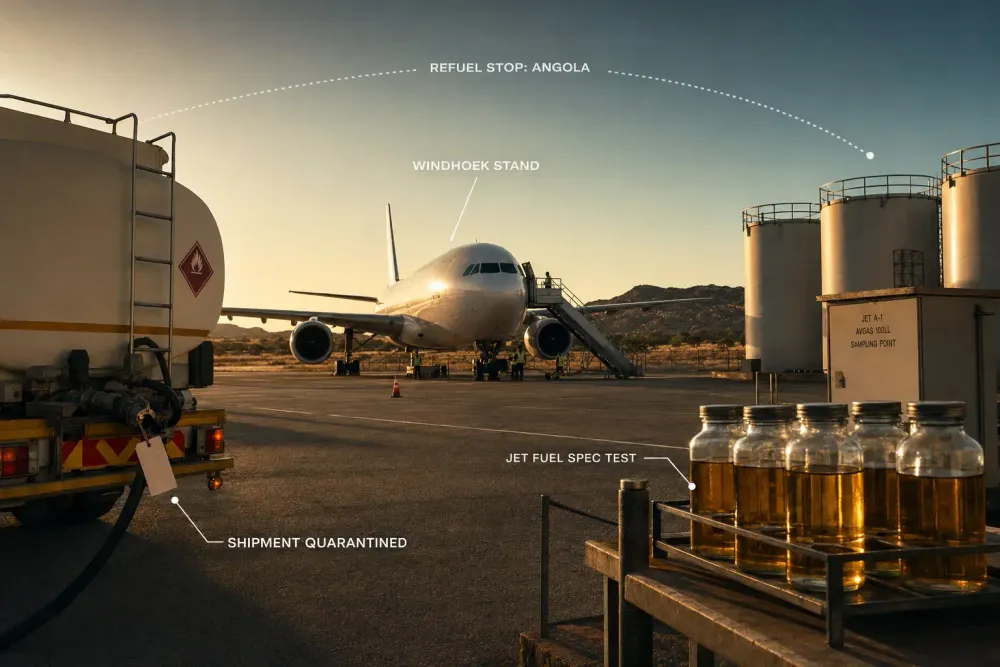
A shipment of aviation fuel delivered to Namibia failed required quality standards and was quarantined before distribution, leaving Windhoek's main international airport short of usable jet fuel and forcing some Europe-bound flights to make an additional stop in Angola for refueling. Lufthansa Group's Discover Airlines said Thursday that the temporary shortage was disrupting flights from Namibia to Frankfurt and Munich, while cargo operations were also affected. Reuters reported that the problem originated with an operational supply issue rather than the wider disruption in global fuel markets associated with the Iran conflict.
The episode illustrates an invisible dependency in international travel. Passengers can see aircraft, terminals and runways. They rarely see the fuel-testing laboratories, import contracts, storage tanks and certification processes that determine whether an aircraft can depart.
When that system fails, an airport can remain physically open while airlines are unable to operate normally.
Aviation fuel cannot simply be used because it arrived at the airport
Jet fuel is produced to tightly controlled specifications because contamination or an incorrect fuel property can damage engines or compromise flight safety.
Quality controls govern manufacturing, transportation, storage and delivery into aircraft. The relevant question is not whether a tanker or ship contains something generally described as jet fuel; the fuel must meet the required specification and remain within that specification throughout the supply chain.
Current IATA guidance emphasizes certification, fuel-grade control and operational communication as core conditions for safely introducing aviation fuel into airport systems.
That explains why rejecting the Namibian shipment created a shortage instead of merely an inconvenience.
Once the fuel failed quality requirements, placing it into airport storage could have contaminated larger quantities of approved fuel. Quarantine therefore protected aircraft operations even while creating a logistical crisis.
The safest action can be the action that causes the travel disruption.
Import dependence turns one failed delivery into a national aviation problem
Namibia does not have the same depth of aviation-fuel infrastructure available at a major global refining center.
When a market depends heavily on imported fuel, supply schedules are built around ships, storage capacity and forecast consumption. A replacement cargo cannot necessarily be summoned immediately after another one fails testing.
The consequences become more pronounced at a long-haul airport.
A short regional flight may be able to carry additional fuel from its point of origin and operate without purchasing much at the destination. A long-distance flight from Windhoek to Europe requires much larger fuel quantities and must remain within aircraft weight and reserve requirements.
If sufficient certified fuel is unavailable at departure, airlines need another plan.
Discover's solution is a technical stop in Angola, where aircraft can obtain fuel before continuing to Europe, according to Reuters.
A refueling stop preserves the flight while adding cost and complexity
An additional stop is preferable to canceling a long-haul service, but it is not operationally neutral.
The aircraft must descend, land, taxi, refuel and take off again. That consumes crew duty time, airport capacity and additional fuel. Passengers remain on a longer itinerary, and onward connections in Europe can become more difficult to protect.
Airlines also schedule aircraft tightly. A delay to one long-haul rotation can affect when the same airplane becomes available for its next trip.
Crew schedules create another constraint.
Pilots and flight attendants are subject to maximum duty and rest rules. A routing that was legal with a nonstop flight may require adjustment if an unplanned fuel stop extends the working day.
Airlines therefore manage a fuel shortage as a network problem rather than simply a purchasing problem.
Cargo can be more vulnerable than passengers to a fuel constraint
Passenger airlines have strong incentives to preserve scheduled services, even if that requires an intermediate stop.
Cargo economics can differ.
Freight aircraft carry heavy payloads, and every additional kilogram of fuel affects allowable takeoff weight. Operators can sometimes trade payload for fuel, but that means leaving revenue-generating cargo behind.
Time-sensitive shipments can also lose value quickly. Perishable products, manufacturing components and medical supplies may be scheduled around tightly defined connections.
Reuters reported that cargo activity was facing disruption alongside passenger flights, according to its coverage.
That broadens the economic consequence beyond tourism.
Namibia's air links carry people into the country, but they also connect exporters and importers to international supply chains. A shortage lasting days rather than hours can therefore affect businesses that never purchase an airline ticket.
The incident shows why redundancy is expensive until the moment it is needed
Airports and governments can reduce supply risk by maintaining larger inventories, contracting with multiple suppliers or developing additional storage.
Each solution costs money.
Holding more fuel ties up capital and requires tanks. Multiple supply contracts may sacrifice volume discounts. Alternative import routes require transportation and infrastructure that may sit underused during normal operations.
A lean supply chain is cheaper when every shipment arrives on specification.
A redundant supply chain becomes valuable when one does not.
The Namibian disruption does not establish that the country's fuel system is fundamentally unreliable. One rejected cargo can occur in any sophisticated supply network, and the fact that the product was quarantined demonstrates that quality controls identified the problem before it reached aircraft.
The episode instead reveals the trade-off built into aviation logistics.
Passengers experienced delays because the safety system worked.
The immediate goal is to restore certified fuel supplies at Windhoek and eliminate the Angola stops. The longer-term question is how much redundancy is economically justified to make the next failed shipment less disruptive.
For travelers, the lesson is unusually concrete: an international airport can have functioning runways, staffed terminals and aircraft ready to depart, yet one unsuccessful fuel-quality test can still add another country to the journey home.