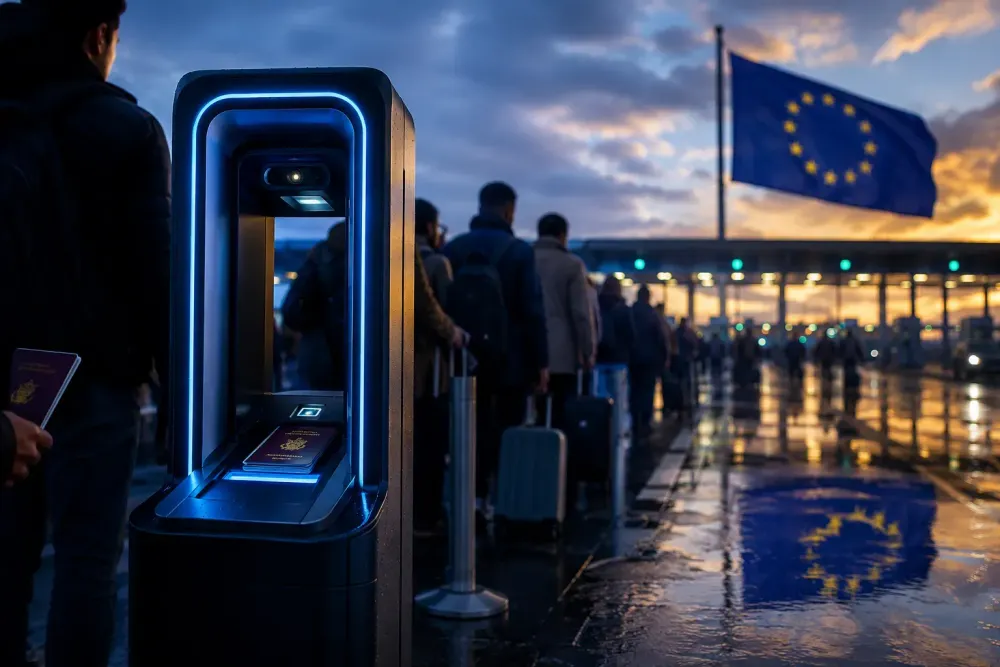
More than 1.4 billion visits from visa-exempt travelers enter the European Schengen Area each year, according to the European Commission, yet not one of those arrivals has paid the €7 youth fee or the €20 adult authorization charge that the EU's long-anticipated travel screening system was designed to collect, because the system itself remains unfinished, repeatedly delayed, and now suspended without a confirmed relaunch date.
The European Travel Information and Authorization System, known as ETIAS, was first approved by the European Parliament in 2018 and was originally scheduled to go live in 2021. That deadline slipped to 2022, then 2023, then mid-2025. As of 2026, the European Union has acknowledged that ETIAS will not launch on any previously announced schedule, citing persistent failures in the biometric border infrastructure it depends on, specifically the Entry/Exit System, or EES, which was itself supposed to begin fingerprint and facial-recognition screening of non-EU nationals at Schengen borders before ETIAS could function at all.
The Tag=Travel story of the European Union's indefinite delay of the €20 ETIAS border levy amid ongoing biometric rollout failures is not a minor administrative setback. It is a structural collapse of a decade-long digital border modernization effort that has already consumed hundreds of millions of euros in public funding and left airlines, travel operators, and tens of millions of American and other non-EU travelers in a prolonged state of regulatory uncertainty.
Key Takeaways
- The EU's ETIAS travel authorization fee, €20 for adults, has no confirmed launch date as of 2026, following years of consecutive missed deadlines.
- ETIAS cannot go live until the Entry/Exit System biometric infrastructure is fully operational at Schengen borders, and EES itself remains stalled.
- American travelers, who currently need no visa to visit the Schengen Area for stays under 90 days, will eventually need ETIAS pre-authorization once the system launches.
- The delays stem from hardware shortages, software integration failures, and disagreements among EU member states over implementation timelines.
- Travel industry stakeholders, including airlines and tour operators, face ongoing compliance planning costs with no actionable government timeline to plan against.
Why the Entry/Exit System Failure Directly Blocked ETIAS
The EU designed EES and ETIAS as sequentially dependent systems. EES was built to replace passport stamping with automated biometric registration, collecting fingerprints and facial images from every non-EU national crossing an external Schengen border. ETIAS, the pre-travel authorization layer, was engineered to cross-reference its applicant database against EES records in real time. Without a functioning EES, ETIAS has no operational backbone.
EES was scheduled to launch in October 2022, according to the European Union Agency for the Operational Management of Large-Scale IT Systems (eu-LISA), which manages the technical infrastructure. That date was pushed to May 2023, then November 2023, then 2024. Each postponement was traced to the same cluster of problems: insufficient biometric kiosk hardware at major border crossing points, software integration failures between national border management systems and the central EU database, and inadequate staffing and training at high-volume entry points such as the Channel Tunnel terminals and major international airports in France, the Netherlands, and Spain.
The European Parliament's Committee on Civil Liberties, Justice and Home Affairs held multiple hearings in 2024 and 2025 examining why eu-LISA and the European Border and Coast Guard Agency, Frontex, had failed to meet any of their self-imposed deadlines. Testimony from member-state border officials, cited by Euronews, revealed that fewer than 40 percent of the required biometric kiosks had been installed and tested at the busiest Schengen entry points as of late 2024, a figure that made any near-term EES activation operationally impossible.
The €20 Fee Structure and What American Travelers Actually Face
Once ETIAS does launch, the fee structure is straightforward but consequential for high-frequency travelers. Adults aged 18 to 70 will pay €20 per application, which covers multiple trips within a three-year validity period or until the applicant's passport expires, whichever comes first. Travelers under 18 or over 70 are exempt from the fee entirely. Citizens of countries with which the EU has specific reciprocal agreements may also qualify for waivers.
For American travelers, the practical impact is a new administrative step before any leisure, business, or transit trip to the Schengen Area. The application process is designed to be online-only and requires a valid passport, an email address, a payment method, and answers to security and health screening questions. The EU projects that 95 percent of applications will receive automated approval within minutes, with a small percentage flagged for manual review by national authorities.
The European Union indefinitely delaying the €20 ETIAS border levy matters most to frequent travelers, Americans who make multiple annual trips to Europe for business or family reasons, and travel industry professionals who book and manage those itineraries. Under the three-year validity model, a traveler making two or three European trips per year would pay roughly €6 to €7 per trip in authorization costs, a modest sum but a new compliance obligation that requires advance planning.
| Traveler Category | ETIAS Fee | Validity |
|---|---|---|
| Adults (18-70) | €20 | 3 years or passport expiry |
| Under 18 | Exempt | 3 years or passport expiry |
| Over 70 | Exempt | 3 years or passport expiry |
| Certain treaty nationals | Waived | Varies by agreement |
Structural Causes Behind the Repeated Delays
The biometric rollout failures driving the European Union indefinitely delaying the €20 ETIAS border levy story are not attributable to a single agency or government. The EU's border technology modernization program involves 27 member states, each with sovereign control over its own border infrastructure procurement, staffing, and IT integration. The result is a coordination problem of significant scale.
France, which handles one of the highest volumes of non-EU arrivals through Charles de Gaulle Airport and the Channel Tunnel, raised formal objections in 2023 to the EES launch timeline, arguing that the infrastructure at its busiest crossing points was not ready and that a premature launch would create severe passenger processing delays, according to reporting by Politico Europe. The Netherlands and Belgium raised similar concerns. These objections were not partisan or ideological; they were operational, reflecting genuine hardware and staffing gaps that no political decision could paper over.
The European Commission, which oversees the program at the supranational level, has faced criticism from the European Court of Auditors for inadequate oversight of project management and for failing to enforce milestone accountability with member states. A 2024 Court of Auditors report, cited by Reuters, found that the Commission lacked enforceable contractual mechanisms to compel national border authorities to meet deployment schedules, a structural gap that had been present since the program's original design.
What the Indefinite Delay Means for the Travel Industry in 2026
Airlines operating transatlantic routes have a direct compliance interest in ETIAS because, under the system's design, carriers will be required to verify ETIAS authorization status before boarding passengers at non-EU departure points, similar to how airlines currently check U.S. Electronic System for Travel Authorization, or ESTA, compliance for U.S.-bound flights. The indefinite delay removes a near-term compliance obligation but also removes planning certainty.
Major airline industry groups, including the International Air Transport Association, have publicly called on the EU to provide a firm, credible launch date rather than continued rolling deferrals, according to IATA. The argument is straightforward: airlines have already invested in system modifications to handle ETIAS verification, and prolonged uncertainty forces repeated revision of those investments without a return.
Tour operators and travel management companies face a parallel problem. Client-facing communications about ETIAS requirements have been drafted, revised, and shelved multiple times. As of 2026, the American Quorum's Travel Daily Briefing finds no confirmed EU government timeline for either EES activation or ETIAS launch, only statements from eu-LISA and the Commission that work is "ongoing" and that a new target date will be announced when technical readiness has been verified.
Conclusion
The indefinite delay of the €20 ETIAS border levy is a direct consequence of the EU's failure to build and integrate the biometric Entry/Exit System that ETIAS requires to function. For American travelers, the practical action in 2026 is straightforward: no ETIAS authorization is needed now, no fee is due, and current 90-day visa-free access to the Schengen Area remains fully intact. Travelers should monitor official EU communications, specifically the European Commission's ETIAS information portal and eu-LISA's operational announcements, for any confirmed launch date, and should expect a minimum of several months' public notice before any activation takes effect. Travel agents and corporate travel managers should build ETIAS compliance steps into itinerary templates now, so that when a firm date does arrive, client communications and booking workflows require only a date substitution rather than a structural redesign.
Tags: ETIAS delay, European Union travel authorization, EES biometric system, Schengen border technology, EU travel fee 2026, American travelers Europe, ETIAS €20 fee, Entry Exit System failure, eu-LISA, Schengen visa-free travel, European border policy, travel authorization systems