
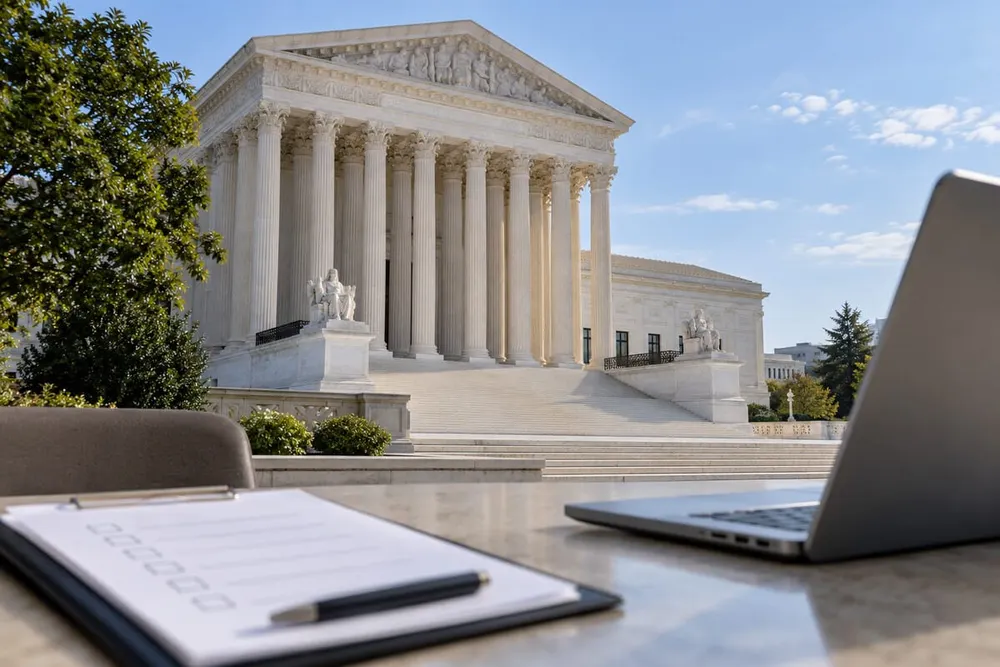
The Supreme Court on Friday temporarily cleared the Trump administration to let states use a revamped federal citizenship database to check voter rolls, reversing the operative effect of lower-court rulings just 39 days before the November 3 midterm elections.
The unsigned emergency court order lifts restrictions that had stopped election officials from using the Department of Homeland Security's Systematic Alien Verification for Entitlements system, known as SAVE. State participation remains voluntary, and the order does not decide the underlying lawsuit. An AP report said Justices Ketanji Brown Jackson, Elena Kagan and Sonia Sotomayor publicly dissented.
The immediate change is significant because the federal government rebuilt SAVE to accept batch searches using names, birth dates and Social Security numbers, allowing states to compare large portions of voter files against federal citizenship records. Before Friday, a nationwide injunction barred that expanded election use. The administration's court filing asked the justices to suspend the injunction while its appeal proceeds.
Friday's order does not itself remove anyone from a voter roll. State and local election officials still control registration decisions under applicable federal and state law, and any action based on a database match may face separate procedural limits or litigation. The practical effect will therefore vary by state, depending on whether officials use SAVE, how they investigate possible mismatches and how close their registration processes are to completion.
The case turns on both access to citizenship information and the legal limits on combining federal records for election administration. In June, U.S. District Judge Sparkle L. Sooknanan concluded that the government's overhaul violated federal privacy protections and created a risk that eligible citizens could be wrongly flagged. The D.C. Circuit left that block in place in a 2-1 appeals ruling earlier this month.
The administration argues that Congress authorized DHS to collect citizenship and immigration data and required the government to respond when states seek verification. Voting-rights and privacy groups counter that SAVE was designed for benefits eligibility, not mass voter-list review, and that incomplete or stale records can misidentify naturalized citizens and other eligible voters.
The scale of the system raises the stakes. At least 67 million voter registrations had already been checked through SAVE before the nationwide block, according to the June decision. That reporting also documented instances in which records initially flagged as questionable were later found to belong to citizens, illustrating why a database result is not the same as a final eligibility determination.
Jackson warned in dissent that the order could expose lawful voters to erroneous removals close to an election. The administration has said the lower courts improperly prevented states from using federal information to enforce the citizenship requirement for voting. Noncitizen voting in federal elections is already illegal; the dispute is over the reliability and lawful use of the federal data, not that underlying prohibition.
What happens next will unfold on two tracks. States that choose to use SAVE can resume checks immediately, while the full appeal continues over whether the database expansion complies with federal law. Election officials will also have to decide how to handle uncertain matches without denying eligible voters notice and an opportunity to correct records.
Because the Supreme Court acted on an emergency application, Friday's order is temporary and does not establish a final nationwide rule for future elections. But for the 2026 midterms, it changes the status quo at a consequential moment: the federal tool is available again as registration deadlines and early-voting periods approach across the country.