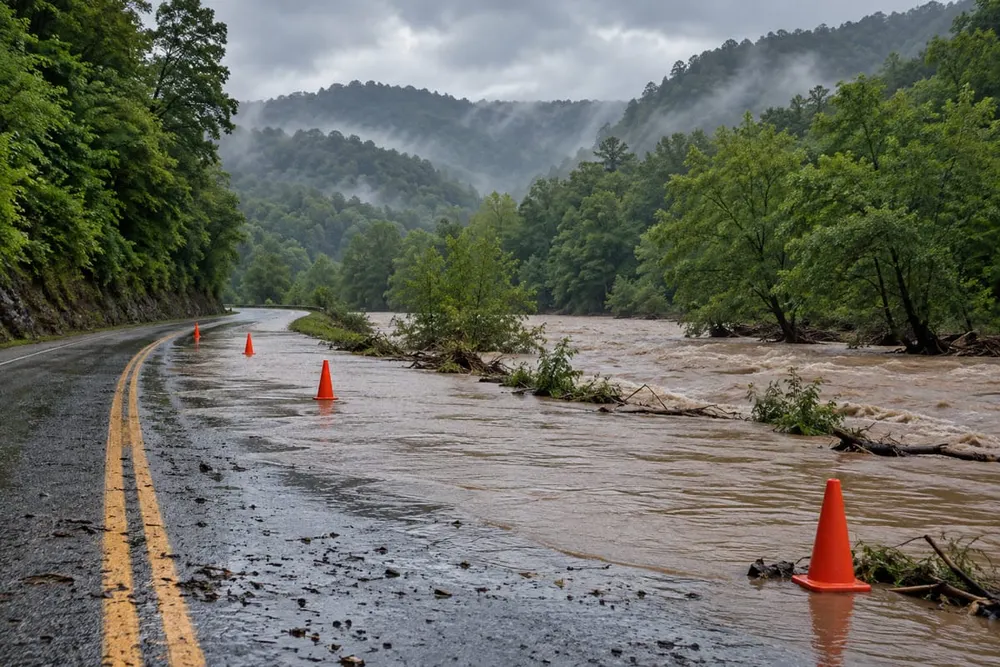
West Virginia has placed Boone and Lincoln counties under a 30-day state of emergency after slow-moving thunderstorms dumped as much as 6.5 inches of rain, triggered water rescues and closed flooded roads.
Gov. Patrick Morrisey issued the declaration Wednesday night after repeated storms overwhelmed streams, creeks, drainage systems and low-water crossings in southern West Virginia. The order allows state agencies to coordinate personnel, equipment and other resources with county and local responders.
The National Weather Service in Charleston said law enforcement reported flooded roads in northwestern Boone and east-central Lincoln counties after 3 to 6.5 inches of rain. Its 7:18 p.m. statement described the flash flooding as life-threatening and warned of impacts to creeks, streams, highways, streets and underpasses around Julian, Woodville and Alkol, including a segment of U.S. Route 119.
A separate warning covering western Boone, southern Lincoln and northern Logan counties estimated 2 to 4 inches had fallen by 7:20 p.m., with up to another inch possible. That warning focused on small creeks, urban drainage, streets and other low-lying areas near Mud and another portion of Route 119.
The two warnings show how sharply totals varied across a relatively small area. The heaviest reported band crossed northwestern Boone and east-central Lincoln, while nearby communities received lower but still dangerous totals. That uneven pattern can leave one road passable while another crossing or hollow floods quickly, complicating county-level response.
By 8:18 p.m., the weather service replaced one flash-flood warning with a lower-level flood warning after heavy rainfall ended. Officials cautioned that high water and road closures remained. Morrisey’s office also warned that saturated ground could contribute to additional flooding, landslides, debris and infrastructure damage even after the most intense rainfall moved away.
The governor’s announcement confirmed water rescues and hazardous travel but did not provide a count of rescued residents, injuries, damaged homes or closed roads. No statewide damage estimate had been released. That leaves the first phase of the response focused on access, safety checks and damage assessment rather than recovery totals.
The weather service had placed a broader area under a flood watch through Wednesday evening. It covered Boone and Lincoln as well as neighboring counties in southern West Virginia, eastern Kentucky and southwestern Virginia. The repeated storms began Sept. 21, leaving the ground increasingly unable to absorb additional rain.
Residents should not drive around barricades or enter water covering a roadway. The emergency declaration does not itself create federal disaster assistance; it activates state coordination and can support later requests if damage assessments show that local and state capacity has been exceeded.
The declaration remains in force for 30 days unless Morrisey ends it sooner. County officials and the West Virginia Emergency Management Division will determine when closed roads are safe to reopen and whether shelters, debris removal or longer-term assistance are needed.