
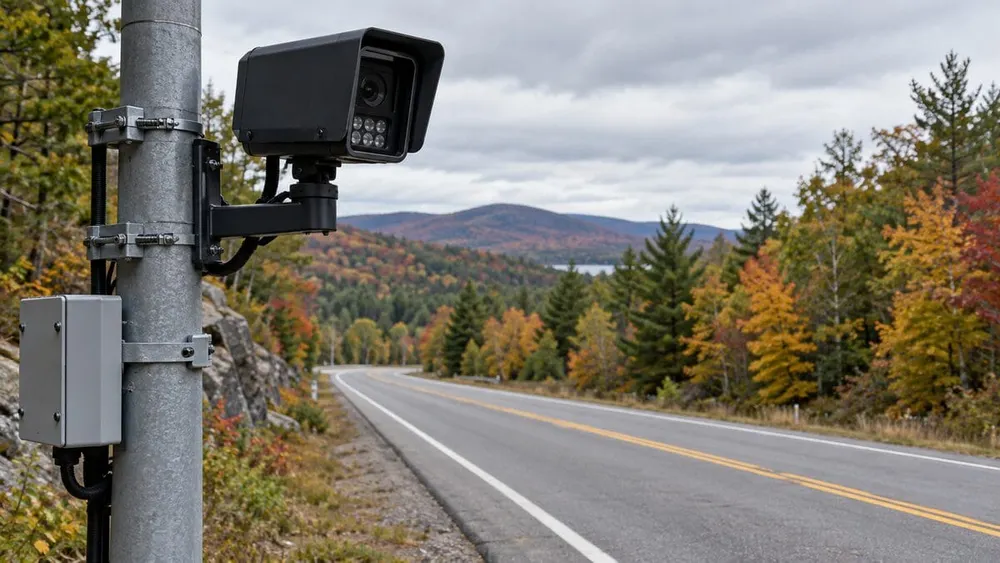
New Hampshire’s three-minute deletion rule for automated license-plate scans is drawing national attention as other states reconsider systems that can build searchable histories of where vehicles have traveled.
The Granite State’s plate-reader law limits the devices to state, county and local law-enforcement officers. It permits scans for defined purposes, including locating stolen vehicles, people with outstanding warrants, missing or endangered people, vehicles connected to serious crimes and commercial trucks that violate operating requirements.
The statute’s most consequential safeguard is its retention limit. A plate record must be destroyed and made unrecoverable within three minutes unless the scan leads to an arrest, citation, protective custody or identification of a wanted or missing person. The law also says a positive match alone does not justify a traffic stop; an officer must independently verify the plate and establish legal grounds.
That structure is significantly narrower than commercial networks built to let agencies search historical sightings. Flock Safety says its default period is seven days, reduced from 30 days, although customers can select other retention settings. New Hampshire’s three-minute ceiling leaves little opportunity for ordinary scans to accumulate into a long-term location database.
A second state statute broadly prohibits government surveillance on public roads unless a listed exception applies. Those exceptions include case-specific criminal investigations, toll collection, transportation management during particular incidents, designated bridge security and cameras at specified state park-and-ride facilities. The law also sets separate retention limits for several exempt uses.
The combined rules have made New Hampshire a reference point in the expanding debate over automated plate readers. The New Hampshire Bulletin reported that Florida Gov. Ron DeSantis cited the state as a model this month while calling for restrictions in Florida. The report also said Rep. Michael Granger, a Milton Republican, filed a request for 2027 legislation concerning surveillance on public roads and public property.
New Hampshire’s law does not eliminate every potential pathway to plate data. The Bulletin reported that Manchester police have contracted for access to databases generated outside the state. That distinction matters: preventing local cameras from retaining ordinary scans is different from restricting searches of records gathered elsewhere.
State law nevertheless imposes several layers of accountability on agencies that operate readers. Devices must be approved by the agency head, registered with the Department of Safety and governed by a written policy and documented training. Agencies must report annually on the number of devices, matches, stops, searches, arrests and other outcomes. The attorney general may audit systems and seek an injunction against agencies that repeatedly violate the rules.
For New Hampshire drivers, the practical protection is data minimization: most routine plate captures cannot be retained for later searches. The coming legislative debate will determine whether lawmakers preserve that framework, tighten access to out-of-state databases or expand the state’s broader surveillance restrictions.