
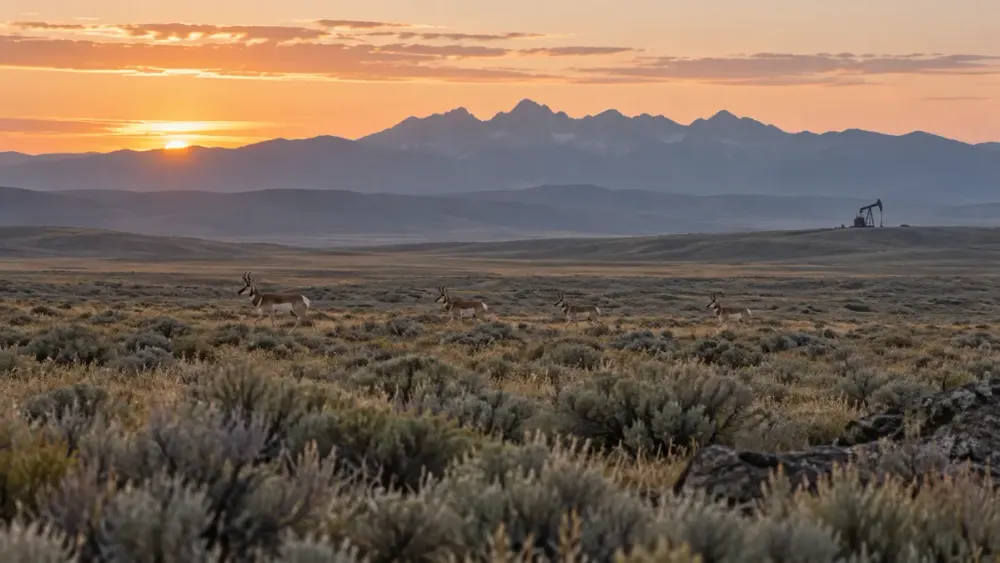
Conservation groups have asked a federal court to set aside oil and gas leases covering about 179 square miles of Wyoming, arguing that the June sale exposed important mule deer and pronghorn migration corridors to development without an adequate environmental review.
The lawsuit, filed in federal court in Montana, challenges leases in Wyoming and Colorado that the Bureau of Land Management offered under revised federal energy policy. The groups' complaint says the Wyoming parcels overlap or sit near the Baggs mule deer and Sublette pronghorn corridors and other seasonal habitats. It asks the court to void the lease decisions and require further analysis.
BLM's project record shows that the Wyoming sale initially offered 108 parcels totaling 119,594.81 acres. The agency issued its finding of no significant impact and decision record on June 9, the same day bidding began. According to WyoFile, 102 parcels sold for roughly $34.7 million, with revenue shared by the federal government and Wyoming.
The plaintiffs—including The Wilderness Society, Western Watersheds Project and several local conservation organizations—contend that BLM relied on a shortened review and did not fully assess how future roads, drilling pads and traffic could affect seasonal movement. Their case summary says leasing is the point at which the government makes an enforceable commitment that can constrain later protections, even though specific wells still require additional approvals.
Industry representatives dispute that characterization. The Petroleum Association of Wyoming told WyoFile that a lease is only an initial step and that site-specific proposals remain subject to environmental review and wildlife protections. The association said the complaint treats the sale as if drilling were immediately authorized, when operators must still submit development plans and obtain permits.
That distinction is central to the case. BLM commonly analyzes lease sales at a broader level and reserves detailed mitigation for later permitting. The challengers argue that some environmental consequences must be evaluated before a lease is issued because the government may lose the ability to prohibit all surface disturbance afterward. BLM declined to discuss the pending litigation, according to the report.
The wildlife stakes are statewide as well as local. Wyoming has invested in mapping and protecting migration routes used by big game moving between winter ranges and summer habitat. Reporting by public radio says the disputed parcels include areas east of Rawlins and within major movement corridors, where habitat fragmentation can create cumulative effects across large landscapes.
The court has not ruled on the merits. If the plaintiffs prevail, the Wyoming leases could be returned to BLM for a fuller review rather than permanently closed to development. If the government and industry position prevails, environmental safeguards would largely be addressed when companies propose specific wells, roads and related infrastructure.