
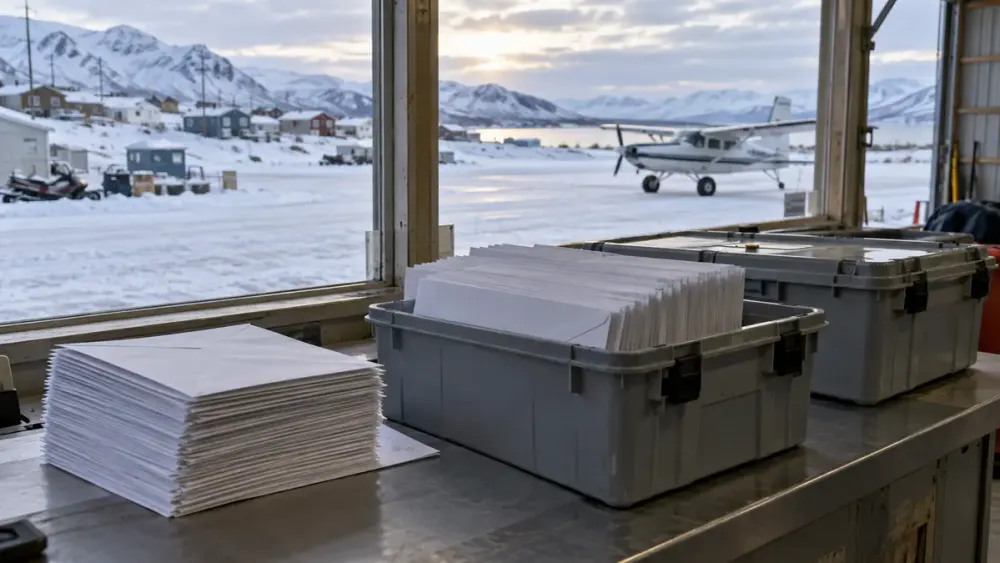
Alaska election officials are changing how absentee-in-person ballots from western communities move through the mail after 75 primary ballots arrived too late to count, a failure that disproportionately affected voters in places without road connections.
For the regional education election and the Nov. 3 general election, return mail from the Nome-based Region IV office will be routed to the Region II office in Anchorage, the Division of Elections said in a Sept. 16 public notice. The state said the change is intended to reduce unexpected delays while preserving the required eligibility review.
The missed ballots came from seven communities. Kotzebue accounted for 28, Igiugig for 21 and Naknek for 13; King Cove, Nikolski, Quinhagak and Pitka’s Point accounted for the remaining 13. The ballots were cast in person but still had to travel to the regional office so staff and the Absentee Review Board could verify eligibility. They arrived after the Aug. 31 certification of the primary results.
The distinction matters for voters: early-vote ballots are verified when cast at a regional office or designated early-voting site, while absentee-in-person ballots are sealed and mailed for later review. The division’s current election archive also says selected permanent-absentee communities in Region IV will be allowed to continue in-person absentee voting through Election Day, after local officials reported voter confusion during the primary.
The postal problem was not merely theoretical. The Associated Press reported that a Naknek voter cast her ballot Aug. 5, 13 days before the primary, yet later received notice that it arrived too late. The Postal Service said delivery time can be affected by multiple factors and that it would coordinate with state officials, but it could not assess the specific ballots without examining the mailpieces.
Alaska generally accepts domestic absentee ballots postmarked by Election Day for 10 days afterward. That grace period recognizes the state’s geography, where most communities are outside the main road system and mail often depends on air service. Even so, a statutory deadline cannot rescue a ballot that misses the final receipt window.
The primary was not the first warning. AP reported that ballots from some villages also went uncounted after delivery delays in 2022. This year’s loss is small compared with statewide turnout, but the effect is concentrated: all 75 ballots came from remote Region IV communities, and 62 came from just Kotzebue, Igiugig and Naknek. That pattern makes the route itself a central election-access issue.
The episode also lands after Gov. Mike Dunleavy vetoed a bipartisan election bill in April. That measure would have added ballot tracking and a rural liaison, among other changes, but Dunleavy cited implementation and legal burdens before the 2026 elections, according to Reuters.
Rerouting mail is a narrower administrative fix, and officials have not promised it will eliminate every delay. Its practical measure will be whether ballots cast on time in remote communities reach review boards before certification—especially during a general election with statewide and federal races on the ballot.