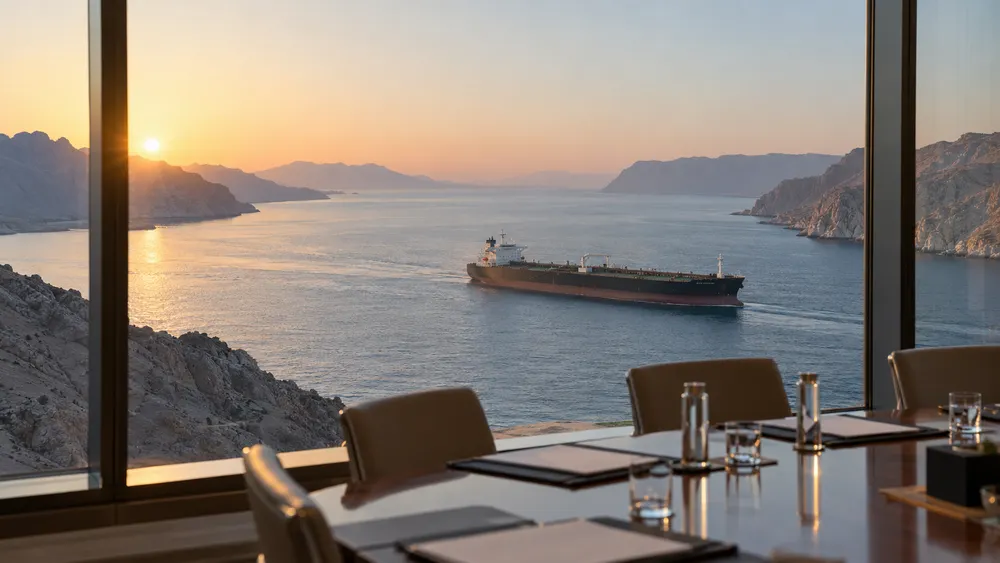
Qatar said Tuesday that it was exchanging messages between the United States and Iran in a renewed effort to build an interim agreement around reopening the Strait of Hormuz, the central commercial choke point in an eight-month war that has strained energy markets and Iran’s economy.
The latest push has produced an amended draft but no settlement. Qatar’s Foreign Ministry said recent contacts included meetings in New York during the United Nations General Assembly, while Reuters reported that shuttle diplomacy had yet to secure an agreement on the waterway. The diplomacy matters because a limited maritime arrangement could reduce immediate economic pressure even if a comprehensive peace remains out of reach.
The initiative is also unfolding alongside continued coercion. On the same day Qatar described its mediation, the U.S. Treasury imposed sanctions on 10 people and entities that it said supported Iranian military procurement. That combination—indirect talks and intensified pressure—shows why the negotiations may be active without being close to resolution.
Qatar Moves Messages Between the Parties
Majed bin Mohammed Al Ansari, the Qatari Foreign Ministry spokesperson, said the past several days had brought meetings and exchanges of messages and that Doha was trying to establish common ground. The ministry’s official account also stressed Qatar’s support for Pakistan’s mediation, underscoring that the channel is a regional effort rather than a direct bilateral negotiation.
That distinction is important. The two governments are still relying on intermediaries to test language and sequence possible concessions, a structure that can keep talks alive but makes misunderstandings harder to resolve. The Associated Press reported that mediators were working on an arrangement covering maritime access, sanctions and nuclear inspections, while major hurdles remained over trust and timing.
The Interim Bargain Comes Before a Final Peace
The proposed first stage is narrower than an agreement ending the war. Two officials briefed on the talks told the Financial Times that Iran would permit free traffic through Hormuz and the United States would lift its blockade of Iranian ports. Later steps under discussion included an oil waiver, access to some frozen Iranian assets and the return of International Atomic Energy Agency inspectors.
The unresolved issue is not only what each side might do, but when. Iran has sought early economic and maritime relief, while Washington has insisted that nuclear questions be part of any durable arrangement. A plan can therefore appear balanced on paper and still fail if either side believes it must surrender its main leverage before receiving a verifiable concession.
There is recent evidence for that caution. Qatar and Pakistan helped produce a June memorandum that briefly reduced hostilities, but the arrangement did not mature into a lasting settlement. The current draft is best understood as an attempt to restore a workable sequence, not as proof that either government has accepted the other’s core demands.
Hormuz Gives a Limited Deal Global Weight
The Strait of Hormuz carried about 21.6 million barrels a day of oil and petroleum liquids in the fourth quarter of 2025, before average flows fell to 4.9 million barrels a day in the second quarter of 2026, according to the U.S. Energy Information Administration’s estimates. Those figures make reopening the waterway economically consequential far beyond the combatants.
The International Energy Agency has called the disruption the largest supply shock in oil-market history and said restoring transit is the single most important step toward stabilizing oil and gas flows. Its shipping monitor also warns that tracking data may understate actual traffic, a reminder that real-time assessments carry uncertainty when vessels limit or disable transmissions.
Regional exports have recovered from their lows, but that improvement does not remove the chokepoint risk. A formal arrangement could lower the danger of attacks, miscalculation and abrupt price spikes in a way that improvised routes and military escorts cannot. It would also create a measurable early test: whether traffic rises safely and consistently after commitments take effect.
Pressure on Tehran Is Still Intensifying
Washington has not paused its economic campaign while the messages move. The Treasury Department’s latest sanctions targeted networks in Iran, Hong Kong, mainland China and Pakistan that the department alleged had procured weapons systems and dual-use components for Iran’s defense establishment. Those are U.S. government allegations, not independent findings, but the action is concrete evidence that the administration is preserving leverage during the diplomatic push.
Iran also faces acute domestic pressure. The AP reported Tuesday that the rial had fallen past 2.5 million to the U.S. dollar as war and sanctions eroded economic stability. That deterioration may strengthen Tehran’s incentive to obtain relief, but it does not establish that Iranian leaders will accept Washington’s nuclear conditions or the order in which concessions are proposed.
The Next Test Is a Verifiable Sequence
The immediate benchmark is whether mediators can produce a mutually acknowledged draft with dated, reciprocal steps. Maritime access can be observed through sustained vessel movements; blockade changes and sanctions waivers can be documented; and renewed nuclear inspections would require a defined mandate and access. Without those elements, public expressions of willingness remain signals rather than an enforceable off-ramp.
Qatar’s announcement confirms that the diplomatic channel is active, and the amended proposal gives that channel substance. It does not confirm a breakthrough. The next meaningful development will be evidence that both governments have accepted the same sequence for Hormuz, economic relief and nuclear verification—and that the first promised actions have actually occurred.